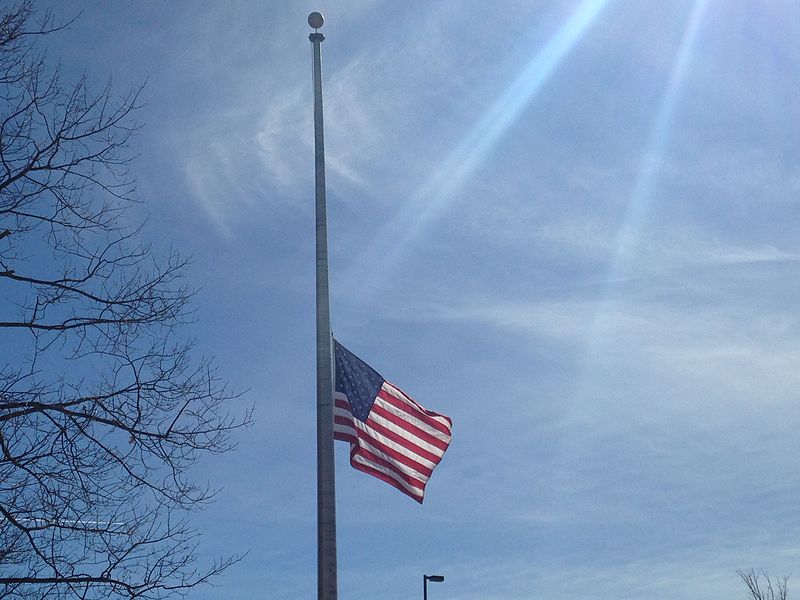
On December 29, 2025, former president Jimmy Carter passed away. In keeping with both precedent and U.S. statute, President Biden ordered that flags fly at half-staff for thirty days. That thirty day period overlaps with the inauguration of Donald Trump on January 20, something Trump simply could not abide. On January 3 he posted on his Truth Social platform:
The Democrats are all ‘giddy’ about our magnificent American Flag potentially being at ‘half mast’ during my Inauguration. They think it’s so great, and are so happy about it because, in actuality, they don’t love our Country, they only think about themselves.
Ignoring the fact that flags only fly at half-mast on a ship, this pathetic rant proves only to demonstrate that Donald Trump is the Whiner in Chief. He thinks of no one but himself and casts anyone and anything that gets in his way as un-American.
President Biden had no control over then Jimmy Carter died. And I cannot imagine even Donald Trump would have the audacity to suggest that Carter timed his own death to somehow cast a shadow over Trump’s inauguration. President Biden did not arbitrarily pick thirty days. As I said, that’s actually stated in U.S. Statute.
The United States Code, 2011 Edition, Title 4, Chapter 1—The Flag states the following:
The flag of the United States shall be flown at half-staff on all buildings, grounds, and naval vessels of the Federal Government in the District of Columbia and throughout the United States and its Territories and possessions for the period indicated upon the death of any of the following-designated officials or former officials of the United States:
(a) The President or a former President: for thirty days from the day of death.
This was signed by President Dwight Eisenhower when little Donald Trump was just eight years old. Surely no animosity toward Trump, or any presidential inauguration, was intended. And I dare anyone to suggest that Dwight Eisenhower didn’t love America.
Yesterday, Speaker of the House Mike Johnson announced, “On January 20th, the flags at the Capitol will fly at full-staff to celebrate our country coming together behind the inauguration of our 47th President, Donald Trump. The flags will be lowered back to half-staff the following day to continue honoring President Jimmy Carter.” Here’s the rub: Johnson has no authority to do that. But rather than display some semblance of a backbone, Johnson—who owes his continuation in the Speaker’s chair to support from Trump—kowtowed to Trump’s bullying and bluster.
Not only Johnson, though; as of today, Alabama Gov. Kay Ivey, Texas Gov. Greg Abbott, Nebraska Gov. Jim Pillen, North Dakota Gov. Kelly Armstrong, Tennessee Gov. Bill Lee, Florida Gov. Ron DeSantis and Iowa Gov. Kim Reynolds—all Republicans—have announced that flags will fly at full staff in their states on the day of the inauguration, too. Like Johnson, they lack the authority to override the order of President Biden that flags will fly at half-staff for thirty days.
Stupidly, those governors are citing sections of the same federal statute in support of their position. Their arguments, however, demonstrate either a severe lack in reading comprehension skills or the presence of deluded legal counsel in their administrations. Maybe both. One section they have touted says this:
It is the universal custom to display the flag only from sunrise to sunset on buildings and on stationary flagstaffs in the open. However, when a patriotic effect is desired, the flag may be displayed 24 hours a day if properly illuminated during the hours of darkness.
I’ve been a teacher for a long time. If I gave those two sentences to a student and asked them to explain them to me only to be told that it means that flags must fly at full-staff during presidential inaugurations I would promptly give the student an F. That section of the statute provides only for a longer-than-usual display of the flag; it says nothing whatsoever about the flag being at full- or half-staff.
The other section they’ve used says this:
The flag should be displayed on all days, especially on New Year’s Day, January 1; Inauguration Day, January 20; Martin Luther King Jr.’s birthday, third Monday in January; Lincoln’s Birthday, February 12; Washington’s Birthday, third Monday in February; Easter Sunday (variable); Mother’s Day, second Sunday in May; Armed Forces Day, third Saturday in May; Memorial Day (half-staff until noon), the last Monday in May; Flag Day, June 14; Father’s Day, third Sunday in June; Independence Day, July 4; National Korean War Veterans Armistice Day, July 27; Labor Day, first Monday in September; Constitution Day, September 17; Columbus Day, second Monday in October; Navy Day, October 27; Veterans Day, November 11; Thanksgiving Day, fourth Thursday in November; Christmas Day, December 25; and such other days as may be proclaimed by the President of the United States; the birthdays of States (date of admission); and on State holidays.
You noticed, I am sure, that Inauguration Day is included. Fine. Of course flags should be displayed on Inauguration Day. But no where in that section is there any suggestion that flags must be displayed at full-staff on any of those days. And no one suggested that flags should be flown at full-staff on January 1 of this year, which was within the thirty days. Were the inauguration not falling on Martin Luther King Jr.’s birthday this year, I am sure no one would have suggested it for that day, either.
This is not about a desire to honor America. It is purely about Donald Trump’s narcissism and the desire of weak politicians—almost always Republican—to get, or stay, on Trump’s good side so that they do not face the recriminations that would otherwise come their way.
Congratulations, America. Next Monday we are returning to office the Whiner in Chief.
Another year has arrived, meaning it is time for another review of my year in books. I read fifty of them in 2024. So, here we go.
The first book I read was 24: Life Stories and Lessons from the Say Hey Kid by Willie Mays and John Shea. It was an enjoyable read, providing an interesting look at what baseball was life when Mays played but also his life outside of baseball. It was a Christmas gift from my son and proved timely since Mays passed away in June. Another Christmas present was Joe Posnanski’s The Baseball 100. Anyone who reads the book will take issue with some of the players Posnanski included, or the order in which he placed them, but it is an excellent book providing fascinating details about one hundred incredible ballplayers as well as personal anecdotes from Posnanski, who is a fine writer.
Katie Ledecky’s Just Add Water tells her life story, so much of which is centered around swimming. It is an enjoyable read and it is encouraging to see just how much fun she has swimming. Even as perhaps the best female swimmer in the world, with innumerable records to her name, she truly enjoys swimming. Misty Copeland’s The Wind at My Back is sort of an autobiography and a biography of Raven Wilkinson, who became a mentor to Copeland.
Woody Holton’s Liberty Is Sweet is a good book. He overreaches with his subtitle, though; “The Hidden History of the American Revolution” clearly implies that Holton uncovered some fascinating details that had somehow gone unnoticed—but he didn’t. While the book is voluminous—some 560 pages of text and another two hundred of notes and sources—I don’t think he revealed anything I had never heard or read before. He may be the first person to put it all in one book, and I would recommend it to anyone looking for a one-volume exhaustive history of the Revolutionary War, but honestly, his short overview of the ten years following the war that he included at the end of the book was perhaps the most insightful.
Allen Guelzo’s Robert E. Lee: A Life is a notable addition to the already numerous books on Lee. Guelzo is probably most recognized as an expert on Gettysburg, but he writes a well-researched and balanced account of Lee’s life. Erik Larson took his gifted approach to writing history to the story of the battle of Fort Sumter in The Demon of Unrest. Anyone wanting to understand everything that was involved in that conflict would do well to read this book. Andrew Delbanco’s The War Before the War capably traces the fight of enslaved Africans seeking freedom from the time of the American Revolution to the Civil War. But Samuel W. Mitchum Jr.’s It Wasn’t About Slavery is a pitiful attempt at showing that the South was motivated by things other than slavery when eleven states seceded from the Union, but his arguments fail, badly. Anyone with the desire to do so can discredit what he thinks are his strongest arguments within a matter of minutes if they are willing to search online for the full text of the documents he likes to cite. And anyone doing so will find that it actually was about slavery. The Crooked Path to Abolition by James Oakes, on the other hand, capably shows that while Lincoln’s position on slavery changed over time in terms of his strategies, his position as an opponent of slavery itself was much more consistent than he is often given credit for.
Solomon Northup’s Twelve Years a Slave is his autobiographical account of being tricked in New York, kidnapped in Washington, D.C., and sold into slavery for twelve years. The story gained significant attention a number of years ago when a movie of the same title was made.
Rachel Devlin’s A Girl Stands at the Door: The Generation of Young Women Who Desegregated America’s Schools, recounts the incredible bravery and fortitude of the girls who integrated American schools in the 1950s. While boys were involved in desegregation efforts as well, it fell disproportionately to girls, as Devlin explains. She interviewed many of the women who fought that fight and this is a book I would recommend to anyone wanting to learn more about that part of America’s history. Anne Gardiner Perkins wrote Yale Needs Women, and that was an eye-opener for me. I had no idea that Yale had not admitted female students until 1969. The book recounts the challenges they faced, the reluctance of so many to allow them to attend the school and the determination with which so many pressed on.
T. Martin Bennett’s Wounded Tiger is a sizable but fascinating book that intertwines the stories of Jacob DeShazer, Mitsuo Fuchida and a missionary family. Highly recommend.
Liz Cheney’s Oath and Honor is her accounting of the events of January 6 and her stand against Donald Trump, especially following his role in those events. She defends her service on the January 6 Select Committee. No one who despises Cheney will be swayed by the book—especially those who agree with Donald Trump and his recent claims that she should be put in prison—but as one of very few Republicans who was willing to stand up to Trump publicly, her side of the story deserves to be read. And Michael Wolff’s Landslide will also be dismissed by the MAGA crew, but the story he paints of the end of the first Trump administration shows why so many are concerned about what the Trump Presidency 2.0 is going to look like. Going back to his breakout period following Watergate, one wonders where Bob Woodward gets all of his information—and whether or not it is all accurate. If it is, Peril, which he co-wrote with Robert Costa, is, if anything, even scarier than Landslide. Tulsi Gabbard’s For Love of Country was shallower than I expected. I was disappointed at how dismissive of Gabbard the Democrats were in 2016. I do not think she is a Russian agent or even a Russian defender but I am not sure I want her as the head of national intelligence, either.
Elijah Cummings, with James Dale, wrote We’re Better Than This. Cummings represented the congressional district that includes Baltimore for twenty-four years. There is probably more that I would disagree with him on politically than agree but his commitment to finding ways to get along with people and be respectful even when he disagreed is something sorely missing in politics today.
Andrew Whitehead’s American Idolatry examines the dangers of Christian nationalism and shows how anyone who is not careful can easily go from nationalism to other dangerous -isms, like racism. Paul Miller’s The Religion of American Greatness: What’s Wrong with Christian Nationalism was the better book, I thought, but both are thought-provoking. The beginning of Russell Moore’s Losing Our Religion probably comes closer than anything else I have read to describing how I have felt over the past few years as so many people I thought highly of and often agreed with have become lockstep adherents of Donald Trump, even to the point of ignoring when and how he clearly acts inconsistently with what the Bible teaches.
Timothy Keller’s Jesus the King, which was previously published in hardcover as King’s Cross, explains the life of Christ, based on the account provided by Mark, with unique insights and reminders. R.C. Sproul’s A Taste of Heaven is a short book that puts proper worship into perspective. Even shorter, Bob Kauflin’s True Worshipers gives keen perspective on what it means to worship God. Steven Lawson’s The Daring Mission of William Tyndale is a short biography of the man who was cruelly executed for translating the Bible into English.
Karen Swallow Pryor’s The Evangelical Imagination looks at the term “evangelical” and at how one’s understanding of it has been shaped by art and popular culture. The subtitle, “How Stories, Images, and Metaphors Created a Culture in Crisis,” gives you an idea of the argument that she makes. Rosaria Butterfield’s Five Lies of Our Anti-Christian Age is a good book, but there were a few times when I thought she went too far in her position. Nancy Pearcey’s The Toxic War on Masculinity does a capable job of outlining the concern she has about the culture’s attitude toward masculinity but I thought it was longer than it needed to be. Richard Alan Fuhr, Jr. and Andreas Kӧstenberger wrote Inductive Bible Study, which is essentially a guide on how to do that. Alisa Childers and Tim Barnett, in The Deconstruction of Christianity, do an excellent job of defining deconstruction, explaining what it is and explaining how to come alongside those who are “deconstructing.” And Christopher Ash, in Zeal Without Burnout, provides a short book with important insight into the very real issue of burnout.
Christopher Knowlton’s Bubble in the Sun is fascinating look at the original development of Florida real estate—the people involved, the money involved and the fabulous crashes involved. Tecumseh and the Prophet, by Peter Cozzens, is a well-written book about a part of American history that I did not know much about before beyond the battle of Tippecanoe. And The Curse of Beauty by James Bone was an intriguing read about someone I had never heard of—Audrey Munson—but whose face and even figure I have probably seen. Bone calls her America’s first supermodel, and she posed for an incredible number of statues during the Gilded Age but then spent the last 64 years of her life in an asylum.
The Outer Banks of North Carolina is perhaps my favorite place on the planet and I read a few books about that area this year. David Stick’s Graveyard of the Atlantic is an overview of the hundreds of ships that sunk off of the Outer Banks of North Carolina, as well as stories of incredible rescues of the passengers and crew on board some of those ships. John Railey’s A Murder in Manteo is not as well-written as his The Lost Colony Murder on the Outer Banks, but it is an interesting read and is different from the earlier book in that someone was convicted of the murder—though Railey thinks it was the wrong man. His Andy Griffith’s Manteo was the better of his two books I read this year and it was fun to get a look into the relaxed Griffith in his adopted hometown, but I am not sure Railey successfully made his case that Manteo was the real Mayberry. Scott Dawson’s The Lost Colony and Hatteras Island contributes to the discussion about what happened to the Roanoke colonists and lends some credence to his suggestion that they never really left the Outer Banks.
Mark Pryor’s The Dark Edge of Night is the second book in his Henri Lefort series. It has what readers of Pryor have come to expect but he weaves in some Nazi experiments being done on children that have their foundation in reality. Alex Cross Must Die, by James Patterson, is exactly like every other Alex Cross book in tempo and excitement and Crosshairs, the latest Michael Bennett book co-written by Patterson and James O. Born is, too. John Grisham’s Camino Ghosts is the third book in his Camino Island series and, for my money, probably the best of the three. Jeffrey Archer’s An Eye for an Eye is the penultimate book in his William Warwick series and, as he always does, he has Warwick, his family and the police department constantly battling Miles Faulkner. Daniel Silva’s A Death in Cornwall is the latest Gabriel Allon book. It was an enjoyable read, but one really does have to suspend reason when considering everything that Allon is able to get away with as the retired head of Mossad. I think David Baldacci’s A Calamity of Souls may be my favorite fiction book by a bestselling author that I read this year. In many ways I found it reminiscent of Grisham’s A Time to Kill, but it was certainly no copycat story. Colson Whitehead’s Crook Manifesto continues the saga of Ray Carney’s life in 1970s Harlem that began in Harlem Shuffle. Whitehead is an excellent writer, period. Sarah Crouch’s Middletide is her debut novel but will not, I am sure, be her last. Set in the Pacific Northwest, it creatively intertwines a couple of storylines and ends with an unexpected twist.
I’m halfway through my next book—another baseball book that I received for Christmas. Perhaps you’ll find a title in the overview above that you would like to read. Whether it’s something here or something else, happy reading.

 THINKING OUT LOUD