Why Are You Offended?

It is not a secret that I do not like Donald Trump as a person and I do not think that he is fit to be the President of the United States. That was true when he ran in 2016, when he ran in 2020 and when he sort-of ran in 2024 (I say sort-of since he declined to participate in the GOP debates and the Republican party did not require him to do so). And, since 2016, I have used my Facebook account to point out the concerns that I have with Mr. Trump, including his actions in office.

But suddenly, in the past month, I have had three individuals–all trusted brothers in Christ–approach me to express concern over my posts about Mr. Trump. I appreciate that they were willing to approach me; far too often we believers—especially, I dare say, Christian men—shy away from difficult, iron-sharpening-iron conversations. All three me approached me in the right way, following biblical principles, and all three, I believe, had an appropriate motive. To my knowledge, none of them knew anything about the other talking with me.

I will be the first to admit that if three Christian friends approach you about the same thing, it would be wise to listen. And I did listen. I don’t think I became defensive. I said that I would think and pray about what they had to say, and I have done that. But I should add that within the same time period I received, unsolicited, feedback from two or three people thanking me for taking a stand. I then solicited feedback from three other friends–people I have known for a long time, whose opinions I respect and whom I believe would tell me if they thought I was in the wrong–whether they thought I was out of line or risking offense with my posts. I have reached three conclusions as a result of those conversations and my prayerful reflection on them and I feel it is appropriate to share them here.

First, I care about politics and I like to argue. Debate would sound more polite, but argue may be more accurate. I have followed presidential politics since 1988. My undergraduate degree is in political science. I thought, for a long time, that I would be serving in an elected office or working for an elected official. God showed me that, thus far anyway, that has not been His plan for my life. But I am still interested in politics, I still like to argue and I definitely still have opinions. So maybe I have posted about Mr. Trump more than I should. I will continue to prayerfully evaluate that.

Second, the concern that was expressed, and all of the feedback and pushback that I have received about my posts and comments about Mr. Trump have come from other believers. And I cannot help but wonder why. None of the men who approached me suggested that I have posted anything that was factually wrong or biblically inaccurate. So why are the posts potentially offensive?

Strangely, some people who have taken issues with my posts have pointed out that God appoints leaders to accomplish his purposes on earth. There are two things to consider in regard to that. First, if you believe that, then you have to believe that God also appointed Joe Biden for office and that He had a purpose for having Biden in office for four years. You have to believe that about every office holder in the country. You don’t get to claim God is in charge only when things are going your way; God is in charge all of the time. The vast majority of the people who are now questioning my posts about Mr. Trump are the same people who repeatedly claimed that the 2020 election was stolen, said of Biden that he’s “Not my President!” and proudly wore shirts and flew flags proclaiming “Let’s Go Brandon!” But God put Trump in office for “such a time as this,” they say! Okay. Did he also put Biden in office for such a time as that? And Obama? And Bush? And Warren Harding? You can’t have it both ways.

Second, that argument is, I assume, based on Romans 13. That passage deals with being subject to rulers—including the often-overlooked instruction to pay taxes to whom taxes are due. But it begins with this verse: “Let every person be subject to the governing authorities. For there is no authority except from God, and those that exist have been instituted by God.” The verse says that governing authorities are instituted by God. But who is the governing authority in the United States? It is “we the people.” God, in His sovereignty, has given the citizens of the United States of America the ability to choose our own leaders. That does not mean that God chooses who our leaders will be. He allows them to be in office, because nothing happens that He does not allow, but there is a significant difference between what God allows and what God ordains. Check out 1 Samuel 8. The people of Israel wanted a king. God warned them of the results, but He also let them have what they wanted. The fact that Donald Trump is the President of the United States means that God has allowed Him to be; it does not mean that God ordained Him to be or put Him in that place.

Also interestingly, those questioning my posts repeatedly disregard Mr. Trump’s actions on January 6, 2021, and suggest that he did nothing wrong. It was all a peaceful protest or it was all manipulated or it was all faked. It was none of those things. I, and many, many others, watched it live. The testimonies of many who were there tell us what happened. People died. People were seriously injured. It was an incredibly sad day for America. Yet, they keep trying to claim that the J6 Committee destroyed evidence, which is a sure sign that they faked it all. Except that when I ask, as I have done repeatedly, for any evidence at all that the evidence was destroyed I get…crickets. That’s because there is no truth to that claim. (You can find far more evidence than you probably have time to read on GovInfo.gov—all there for you to look at it whenever you would like).

But what about the assassination attempts? Is God responsible for the fact that Donald Trump is still alive? Of course He is. He is responsible for the fact that I am still alive, and you are still alive and every person who is currently alive is still alive. That’s what it means for Him to be the almighty, sovereign God of the universe. It is not proof positive that God ordained Trump to be the president right now.

As I said, I have been following presidential politics since 1988. Since I have been old enough to vote, my preferred candidate in the primary election has only won the White House once, and that was in 2004 when George W. Bush was reelected. But I have prayed for every one of those presidents. I have prayed for wisdom and discernment and protection. And, when I felt it necessary, I have criticized the actions of every one of those presidents. Therein lies the rub…

The fact that I criticize some of what Donald Trump does, or how he does it, does not mean that I disagree with him on everything. When it comes to substance, I agree with him on more than I disagree with him. But he is not a nice man. He is not a good role model for young people. He does not have habits or leadership skills that anyone would tolerate in almost any other setting. He is arrogant. He is vindictive. He is petty. And he seems to have either forgotten, or not to care, that he is not a dictator and he cannot rule with the squiggle of his Sharpie. I think birthright citizenship for children of illegal immigrants should be reconsidered. I think the Department of Education should be eliminated. But he can’t do that on his own. He has to go about it the right way. This is a republic. We have rules and laws that must be followed. When he does admirable things the right way, I will probably comment on that. But when he does admirable things the wrong way, or things which are not admirable, I will definitely comment on that. Not because I am better than he is or because I enjoy it, but because I cannot sit idly by while so many people who profess to be followers of Christ blindly embrace his every move and follow in lock step his plan to Make America Great Again. I want America to be great, but that’s not what the Lord has called His children to pursue.

So, if you’re a follower of Christ, and my posts offend you, why is that? I am asking sincerely. I would honestly like to know. Are you really concerned about my relationship with the Lord—or are you bothered by the fact that I am not as gung ho about Donald Trump as you are? If it’s the latter, so what? I probably don’t cheer for the same sports team(s) you do either, or watch the same TV shows or prefer the same music. What difference does that make? But if it’s the former, that’s a real cause for concern—unless you’re equating the two. And I’m not being dramatic. I am aware of a church that has informed its congregants that if they do not support Donald Trump, they need to leave the church. That’s heresy. That’s idolatry. That’s elevating Donald Trump to a position of being more important than fidelity to the Word of God. And that cannot be ignored. The Bereans were commended for testing what Paul taught. We are exhorted to do that in our churches. We need to do it in the political sphere, too. Just because Trump says it or posts it on Truth doesn’t mean it’s true. Do some research. Don’t live in an echo chamber. Read, watch and listen widely—even, sometimes, to people you’re sure you disagree with. Be mature enough to admit that Trump makes mistakes and has flaws.

And please, keep in mind that when I post about Trump, I don’t mean it as a personal attack on you.

The third conclusion I have reached is that populism is so dangerous. It is not coincidental that Mr. Trump has a portrait of Andrew Jackson hanging in the Oval Office. It was during Jackson’s presidency that the worst domestic riot at the White House ever occurred—celebrating his election to the White House—and it was during Trump’s first term that the worst domestic riot at the Capitol ever occurred, trying to prevent his loss to Joe Biden from being certified by Congress. At least Jackson had lawfully invited “the public” to the President’s House, but the resulting fiasco resulted in such a mess that it took a week to clean it up. I have never seen—and in my study of history I am not aware of—a U.S. president who has gained such a cult-like following as Donald Trump. Sure, for decades now people have used pins, bumper stickers, t-shirts and signs to demonstrate their support for a political candidate and to encourage others to vote for that candidate. But those things generally disappear after an election other than in museums and in the hands of collectors. Not with Trump, though. People continued to wear MAGA hats and fly Trump flags for the duration of the Biden presidency. Entire MAGA stores sprung up. And Trump has capitalized on the blind loyalty of his followers, making money selling everything from Trump-branded shoes to Bibles to silver coins to cryptocurrency—and that’s not an exhaustive list.

Andrew Jackson would not, historically, be considered a populist, since most historians date the emergence of populism to the end of the 19th century. But the explanation of populism provided by Brittanica fits Mr. Trump to a t.

In its contemporary understanding, however, populism is most often associated with an authoritarian form of politics. Populist politics, following this definition, revolve around charismatic leaders who appeal to and claim to embody the will of the people in order to consolidate their own power. In this personalized form of politics, political parties lose their importance, and elections serve to confirm the leader’s authority rather than reflect the different allegiances of the people. Some forms of authoritarian populism have been characterized by extreme nationalism, racism, conspiracy mongering, and scapegoating of marginalized groups, each of which served to consolidate the leader’s power, to distract public attention from the leader’s failures, or to conceal from the people the nature of the leader’s rule or the real causes of economic or social problems.

Donald Trump’s supporters are no longer about the Republican party—they are about Donald Trump. He claims he has a mandate from the people to enact the sweeping changes he is instigating though his electoral victory was actually quite thin. While he did win a clear electoral vote, he won a bit less than half of the popular vote, making him the first minority president since…oh, Donald Trump, in 2016. When he was elected in 2016, Trump received a smaller percentage of the popular vote than any president since George Bush in 2000. But Trump is all about nationalism, scapegoating and conspiracy mongering. Watch out of you get out of step with him, even if you used to be his buddy. Just ask Nikki Haley, Mark Milley, Christopher Wray and a host of others. He seems to think he’s still starring on The Apprentice, firing people left and right, including the Archivist of the United States.

Since taking office three weeks ago, Trump has issued 59 executive orders. That’s more than any president has averaged per year since Jimmy Carter was in office. Executive Orders were designed to be rare. The first ten U.S. presidents didn’t issue as many combined as Trump has issued already. Not until Andrew Johnson did any single president issue more than Trump has in the past three weeks—and he was definitely serving during uniquely challenging circumstances. Not even Abraham Lincoln, who was widely criticized for expanding the power of the executive branch, possibly illegally, issued as many executive orders in his four-plus years in office as Trump has in the past three weeks—and Lincoln was literally trying to save the Union. No single president averaged as many executive orders per year as Trump has issued in three weeks until Theodore Roosevelt—who was president, interestingly, at the height of populism. Executive orders became a popular means of presidential influence through his cousin Franklin’s three-plus terms in office (he averaged 307 per year) but since then have declined sharply. In fact, Trump has already exceeded in number his own per-year average from his first term.

People have become so angry about the state of affairs in Washington, D.C.—and, in many cases, rightly so—that they don’t care what Trump does to “drain the swamp.” But doing the right thing the wrong way is still wrong. This is the United States of America, not some banana republic. Do you remember the Pledge of Allegiance? It says, “…and to the republic, for which it stands….” The power here resides with the people, not with the president, regardless of who he is.

We’re about to see if the courts will slow Trump’s abuse of power—or if he will even care if they try. If they don’t, or he doesn’t, we the people better care. We better take action—legal action, through our elected representatives—to bring him to heel. Throughout history, no story beginning with someone claiming that they are accumulating power for the good of the country has ended well, and it won’t this time, either.

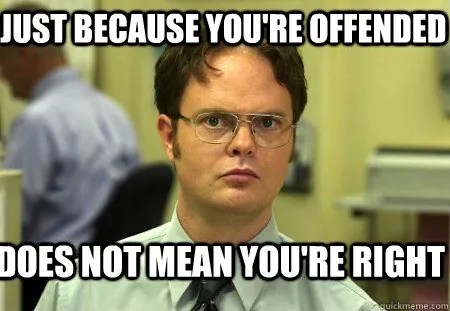
Image credit: John Scott Comedy.

A Tale of Two Fathers

Joe and Hunter Biden.

I know that I am by no means in the minority when it comes to people disgusted by Joe Biden’s pardon of his son, Hunter. In fact, an AP-NORC poll found that only 22% of Americans approve of the pardon (though another 26% either didn’t approve or disapprove or didn’t know). Even among Democrats, only 38% approve. Partially the disapproval comes from the idea of a president using the power of his office for the benefit of his son and partially it comes as a response to Biden’s repeated statement that he would not pardon his son.

If you’re one of the few people not aware of what’s going on, Hunter Biden was convicted on both tax and gun charges. Biden said that the charges were a “miscarriage of justice” and White House press secretary Karine Jean-Pierre said that Biden ultimately decided to issue the pardon “because of how politically infected these cases were” and “what his political opponents were trying to do.”

The “politically infected” argument might have carried a little more weight if Hunter Biden had not already pleaded guilty to the charges and if Biden’s pardon were not so expansive. As to the guilty plea, Biden said that if the negotiated plea deal had held, “it would have been a fair, reasonable resolution of Hunter’s cases.” But because the plea “unraveled in the courtroom” and a number of Republicans “taking credit for bringing political pressure on the process,” Biden felt justified in issuing the pardon. Even if you want to accept that argument, though, Biden went further, issuing Hunter “A Full and Unconditional Pardon for those offenses against the United States which he has committed or may have committed or taken part in during the period from January 1, 2014 through December 1, 2024.” In other words, Hunter was pardoned not just for the two crimes to which he plead guilty, but for any and all crimes he may have committed during an eleven-year period leading up to the issuance of the pardon. No matter what Hunter did, or may have done, during that period—at least half of which he was addicted to drugs and/or alcohol—he will get off scot-free.

As reprehensible as this from a political standpoint, and as dangerous as the precedent is that it sets, Biden’s choice is understandable from a purely parental perspective. Every parent knows the tug that is felt when their child is in trouble and the wish that there was something that could be done to save them the pain of their choices. If anything, Joe Biden’s tug when it comes to Hunter would be even stronger, exacerbated by the fact that he was unable to do anything to protect his first wife or the two other children he had with her. Neilia, his first wife, and Naomi (known as “Amy”), their one-year-old daughter, both died in a car accident in 1972. Biden had just been elected to the Senate and was on his way to Washington, D.C. when, one week to the day before Christmas, Neilia was driving the family station wagon with all three children and was hit broadside by a tractor trailer. Neilia and Amy were pronounced dead on arrival at the hospital. Beau and Hunter survived, suffering a broken leg and fractured skull respectively. There was nothing Biden could have done for his wife and daughter.

Their first-born, a son named Joseph R. Biden III, but known as Beau, died of brain cancer in 2015. There was nothing that Joe Biden could do to protect him, either. Beau was a veteran, receiving the Bronze Star for his service in Iraq, and became the Attorney General of Delaware. In 2010, he suffered a stroke, but it was not debilitating. Three years later, after becoming weak and disoriented, a lesion was found on his brain and removed. He was given a clean bill of health but later that year was diagnosed with brain cancer. He underwent surgery, chemotherapy and radiation, but died in 2015. Despite the fact that he was the vice president of the United States at the time, there was nothing Joe Biden could do about it. Leaving behind a wife and two children, Beau was just 46—and Joe Biden had outlived a second child.

So, as I said, it is completely understandable that Joe Biden would, now that he finally had the ability to do so, act to protect his son Hunter from time in prison. But the fact that it is understandable doesn’t make it right. In fact, it will be a lasting blemish on Joe Biden’s career of more than fifty years in public service. Whenever the time comes and his obituary is written, it will certainly be mentioned. It also sets a dangerous precedent that will surely be followed by Biden’s successors.

All of that has been on my mind since Biden issued the pardon on December 1. But last night, lying in bed trying to go back to sleep after a mid-sleep trip to the bathroom, I was thinking about it being Christmas Eve and what that is really all about. Somehow, in the middle of that somewhere-between-sleep-and-awake state, I thought about the contrast between Joe Biden and God. Yes, I know, the differences are extensive, but I do have a point.

Joe Biden used his power to enable his son to avoid the consequences of crimes he committed. God, despite His unlimited power, sent His Son to earth in the form of a human baby with the sole purpose of living a perfect, sinless life in order to die an excruciating death on the cross for crimes (sins) that He did not commit. God did that, and His Son consented, in order to provide a way for me to be pardoned—for me to avoid the consequences I rightly deserve to pay for the crimes (sins) I have committed. When He rose three days later, Jesus conquered sin, hell and the grave. Today He is alive and seated at the right hand of His Father. But that in no way negates or diminishes the awesome gift of salvation or the unimaginably self-sacrificial obedience of Jesus Christ.

Joe Biden loves his son and he thinks that using his power to enable him to avoid the just penalties of his crimes is a demonstration of that love. It really isn’t, but that’s not the point I want to make here. God loves His Son, too. But He also loves the world (as John 3:16 tells us). In fact, He loves the world so much that He sent His Son to “save His people from their sins” (Matthew 1:21). Joe Biden let his Son off the hook for what he did; God put His Son on the hook for what He didn’t do. In so doing, He gave “the gift of…eternal life in Christ Jesus our Lord” (Romans 6:23). That was given “in accordance with the riches of God’s grace” and, as a result, I have “redemption through His blood, the forgiveness of [my] trespasses” (Ephesians 1:7)

You can have that, too. That’s the first, and best, Christmas gift.

Photo credit: REUTERS/Craig Hudson

Whiter Than Snow

South Dakota has had unseasonably warm weather recently. That, combined with the fact that we have received far less snow than we had a year ago, meant that much of the snow had melted. In fact, I was observing the absence of snow yesterday and thinking how nice it was to see grass in February—even if it was not very attractive grass, given that it is a weird brownish-gray color.

This morning, however, I awoke to find that it was snowing again. It was not a shock, as the meteorologists had accurately predicted it. But within a few hours it had snowed enough that all of that grass I could see yesterday was no longer visible. It had been covered by the snow and the world around me was all white again.

That transformation, on Valentine’s Day, reminded me of the transformation that is made possible by the love of God. I wrote a post about that twelve years ago (you can find it here) so I will not go into detail about God’s Valentine. But God’s love for humanity caused Him to send His Son, Jesus, to die on the cross in payment for our sins, and the forgiveness of sin is often symbolized as a stain being made white. Isaiah 1:18 says, “Come now, let us reason together, says the Lord: though your sins are like scarlet, they shall be as white as snow; though they are red like crimson, they shall become like wool.”

That verse was, I imagine, the inspiration for James Nicholson’s hymn, “Whiter Than Snow,” and it was the lyrics to that hymn that went through my mind this morning, specifically the first verse and the refrain:

Lord Jesus, I long to be perfectly whole;
I want Thee forever to live in my soul,
Break down every idol, cast out every foe;
Now wash me and I shall be whiter than snow.

Whiter than snow, yes, whiter than snow,
Now wash me, and I shall be whiter than snow.

Thank you, Father, for the assurance of knowing that “I shall be whiter than snow.”

Photo credit: “Footprints in the Snow.” Wikimedia Commons.

Do Not Affirm

The cover of the September issue of Christianity Today says “they them their” staggered across three lines, with the question below, “Does it matter if Christians declare their pronouns?” That question is not really the main thrust of Kara Bettis Carvalho’s article, though. The article’s lead page says, “Gender pronouns are increasingly controversial in public life. Christians are grappling with how to engage.” That is a more accurate lead-in.

To be fair, Carvalho does cover the use of preferred pronouns by Christians, beginning her story with the account of two residence life employees at Houghton University who included their pronouns in their e-mail signature despite it being a violation of school policy for them to do so. The two in question, however, claimed that they did it in order to help students identify their genders because of their unusual names—Shua and Raegan. It is true that their names are unusual, and it is true that one might inaccurately guess their genders if inclined to do so. Shua, for the record, is male and Raegan is female. But Shua’s explanation in a video released after their firing is a bit flimsy. He said that he included it because “It’s an unusual name. And it ends with a vowel, ‘a,’ that is traditionally feminine in many languages. If you get an email from me and you don’t know who I am, you might not know how to gender me.”

Fair enough, but guess what? We don’t necessarily need to gender anyone. Long before the issue of gender identity and preferred pronouns was a thing there were people whose names did not reveal whether they were male or female. Believe it or not it is possible to reply to an e-mail, politely and respectfully, without knowing someone’s gender or using any pronoun at all to refer to the person being addressed. So while I may understand his reasons for including the pronouns, I do not believe their explanation justifies them refusing to remove the pronouns when being told to do so by their employer. Raegan’s explanation holds no water, in my opinion. (I’m not even going to address the fact that Shua told ABC News that his views on gender and identity do not fully align with those of the Wesleyan Church, which is the denomination with which Houghton is affiliated other than to simply say this: Then why work there? If you cannot support what they believe and stand for, find another job).

The most important part of Carvalho’s article, in my opinion, is the second half—the half that deals with how churches should deal with what Carvalho calls “evolving linguistic norms” and the question of whether or not using preferred pronouns can ever be a sin. The article mentions Travis Rymer, a pastor in Rhode Island who has studied pronouns and taught on gender ideology and who sees it as “a sort of secular religious system that aims to dismantle the binary of male and female. To use preferred pronouns without further honest conversation is not only to acquiesce to a belief system that is biblically unfaithful, but also to promote it.” And on that he is absolutely correct.

I would actually a step further, however, and posit that to use preferred pronouns even after further honest conversation is to acquiesce to a belief system that is biblically unfaithful—assuming, of course, that those preferred pronouns are not consistent with the individual’s sex—and Rymer evidently agrees, since the article says that he encourages his congregation not to use “others’ self-identified pronouns” and that refusing to do so is actually an act of love.

Carvalho provides all sides of the argument; she cites Rosaria Butterfield and Robert Gagnon as examples of those who hold that using a preferred pronoun that does not match biological sex is sin—“bearing false witness and an affront to the Creation mandate.” A bit further over on the spectrum are those like Robert Smith, who prefers to avoid using pronouns altogether. Moving further yet are those like Mark Yarhouse, who will offer his pronouns if asked and believes that there is value in “acknowledging people whose experiences do not fit into social norms about gender identity” and adds that people can teach, talk and preach in such a way that shows awareness that there are people who have “these experiences.” And then not quite to the other end of the spectrum, but getting close, are those like Preston Sprinkle, who promotes the use of preferred pronouns as a way of “showing grace and building relationships.” And Sprinkle is also the one to whip out what may be the most overused and erroneously used expression in Christianity today: “All throughout Scripture, we see God meeting people where they are in order to walk with them toward where he wants them to be.” While Sprinkle believes that pronouns should match biological sex, he doesn’t “think it should be a short-term prerequisite.” The far end of the spectrum is Meg Baatz and others who say that not even so-called pronoun hospitality is enough; in fact it is condescending. “We believe in mutuality. We use language to build trust,” Baatz said. Use preferred pronouns, in other words.

To his credit, Sprinkle does at least acknowledge that Jesus met people “where they are” in order to move them to where they should be—that is the part that so many people leave out—but he fails to recognize, or at least to acknowledge, that while Jesus met people where they were he never affirmed where they were. He met adulterers and prostitutes and tax collectors and more “where they were” but he never told them that being there was okay. He never did or said anything that communicated to them in any way that their behavior was acceptable, even for the short-term. He made it clear that they were sinners and that they needed to repent of their sins. He loved them even while they were sinners but He always condemned their sin.

Baatz and Elizabeth Delgado Black are the co-founders of Kaleidoscope, an organization with the mission of “Providing LGBTQ+ people opportunities to engage with tangible expressions of Christ,” and a vision: “We long to see every LGBTQ+ person empowered to encounter Jesus and mature within supportive Christian communities authentically.” Black says that “Christians should show generosity to those with a different framework.” No small part of the problem is that Kaleidoscope does not acknowledge transgenderism or any of the LGBTQ+ choices as sin. In fact, one of Kaleidoscope’s four values is diversity, accompanied by this statement: “Knowing God’s creative glory shines through our ethnicity, culture, faith expression, age, ability, gender identity, and sexuality, we commit to upholding diversity.” God’s glory does not shine through someone’s gender identity unless that identity is consistent with the gender with which God created them. To suggest otherwise is to suggest that God’s glory can be honored through sin and believe me, God can never be honored through sin. This post is not about Kaleidoscope, so I won’t address that organization further, but if you check out their website you will see exactly the kind of thing that Rymer warns against: acquiescence to a belief system that is biblically unfaithful—despite their assertions of the opposite.

The author J. K. Rowling made news in recent days for declaring that she would gladly spend two years in jail if the alternative was “compelled speech and forced denial of the reality and importance of sex. Bring on the court case, I say. It’ll be more fun than I’ve ever had on a red carpet.” This was in response to the possibility that the government in the UK might make refusing to use someone’s preferred pronouns a hate crime. Rowling’s position is based largely on common sense—certainly more than on any religious convictions, at least to my knowledge. But she has garnered much hatred for saying unequivocally that so-called trans-women are not women. “It isn’t hate to speak the truth,” Rowling tweeted earlier this year (when tweeting was still a thing).

It is unfortunate that Rowling is willing to acknowledge and say what so many professing Christians will not. To say “it isn’t hate to speak the truth” is to succinctly summarize the earthly ministry of Jesus Christ and the call of those who are believers to share the truth of the Bible with a lost and dying world. If Jesus were on our planet today in physical form, would He sit with, eat with and even hang out with people who have preferred pronouns that do not match their sex? I am sure He would. But I am equally sure that He would not use their preferred pronouns and that He would not in any way affirm their confusion and rejection of their God-given identity.

Sam Allberry said that he believes the use of pronouns is a “wisdom matter, not a righteousness matter,” and that Christians should have enough grace to disagree and to accept others’ motives as honorable. “We don’t want to see trans people demeaned or bullied,” he added.

No, of course we don’t. But there seems to be a lack of understanding among those who advocate for some kind of middle way that it is not possible to lead someone to a saving knowledge of Christ while embracing their sin. Salvation requires coming face to face with the reality that I am a sinner and that because of my sin I need a Savior or I will spend eternity in hell. You cannot tell someone both that their sin is okay and that their sin will send them to hell unless you are suggesting that hell is a viable option.

Voddie Baucham has often expressed his frustration that so many Christians will treat homosexuality differently than other sins, soft-pedaling any condemnation or judgment and insisting that they know and love gay or lesbian people. That’s the issue here, as well. Yes, love them, but do not affirm their sin. In keeping with Baucham’s position, no one would affirm someone’s drunkenness or adultery or abuse of another in order to make them feel comfortable and in the hopes of then helping them to realize the error of their ways, so why would we do that with gender identity? Love them, yes, but do not affirm their sin—and using preferred pronouns does affirm their sin.

Carvalho closed her article with this comment from Yarhouse: “I wouldn’t want to reduce my ambassadorship to a pronoun.” Neither would I, sir. But ambassadors do not affirm that which their country opposes in an effort to make the other country comfortable and then try to change their mind later. They don’t do it because it wouldn’t work. It would be foolish at best and dangerous at worst. The issue of pronoun usage is no different.

Image by Ted Eytan/Creative Commons

The Real Target

Last week Target was in the news for a clothing line created by the British company Abprallen for its “PRIDE” Collection. While the items being sold by Target did not, apparently, include Satanic messages, Abprallen is known for selling Satanic merchandise. According to Abprallen’s Instagram post on May 9, the company had been approached by Target to design items for the collection and Erik Carnell, the founder and designer, said that it would be an opportunity “to ensure that any young people who saw Abprallen in Target would know that who they are is beautiful, purposeful, and worth expressing.”

The Abprallen website proudly (pun intended) proclaims itself “Independent LGBTQ+ fashion and accessories, designed in London.” It includes a picture of Carnell who identifies as a “gay trans man” and says that the name of the company comes from the German word for ricochet. Carnell says that pastel colors feature prominently in the company’s designs, juxtaposed against images of “skulls and spooky things.” The statement from Carnell closes, “I hope you find something of yourself in Abprallen and embrace the parts of you you’ve been told not to love.”

While the Abprallen items offered by Target included a tote bag, a messenger bag and a sweatshirt, the company’s website says that it specializes in enamel pins and button badges. Most of the enamel pins are a raised fist symbol, but the buttons—more than 150 of them to date—include a variety of messages promoting LGBTQ+. The pastel goth pride collection is the one in which Carnell takes the most pleased—a series that began with a pin featuring a Baphomet head over a twisting ribbon that proclaims “Satan respects pronouns.” By way of explanation, Carnell writes, “Satan Respects Pronouns is a fun way to show your Pride—a lot of LGBT people have found that Christianity hasn’t always been the most welcoming to them and find solace and humor in the idea that Satan would.” That pin design is also available on a t-shirt.

Other items featured on the Abprallen website feature these messages: “Heteronormativity is a plague,” “Witches and wizards love trans people,” “Time’s up for transphobes” and a guillotine over which is a sign that says “Homophobe Headrest.” The company’s homepage says, under the link for the collection of pins, “Wear your truth.”

Therein lies the bottom line, of course—“your truth.” The notion of “your truth” is a denial of the existence of any actual truth, since if there is such a thing as “your truth” there must also be such a thing as “my truth” and truth for many others, and when we all get to choose our own truth there is no truth. I am reminded suddenly of that notable exchange in A Few Good Men when Lt. Kaffee tells Col. Jessep, “I want the truth!” Jessep replies, “You can’t handle the truth!” Erik Carnell, among many others, really cannot handle the truth. In fact, Carnell would replace Jessep’s “You can’t handle the truth!” with “There is no truth!”

Within days of the Abprallen line debuting at Target, the company faced strong backlash. Target’s pride collection reportedly included more than two thousand items, only three of which were from Abprallen—none of which included the Satanic of threatening designs—and supposedly none of which were being marketed to children. The three Abprallen designs included a sweatshirt that was a play on the caduceus with the words “Cure Transphobia, Not Trans People,” a messenger bag that said “We Belong Everywhere” and a tote bag that said “Too Queer for Here.” The suggestion that the products were not marketed to children loses some merit when Carnell, who I understand to be 29 years old, said on Instagram, “I imagined what it would be like for a younger version of myself to see something more specific, more tailor made than a lacklustre rainbow flag. I wanted to create a range that would embrace younger me and tell him that who he is is more than OK, that being trans is special and wonderful and that the closet is not made for him to thrive in.”

Perhaps these products were not marketed to children, but there are plenty of items in Target’s expansive pride collection that are; just visit the website and see for yourself. In fact, some of the clothing items can be found in infant sizes.

I have seldom shopped at Target since its announcement several years ago regarding the use of bathrooms according to one’s gender identity. Of course, it helps that the closest Target to me is more than 100 miles away, too, but when I used to live close to one, I always preferred Target over Wal Mart. I realize that one could find a reason to boycott just about any company these days and I have not been a committed advocate of boycotts. If you decide to boycott Target because of its pride collection and its association with Abprallen in particular, I would certainly understand and support that decision.

What’s not okay, though, is threatening Target employees because of the pride items. On May 24 Target issued a statement that it was pulling some of the items in the pride collection because of threats to employee safety and well-being. There is no place for threatening anyone who works at Target over anything the stores may sell. There have been reports in recent days that Target has lost $9 to $10 billion in market value since attention has been drawn to the Abprallen association, and that’s fine. That’s an appropriate and effective means of communicating displeasure with a company’s choices. Anheuser-Busch has allegedly lost more than $15 billion in market value since its campaign featuring transgender individual Dylan Mulvaney. Also fine. Money, as they say, talks. Let yours speak loud and clear.

While Target’s decision to utilize a designer that has promoted messages that embrace Satan and even suggest, or at least hint at, execution for those opposed to the LGBTQ+ agenda, is deeply concerning to me and deserves whatever financial repercussions it may bring, Carnell’s messages unaffiliated with the Target merchandise are the greater concern. If nothing else, all the hullabaloo over the Target collection will drive more people to the Abprallen website, cause more people to see and purchase the more offensive and controversial items and prompt further looking into what Carnell has to say about the designs. For example, in on Instagram post, Carnell said, “Satan loves you and respects who you are; you’re important and valuable in this world and you deserve to treat yourself with love and respect. LGBT+ people are so often referred to as being a product of Satan or going against God’s will, so fine. We’ll hang with Satan instead. Satanists don’t actually believe in Satan, he is merely used as a symbol of passion, pride, and liberty. He means to you what you need him to mean. So for me, Satan is hope, compassion, equality, and love.”

Therein lies the real target in all of this; Erik Carnell—and others—have targeted the hearts and minds of everyone willing to listen, and young people in particular, with the goal of convincing them that Christianity is not only wrong, it desires to deny them the right to be who they really are. Christianity is wrong and people who oppose homosexual marriage and deny transgender identity are antiquated in their thinking, bigots who need to be reeducated if not eliminated. That is the real target; not selling some t-shirts or tote bags. Adding in that Satan is fun, a symbol of liberty and the one who really respects people for who they are is an eternally dangerous side dish that Carnell is serving up alongside his “be whoever you want to be” buffet.

Make no mistake, Satan is real, and he is thrilled by the notion that people would think that he isn’t. He is equally thrilled by the idea that Carnell or anyone else would suggest that Satan loves and respects them for who they are. Satan does not love anyone. Satan does not know or understand what love is. Satan has no interest in anyone’s wellbeing. His greatest desire is to have as many people as possible spend eternity in hell with him. We know how the story ends; we know he is going to lose. Don’t play games with Satan.

And pray for Erik Carnell.

A Booze-Soaked View of the World

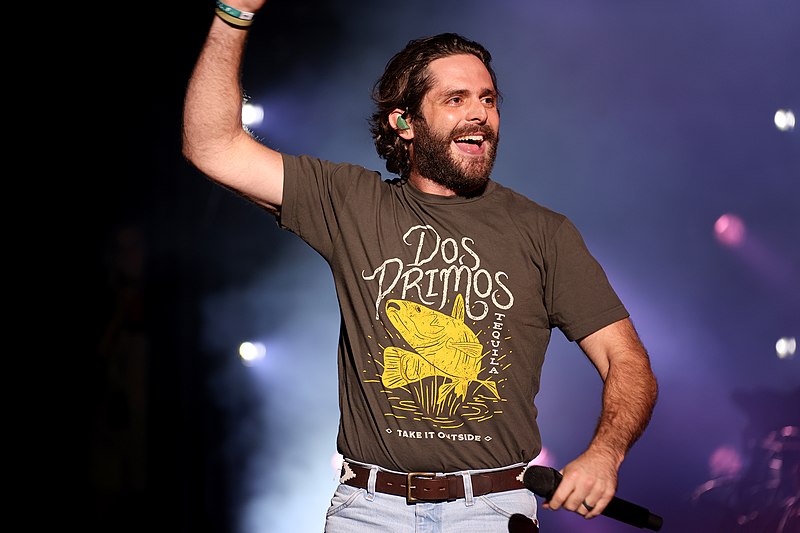
Thomas Rhett at Merriweather in 2021

Yesterday someone mentioned to me that a relative had been unable to get a hotel room in Sioux Falls, South Dakota, on Saturday night because “some country singer was in town.” Who was the singer, I wondered? Turns out it was Thomas Rhett. But I had never heard of Thomas Rhett, so I was curious. After all, the venue at which he appeared can  accommodate 12,000 people for a concert, so who is this guy?

Well, his full name is Thomas Rhett Akins Jr., he is the son of country singer Rhett Akins and he has released six records. (I guess by now you can tell I don’t pay much attention to country music). But I wanted to know more. Why would every hotel room in the city that is home to slightly more than one-fifth of South Dakota’s entire population be booked for this concert?

Beyond the fact that he is obviously a popular act on the country circuit I don’t think I have found the answer to that question. But I have found out enough about Rhett’s music to know that it is disappointing that he is so popular.

What do I mean by that?

That his current tour is titled the “Bring the Bar to You Tour” was my first clue that alcohol is clearly an important part of his persona. His website includes a link to the site for Dos Primos Tequila (which you actually have to enter your birthdate to access), a tequila that Rhett and his cousin “dreamed up” in order “to create a tequila that blended Mexican tradition with southern sensibility.” VIP tickets for Rhett’s current tour include “dedicated cash bar service throughout the show” when the concert is in an arena, one drink ticket and a tasting experience of Dos Primos Tequila where permitted.

Skimming through the lyrics of Rhett’s songs makes it clear that both alcohol and sex play a prominent role in his writing. When I googled Thomas Rhett, I was helpfully provided with a link to a list of his top 20 songs on the website Taste of Country. Here’s what I found:

  • Number 1 is “Die a Happy Man,” which references how happy “last night” made him, between the bottle of wine, the look in her eyes and dancing in the rain. The second stanza says, “that that red dress brings me to my knees/ Oh, but that black dress makes it hard to breathe” before calling her “a saint, you’re a goddess, the cutest, the hottest, a masterpiece.” The good news is, Rhett (along with some help) wrote this song for, and about, his wife.
  • Number 2 is “Life Changes” which is a song about changes Rhett has experienced in life, including becoming a successful singer, getting married, adopting a child and then his wife getting pregnant. Nice enough song and nothing at all objectionable. With a few exceptions, that’s about where the good news ends, sadly.
  • Number 3 is “Marry Me,” which starts out okay—saying “she” wants to get married, she wants her grandfather to do the service and she wants to keep it small so as to save her father some money. But then we find out that the guy singing the song is not the guy she wants to marry, so he will have to take “a strong shot of whiskey straight out the flask” in order to get through the wedding. This could be an okay song—yet another song about the guy who misses out on the love of his life, songs that can be found in numerous genres. But the line about whiskey, and the implication that liquor can help someone get through life’s hard times is a sign of a recurring theme in Rhett’s songs.
  • Number 4 is “Death Row.” Could have been good. Includes the lines, “How Jesus is the ticket/And narrow is the road/About how all we need’s forgiveness/’Fore we see them streets of gold.” Near the end, the song says, “I can’t say that he’s in Heaven, who am I to judge his soul?/But Jesus don’t play favorites, ain’t a name that He don’t know.” It is true that Jesus doesn’t “play favorites” and someone on death row could go to heaven—but it would have been nice if the conclusion had made clear that doing so depends on that needed forgiveness.
  • Number 6 is “Unforgettable.” There are other songs by that title and there are other songs with the same storyline as this one—a memorable first meeting with a beautiful girl. The problem is, the guy in this one who is remembering that meeting says, “I was drunk, said I was sober.”
  • Number 7 is “Look What God Gave Her,” a song that one could quibble about in parts but that is mostly about seeing a beautiful woman.
  • Number 8 is “T-shirt.” Somehow, remarkably, it doesn’t mention alcohol, but it is a song about making out. Heavily. With very little left to the imagination.
  • Number 9 is called “Beer with Jesus.” The idea behind the song has merit—imagine being able to have a conversation with Jesus, hanging out with Him one on one, asking things like how to turn the other cheek and what happens when earthly life comes to an end. The problem is, this song has all of that taking place over a few rounds of beers.
  • Number 10, “Star of the Show,” is an ode to Rhett’s wife and is basically a song about how good looking she is, no matter where or when or in what. Fairly typical country fare, but it does still manage to include a reference to ordering a drink.
  • “Ya Heard,” which is Number 11, is a song about all of the prayers Rhett has seen answered—being married to his wife, having a successful singing career, having children. The only real issue I have with this song is that it clearly implies that we know God hears our prayers when we get what we prayed for, and that is certainly not accurate.
  • Number 12 is “Be a Light.” This is an inspirational song that encourages listeners to make difference in the world. This is a good song that could, with a more clearly stated message be a great song. What is it missing? The reason for being a light—and the source of the ability to do it.
  • Rhett’s Number 13 song is a duet with his father entitled “Drink a Little Beer.” The title is pretty self-explanatory; the song is all about unwinding and having a good time with friends while drinking. The lyrics include “a Yeti full of iced-down booze” and “a jar full of lightning juice.” To be honest, I am not certain what “lightning juice” is, but I feel certain it is alcoholic. The moral of the song? The recipe for fun is beer, music and girls.
  • “To the Guys That Date My Girls” is the Number 14 song. It is a quintessential tale of a dad threatening the guy who shows up to date his daughter. Interestingly enough the song includes a warning about the need for the guy to mind his manners around the mom but makes no real reference to minding manners around the daughter. The only real instruction, other than showing up early and getting home on time, comes immediately after a tacit acknowledgement that sex is on the guy’s mind, and says “But when you pull her close/just save some room for Jesus/’Cause if you ever cross that line/I swear, boy, you’re gonna need him.” Here’s hoping that most fathers give a bit more meaningful instruction.
  • Number 15 is “It Goes Like This.” Fairly typical country song about a boy meeting a girl, and there is no mention of booze, but the song clearly implies that the very first meeting goes well beyond a hello and a conversation.
  • “Craving You,” at Number 16, is a duet with Maren Morris, another singer I’ve never heard of before. The song itself is about the undeniable allure a girl can have on a guy. But there are some problems. First, the lyrics compare the effect to that of a cigarette or 100 proof liquor. The song also says, “Well, girl, my self control’s so paralyzed/When it comes to you, no, I ain’t got no patience.” It does not require any creativity to realize the danger in lyrics that embrace the idea that a guy can lose his self-control and his patience because he wants a girl so badly.
  • Number 17 is “Things Dads Do” and this could have been a wonderful song about the things that fathers do, and why, while raising their sons. And maybe this is the kind of dad that Rhett had and/or the kind of dad that he wants to be, but he includes some characteristics I think we could gladly do without. For example, the song says that when the son has his first heartbreak, his father will suggest talking it out over a beer. Two problems. One, as I have already mentioned, is the continuous suggestion that we need alcohol to help us cope with the pains and struggles life brings our way. Two, I think every guy I have ever known has experienced their first heartbreak before they were 21, making a discussion over a beer not just a bad idea but against the law. When the son does get married, though, dad will pay for the booze, the song says. Later, when he comes to visit, he’ll ask why your refrigerator has “weird beer” in it. And when he is sitting in the waiting room of the hospital awaiting the arrival of his grandchild, dad will be “chewin’ Red Man.” Here’s hoping these are not the things most dads do.
  • “Remember You Young” is Number 18. This, too, could have been a sweet song about the reminiscences that we all have about friends, spouse and children when they were younger. But this song, too, has two glaring problems. First, references to drinking and partying in younger years (I know, no surprise). Two, near the end, the song says, “Yeah, I hope when we get to Heaven/He looks at us all like we’re kids/Shameless and painless and perfect and ageless/Forgives all the wrong that we did.” One should never assume we will all get to Heaven—especially when one follows it by hoping that God will look at us as shameless and forgive us of “all the wrong that we did.” There is indeed a way that that can happen, but it takes admitting ones sins and accepting Jesus as Savior, not hoping God just decides to forget about all of our wrongdoing and let us into Heaven.
  • At Number 19 is “Church Boots,” which is basically a celebration of being the same guy all the time no matter where he is or how much money he makes. The problem is this: the song proudly proclaims that his church boots are his work boots and his partying boots and he doesn’t think “the good Lord minds.” I am sure He doesn’t. But I suspect He does mind this: “Go straight from the farm to the bar to the back row pew.” God isn’t concerned with someone wearing dirty boots to church. He is, however, concerned with someone who makes going to church just one more thing they do—and a think that has no impact on how they live their lives the rest of the week.
  • “Us Someday,” at Number 20, is harmless and even a fine little country song. It’s too bad, though, that as he sings about what their future would hold Rhett includes kids running around the backyard, family round trips and Little League games—but not church.

It wasn’t in this Top 20 list, bur Rhett also has a song entitled “Beer Can’t Fix,” the point of which is that no matter what you may be going through, it “ain’t nothin’ that a beer can’t fix.”

So… Could it be worse? Definitely. At least there is no profanity or explicit sex as is so prevalent in some other popular music these days. But it could also be better. I am well aware that country music has long included references to alcohol; Garth Brooks’s “Two Pina Coladas” and “Friends in Low Places” come immediately to mind (and also clue you in to the timeframe of when I paid any attention to country music). But for someone to be so popular that he packs out an arena that holds 12,000 people should prompt us to wonder why. What is he singing? What worldview is he promoting? What way of life is he celebrating? Do we really want the awards for Male Artist of the Year and Entertainer of the Year and so on to go to someone who is promoting such pro-alcohol messages? The fact that he seems to be a loving husband and father and he throws Jesus into some of his songs actually serves to make the impact of his songs that much more threatening. If you’re a Thomas Rhett fan, that’s your choice, of course—but in the words of the old children’s song, “be careful little ears what you hear.”

Photo source: Wikimedia Commons

Values We Hold Dear

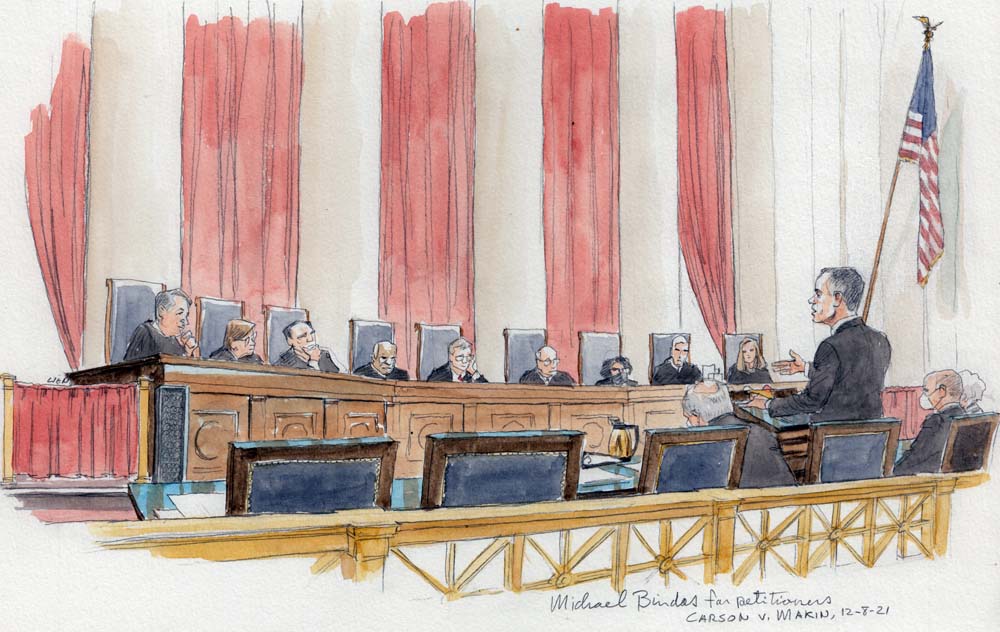
Michael Bindas at lectern arguing for petitioners

The Supreme Court’s decision in Dobbs v. Jackson Women’s Health Organization has, rightly, been getting most of the attention recently, but there have been other significant decisions by the Court recently, too. On June 21 the ruling was issued in the case of Carson v. Makin. The case stems from a provision in Maine that allows families who live in school districts that do not have a public secondary school and do not contract with one in another district to choose where their children will attend secondary school and the state will pay some of the tuition for those students. The payments are made by the state directly to those schools. There are some restrictions; namely, the schools must be accredited by the New England Association of Schools and Colleges (NEASC) or be approved by the Maine Department of Education. But since 1981, Maine has limited the use of the funds to attendance at non-sectarian schools.

On June 21, the Supreme Court struck down that restriction. And rightly so. But to see why I say “rightly so” it is important to understand some specific details.

On the day the decision was released, Maine’s Attorney General, Aaron Frey, issued a statement lamenting the ruling. In the process, however, he revealed both why it was the correct decision legally and why public education is increasingly dangerous.

Frey’s statement indicates that about 5,000 students in Maine live in areas without secondary schools, thus making them eligible for the program. “To ensure that these children have access to a free public education, they are permitted to attend at public expense a public or private school of their choice,” Frey said, continuing, “Public funds cannot be used to attend a private school that promotes religion because such schools, by definition, do not provide the equivalent of a public education.”

Notice that Frey said that eligible students could attend the public or private school of their choice—but then attempted to restrict that choice (which Maine has been doing for more than 40 years). In other words, parents could send their children to the school of their choice as long as the state approves of the choice. Is state-sanctioned choice really a choice? It is, but definitely a limited one.

Notice, as well, that Frey said that private schools that promote religion (that is what a sectarian school is) were not eligible for the program because those schools “by definition, do not provide the equivalent of a public education” (emphasis added).

The most easily addressed issue here is the use of state funds for attendance at a sectarian school. Writing in a dissent, Justice Stephen Breyer, citing a 1948 case, said “that a State cannot use ‘its public school system to aid any or all religious faiths or sects in the dissemination of their doctrines and ideals.’” Well, with all due respect to Justice Breyer, Maine is not using its public school system to aid any religious faith. Precisely because it does not have a public school system adequate to meet the needs of all Maine students, the state is allowing parents to choose where their students will attend school with the state paying part of the cost—since the state is required to provide students with an education.

Breyer further states that the Court has previously held that states may use public funds for the funding of religious schools so long as they choice of school was the “deliberate choice” of the recipient (the parents). He then stated this:

But the key word is “may.” We have never previously held what the Court holds today, namely, that a State must (not may) use state funds to pay for religious education as part of a tuition program designed to ensure the provision of free statewide public school education.

But Breyer is way off here. If Maine’s provision said that parents could choose any public school then this would not be an issue. Frey stated, “the purpose of the tuition program was to provide a public education for students who would otherwise be without.” But if that was the real purpose of the program, then it was written horribly. By definition, attendance at any private school is not public education. And since the program allows the choice of private schools, it cannot then restrict which private schools can be chosen. That is clearly discriminatory, as Chief Justice Roberts notes in the majority opinion. He wrote,

…there is nothing neutral about Maine’s program. The State pays tuition for certain students at private schools— so long as the schools are not religious. That is discrimination against religion. A State’s antiestablishment interest does not justify enactments that exclude some members of the community from an otherwise generally available public benefit because of their religious exercise.

I could cite more cases and reference more of the majority and dissenting opinions, but this is sufficient to demonstrate why the Court made the correct decision legally. The deeper concern, in my opinion, is the clear demonstration provided in Breyer’s dissent and Frey’s statement about the anything-but-neutral instruction being provided in public schools. Consider Frey’s words:

Public education should expose children to a variety of viewpoints, promote tolerance and understanding, and prepare children for life in a diverse society. The education provided by the schools at issue here is inimical to a public education. They promote a single religion to the exclusion of all others, refuse to admit gay and transgender children, and openly discriminate in hiring teachers and staff. One school teaches children that the husband is to be the leader of the household. While parents have the right to send their children to such schools, it is disturbing that the Supreme Court found that parents also have the right to force the public to pay for an education that is fundamentally at odds with values we hold dear. I intend to explore with Governor Mills’ administration and members of the Legislature statutory amendments to address the Court’s decision and ensure that public money is not used to promote discrimination, intolerance, and bigotry.

In case you’re not sure, inimical means to obstruct or harm; unfriendly or hostile. In other words, because sectarian schools teach things that are not neutral, they are not consistent with a public education. To an extent I could agree with that. That is, after all, why sectarian schools exist—so that they can state clearly their positions, their beliefs and their convictions when it comes to issues like religion, marriage, sex, gender identity, family and more. So that they can employ faculty and staff who are likeminded when it comes to those issues. But to a larger extent, Frey reveals in no uncertain terms that public education also has a position and, dare I say it, convictions on these issues—and they happen to be contrary to those of many sectarian schools.

It does not require reading between the lines or inferring anything to grasp what Frey is saying; he comes right out and says it. Teaching that the husband is to be the leader of the household is inimical to a public education. Teaching anything other than acceptance and approval of homosexuality and transgender identities is discriminatory, intolerant and bigoted. Breyer wrote in his dissent, “Maine denies tuition money to schools not because of their religious affiliation, but because they will use state funds to promote religious views.” That’s a pitiful attempt to split a fine hair; what Breyer is really saying is that if there was a religious school that taught exactly what the public schools teach, it wouldn’t be a problem. The problem is what is being taught. The problem, in other words, is that the religious schools actually have a “religion” that means something and has real-life application. “The very point of the Establishment Clause is to prevent the government from sponsoring religious activity itself, thereby favoring one religion over another or favoring religion over nonreligion,” Breyer continued. But again, he undercuts his own argument. What he is saying he really wants is not fairness or equality but to favor nonreligion over religion. Prior to this decision, Maine would fund attendance at a sectarian school as long as the school did not promote the faith or belief system with which it is associated or deliver academic instruction through the lens of that faith. So, as long as it wasn’t really a sectarian school.

Breyer specifically included in his dissent that one of the schools in question has as an educational objective “develop[ing] within each student a Christian world view and Christian philosophy of life.” The other school “is based on a thoroughly Christian and Biblical world view.” These things, apparently, cannot be because they are not consistent with a public education. A public education has to be neutral right?

Oh, wait.

No, Frey said that a public education “should…promote tolerance and understanding” and apparently that means not teaching that parents should be heterosexual and married or that homosexuality is a sin or that God created men and women and that gender is not a multiple choice question. Teaching those things will “promote discrimination, intolerance, and bigotry.” Such belief and teaching “is fundamentally at odds with values we hold dear,” Frey said.

Hmmm… Who is being intolerant now?

In fact, remember that full sentence. Frey said, “it is disturbing that the Supreme Court found that parents also have the right to force the public to pay for an education that is fundamentally at odds with values we hold dear.”

Funny, it seems to me there have been a lot of parents saying that for a long time—how disturbing it is that public funds are used to pay for so-called education that is fundamentally at odds with the values they hold dear.

The Supreme Court made the right decision; the legal reasoning of the majority is sound. But if other attorneys general and state boards of education feel at all like Aaron Frey, parents who really have values they hold dear will want to strongly consider abandoning public schools.

Writing New Rules

On December 1, a bill, Bill C-4, unanimously passed the Canadian House of Commons. On December 7, it passed the Senate and on December 8 it received Royal Assent. On January 8, it took effect.

Bill C-4 is titled, “An Act to Amend the Criminal Code” and it specifically addresses conversion therapy.

Now, in order to be as generous as possible, I am going to give you the definition of “conversion therapy” provided by GLAAD, the organization founded in 1985 as the Gay & Lesbian Alliance Against Defamation. Their definition is, “Conversion therapy is any attempt to change a person’s sexual orientation, gender identity, or gender expression.”

The key words in that definition, and that lead to the problem I am now addressing, is “any attempt.” I will explain in a moment why that is so problematic.

First, however, I want to make it explicitly clear that I do not support anyone being forced to go through any kind of treatment against their will. You have quite possibly heard some horror stories about such so-called therapy and I do not in any way support such activity…nor do I believe that the Bible does so. There is no denying that some people have suffered considerable harm—emotional and in some cases maybe even physical—under someone’s guise of curing them of homosexuality. I condemn that and I believe that Christians have a responsibility to care for such victims if given the opportunity to do so. But conversion therapy can include much more than that—which is why the words “any attempt” are important. And while there may well be many legislators in Canada who were well-intentioned and want only to protect people against coercive so-called therapy, the Canadian legislation certainly includes more than that.

Why is this Canadian legislation such a big deal that I am talking about it—especially since I do not live in Canada?

One, because the U.S. has shown a tendency to follow in Canada’s footsteps in many areas of law. Canada, for example, legalized same-sex marriage ten years before the U.S. did. In 2018, cannabis became legal in all provinces and territories of Canada. Where are we headed?

Two, and more importantly, is that this is a big deal. It is serious. It is more than it initially meets the eye.

Part of why I say that is explained in this quote from CTV News, a Canadian news outlet. It says of C-4, “It includes wider-reaching vocabulary of what constitutes conversion therapy than what the federal government attempted to pass in the last Parliament, and expands beyond the past proposal which focused on outlawing the use of the practice against children and non-consenting adults.”

The article later says that conversion therapy “can take various forms, including counselling….”

The bill makes it a criminal offense to even promote conversion therapy—including counseling.

More than that, however, the bill includes specifically religious terms and attacks.

The preamble to the bill states that conversion therapy “causes harm to the persons who are subjected to it” and “causes harm to society.”

How?

“[B]ecause…it is based on and propagates myths and stereotypes about sexual orientation, gender identity and gender expression, including the myth that heterosexuality…and gender expression that conforms to the sex assigned to a person at birth are to be preferred over other sexual orientations, gender identities and gender expressions.”

I don’t know if you are grasping the significance of that, but a bill, that has now passed the Parliament in Canada, received the approval of the queen, and been enacted into law, says that what the Bible teaches about sexuality and gender is a myth.

Right now, if you are in Canada and you believe what the Bible teaches about sexuality and gender, then, according to Canadian law, you and your belief are wrong. They are nothing more than myths.

So much for freedom of religion. And Canada does, by the way, have freedom of religion. Or at least it did. I am not going to go into the structure of the Canadian constitution, but a significant part of it is the Constitution Act of 1982, which includes the Canadian Charter of Rights and Freedoms, and that states, in Section 2, that everyone has the following fundamental freedoms: freedom of conscience and religion; freedom of thought, belief, opinion and expression, including freedom of the press and other media of communication….

And yet, the law now says that if you think, believe or are of the opinion that heterosexuality is right and homosexuality is not, or bisexuality is not, or that someone’s biological sex should coincide with their gender identity, that you are wrong. And not only are you wrong, but if you express that to anyone else in any form that could be considered therapy—despite the freedoms of expression press and other communication—you are breaking the law!

Later, the bill states that “[e]veryone who knowingly causes another person to undergo conversion therapy — including by providing conversion therapy to that other person — is (a) guilty of an indictable offence and liable to imprisonment for a term of not more than five years.”

The information released by the Canadian Department of Justice about this law, and posted on the official website of the Canadian government, links to a policy statement from the Canadian Psychological Association, which says that conversion therapy includes “prayer or religious rites” and “individual or group counselling.”

A Department of Justice news release says that conversion therapy is discriminatory and proven to be harmful even for adults who consented to it.

And the government’s explanation of the changes to the criminal code says that “These proposed new offences would not criminalize interventions that assist a person in exploring or developing their personal identity, provided that they are not based on the assumption that a particular sexual orientation, gender identity or gender expression is preferable to others.”

So bottom line, what does all of this mean? If you are a pastor or a Christian counselor, and you believe that what the Bible teaches about sexuality and gender is correct, and you allow that to influence your counseling or your prayer with someone—even someone who has consented to counseling and therapy with you—you are breaking the law.

Now, that’s a lot of background. I realize that. But it was necessary because it, I hope, makes clear exactly how serious this matter is. If we sit idly by and bury our heads in the sand and think this is not a big deal we are going to find, very soon, that this is happening here. In fact, I dare say we would find that it would not be very long before what I am saying here would be illegal if I were saying it from a church pulpit or in a counseling session.

That is troubling. I am not, after all, looking to go to prison. Far more dangerous than the possibility of going to prison, however, is the possibility that any pastor, any church or any Christian might shy away from standing firm on biblical truth in the face of such a possibility. We must never allow the fear of persecution—and certainly not the fear of prosecution—to deter us from believing and proclaiming God’s Truth. Should that time ever come, we must, like Peter before the Jerusalem council in Acts 5, says, “We must obey God rather than men.”

That sex is intended for marriage and that marriage is intended to be between a man and a woman and that whether or not someone is a man or a woman is determined by their anatomy and their biology, not by their whims or their feelings…none of that is a myth. All of that is God’s design.

The Bible makes no distinction between biological sex and gender.

Genesis 1:27 – “So God created man in his own image, in the image of God he created him; male and female he created them.”

Genesis 5:2 – “Male and female he created them, and he blessed them and named them Manwhen they were created.”

Mark 10:2-9 – And Pharisees came up and in order to test him asked, “Is it lawful for a man to divorce his wife?” He answered them, “What did Moses command you?” They said, “Moses allowed a man to write a certificate of divorce and to send her away.” And Jesus said to them, “Because of your hardness of heart he wrote you this commandment. But from the beginning of creation, ‘God made them male and female.’ ‘Therefore a man shall leave his father and mother and hold fast to his wife, and the two shall become one flesh.’ So they are no longer two but one flesh. What therefore God has joined together, let not man separate.”

Now, maybe I am missing something, but it seems to me that those three passages make it crystal clear that God created male and female. He did not create entities who could then decide. God, in His sovereignty, by His design, created two sexes. Two genders. Male. Female. If you are a male, you are not a female. If you are a female, you are not a male. You do not get to pick which one you will be—it is not multiple choice. You do not get to change which one you are.

And regardless of how anyone feels, it is a scientific fact that there are genetic differences between males and females. Their bodies are made differently—by design. Neither is better than the other, they are just different.

We see this clearly in sports, when the issue of biological males identifying as women and competing in women’s sports is revealing just how different they are. It has been in the news quite a bit recently with the transgendered swimmer at the University of Pennsylvania. That swimmer, who competed for three years on the UPenn men’s team and, after undergoing hormone therapy is now competing as a woman, has obliterated college records this year. This year, that swimmer has the fastest time by any “female” college swimmer, including a time 0.64 seconds faster than Olympian Torri Huske in the 200m freestyle and a time nearly three seconds faster than Olympian Brooke Forde in the 500-yard freestyle.

A few years ago, a study was done comparing the best elite female athletes to men and boys. That study gave a great example: Allyson Felix, the most highly decorated track athlete in U.S. history, male or female, and who holds the record for most gold medals ever at the track and field World Championships—more than Usain Bolt—and who specialized in the 400m sprint for the latter part of her career and had a lifetime best of 49.26 in that event—in  just the single year of 2017, men and boys around the world beat that time by more than 15,000 times.

Now, do all transgender individuals choose to pursue athletics? No, of course not. But these examples give very clear evidence that there are differences—real differences between men and women.

Of course, the most obvious difference is that men are biologically and anatomically incapable of giving birth. And, despite Alexandria Ocasio-Cortez’s claim to the contrary in September, only women menstruate.

God created male and female. There are only two options, despite what Facebook or others may say—some organizations claim there are as many as 72 gender options. There are two, male and female, and you don’t get to pick. God chooses for you.

The Bible is just as explicitly clear about homosexuality. The passage that we already looked at in Mark 10 makes it clear that marriage is to be between a man and a woman. Clearly, then, homosexual marriage is contrary to God’s design. Even if you were to take marriage out of the picture, however, homosexual activity is also outside of God’s design.

Leviticus 18:22 – “You shall not lie with a male as with a woman; it is an abomination.”

Leviticus 20:13 – “If a man lies with a male as with a woman, both of them have committed an abomination; they shall surely be put to death; their blood is upon them.”

Romans 1:26-27 – “For this reason God gave them up to dishonorable passions. For their women exchanged natural relations for those that are contrary to nature; and the men likewise gave up natural relations with women and were consumed with passion for one another, men committing shameless acts with men and receiving in themselves the due penalty for their error.”

Paul includes homosexuality in I Corinthians 6 when he presents a list of behaviors that are not pleasing to God. Paul addresses homosexuality again in I Timothy 1:8-10. Not only does he specifically name homosexuality in addition to the broader category of sexual immorality, he states that such behavior is “contrary to sound doctrine.”

Homosexuality is not okay. It is not just an “alternative lifestyle.” And certainly no one is made by God to be a homosexual. Homosexual behavior is very real, but that’s what it is—a behavior, not an identity. Not who a person is. And homosexual behavior is sin. There is no other way to honestly and legitimately interpret Scripture.

Plenty of people—some of them prominent and influential—have argued that the Bible’s teaching about homosexual behavior is out of date and no longer relevant, but no one has ever argued sincerely that the Bible does not teach that homosexual behavior is sin.

Back to why I am addressing this even though I do not live in Canada…consider an ordinance under consideration right now in West Lafayette, Indiana. Proposed Ordinance 31-21 has an odd title: “AN ORDINANCE PROHIBITING THE PRACTICE OF CONVERSION THERAPY AND DISCOURAGING ITS USE BY LICENSED PROFESSIONALS.” Hopefully you noticed why I say odd; I do not think it is common to have a law that both prohibits and discourages something! But the ordinance begins with this as the first of its many “Whereas” statements: “contemporary science recognizes that being lesbian, gay, bisexual, or transgender is part of the natural spectrum of human identity.” That is a bizarre statement because all of those things are anything but natural. Indeed, Scripture specifically refers to homosexuality as going against nature.

Further troubling is another assertion, citing the Committee on Adolescence of the American Academy of Pediatrics’ 1993 claim that, “Therapy directed at specifically changing sexual orientation is contraindicated, since it can provoke guilt and anxiety….” Oddly enough, yes, when you tell someone that they are doing something wrong, they might feel some guilt. That is how it is supposed to work in a healthy mind, actually.

But the point of the ordinance is specifically to ban so-called conversion therapy being performed by unlicensed individuals—unlicensed, that is, by the State of Indiana’s Professional Licensing Agency. That would include many pastors and biblical counselors. And what exactly will they be prohibited from doing? The ordinance bans “any practices or treatments that seek to change an individual’s sexual orientation or gender identity, including efforts to change gender expressions or to eliminate or reduce sexual or romantic attractions or feelings toward individuals of the same gender.”

The Lafayette Journal & Courier reported that Dr. Steve Viars, an area pastor, raised concerns about the proposed legislation. “Imagine a scenario where an area teenager voluntarily visits a self-identified faith-based counselor, but because the counselor used the Bible as their source of truth, the local police department imposed a fine of $1000 per day,” Viars said. The article further notes, “Concerns of protecting free speech and freedom of religion have been raised, and [David] Sanders [a council member and co-sponsor of the ordinance] assures that these protections are being considered as the ordinance’s wording is being reworked.”

I do not know anyone in West Lafayette and I am not going to assume anything about anyone’s motives. But the law in Canada and the proposed ordinance in Indiana are both examples of why it is so important to be aware of proposed legislation/ordinances and the consequences, intended or otherwise, of the language they contain. Hopefully the Indiana ordinance can be amended to ban what is truly inappropriate while protecting both the freedom of religion and the freedom to counsel someone from the perspective that homosexuality and alternative gender identities are sin.

Now, let me transition a little bit because there are two other important points to make.

First, plenty of people have criticized the Church for picking on or singling out homosexuality when there are so many other sins. I oppose that sentiment. Yes, there are many other sins in the Bible. And I both believe and hope that I would be just as adamantly opposed to those other sins if our society tried to normalize them and force us to accept them. If this afternoon a movement began to make some other sin acceptable and normal and legally protected—and also to prohibit Christians from speaking out against it and taking a stand for what Scripture teaches, I hope that we would stand up and oppose that.

I am not naïve enough to think that our society is going to embrace the Bible and build our legal code around it completely. In fact, I don’t even know that I would want that completely. After all, if you look at colonial New England where it was against the law to break the Sabbath, that wasn’t a very effective way to win people to Christ or to cultivate sincere faith in Christ.

But I will not—and we as Christians must not—allow the world or the government or any other entity or person to tell us that what God says is sin is not sin. If God calls it sin, it is sin. Period, full stop. It is not up for debate.

Finally, we must be careful not to treat those who support homosexuality or transgenderism as rejected by God. Meaning, therefore, that we cannot reject them. We do not have to approve what they do or stand for. In fact, we cannot approve what they do or stand for. But we must always remember that every human being is created in the image of God, God loves each and every person and He sent His Son to die on the cross for each and every person. We are all sinners who fall short of the glory of God and need a Savior. God detests all sin.

We must never compromise on the truth…and we must always share God’s truth in love.

Image credit: Nick Youngson CC BY-SA 3.0Pix4free.org

The Wrong Message

Robert Jeffress leaves the platform at First Baptist in Dallas after introducing Donald Trump.

Robert Jeffress, pastor of First Baptist Church in Dallas, welcomed Donald Trump to their service this past Sunday morning. The church’s website proclaimed: “The focus of the music and message this Sunday will be on the most important event in human history—the birth of Jesus Christ. President Trump is known for his love for Christmas and what it represents. We are thrilled to have him join us this Sunday morning.” Apparently Trump was in Dallas for a rally that afternoon with Bill O’Reilly, but Jeffress seized the opportunity to have him at First Baptist.

Readers of this blog know that I am not a fan of Donald Trump. In the interest of full disclosure, I should say now that I am not a fan of Robert Jeffress, either. To give you an idea why, consider the biography of Jeffress that appears on the First Baptist web site. It begins, “Dr. Robert Jeffress is Senior Pastor of the 14,000-member First Baptist Church, Dallas, Texas and a Fox News Contributor. He is also an adjunct professor at Dallas Theological Seminary.” It then proceeds to tout his “more than 4,000 guest appearances on various radio and television programs” before listing some of the shows he has appeared on. After mentioning his radio program, TV program and books, it says, “Dr. Jeffress led the congregation in the completion of a $135 million re-creation of its downtown campus. The project is the largest in modern church history and serves as a “spiritual oasis” covering six blocks of downtown Dallas.” Presumably that means First Baptist’s modern church history because if it means modern church history in the broader, worldwide sense then it is an outright lie, but either way…brag much? Jeffress seems to fully embrace the notion of “celebrity pastor.”

Having said that, Jeffress does seem to teach biblical truth. I may not like his personality, his arrogance or his priorities, but I am unaware of any heresy he preaches.

Before preaching his sermon, Jeffress said that Trump’s remarks would be the “climax and conclusion of the service.” While Trump spoke of the biblical account of Christmas, in words he admitted were prepared for him by the church, he added references to Afghanistan, police reform, America first and his never-ending crusade to “make America great again.” He even managed to work in his irritation with the press that Melania Trump received for her selection of White House Christmas decorations while Trump was president. Trump then received a standing ovation that included some chanting “U.S.A.!”

The bulletin at Fist Baptist on December 19

Absurdly, the church’s executive pastor then took the stage and said, “While we were very honored to have the 45th president of the United States with us today, I must remind you that it is our longstanding policy as a church that we do not endorse or oppose any political candidate for public office or otherwise intervene or engage in any political campaign.”

Uh huh…

Interestingly enough, the church’s website even contains a small-print disclaimer that appears on every page and reads, “First Baptist Church of Dallas does not endorse or oppose any candidate for political office. Instead, any information, videos, appearances, posts, etc. related to any political topic are provided for informational purposes only, and represent the personal views or opinions of the individual expressing them, but do not necessarily represent the views or opinions of First Baptist Church of Dallas.”

Trump made it clear that he was going well astray of the remarks that had been prepared for him, but since Jeffress has been an unabashed supporter of Trump all along there is no way he could truly have been surprised. After all, Donald Trump has never stuck to a script in his life and he is not going to pass up any opportunity to make something about him. I am not embellishing here, either; while introducing Trump, Jeffress called him one of his closest friends. He even said that Trump was “the most consequential president since Abraham Lincoln.” After the service Jeffress had the temerity to say that he did not think that Trump had said anything political and that the “full house” at First Baptist was evidence of Trump’s popularity.

Trump’s visit to First Baptist is certainly not the first time a political figure has attended a church service. That happens often and on both sides of the aisle. It is not the first time a political figure has been acknowledged at or given the opportunity to speak at a church service. Again, happens on both sides of the aisle. But a politician should never be the center of attention at a church service. Indeed, no human should ever be the center of attention.

It is incredibly sad that Robert Jeffress would preach a message that was, by all accounts, biblically accurate and invited unbelievers to salvation, yet call Trump’s remarks the climax. That absolutely sends the wrong message. Intended or not, Jeffress essentially declared that the account of Christ’s birth is nice, but Donald Trump is better. There is no greater climax than the birth of Jesus Christ in human form, coming to earth as a baby, knowing He would grow up to die on the cross for the sins of humanity. How tragic that minutes after that truth was proclaimed—and thankfully it was proclaimed—the congregation was chanting about human politics. A church service should never become a political rally. Chants of “U.S.A.!” in a worship service should sadden any true believer.

Do Not Fear

faith-4932875_1920I want to talk about fear. To be transparent, this is absolutely a response to the Coronavirus situation that is currently facing the world, but this is not going to be a political commentary, it is not going to be my thoughts on the news media or the medical professionals or the politicians… It is not going to be a rant. I assure you that I have plenty of thoughts on all of that, and maybe I will share them later, by not now.

But I have to say that over the past 36 hours or so in particular, I have been thinking a lot about this situation and specifically about the responses to the situation that we are seeing. It seems that every time we turn on the news or browse our social media we are hit with new stories of closing and cancellations and quarantines. Of toiler paper shortages. Or, as the New York Times reported yesterday, of the man in Tennessee who, with his brother, amassed over 17,000 bottles of hand sanitizer over the past two weeks so that he could sell them for a huge profit in the midst of this health scare.

And, I have to be honest with you, a lot of what is going on has made me angry. I want to offer you some biblical insight into why Christians are not to allow themselves to become paralyzed or overwhelmed by fear.

We are going to look at several passages and consider several principles, but I want to begin in 2 Chronicles 20.

In chapter 19, we see that Jehoshaphat instituted a number of reforms, including civil and religious. Then chapter 20 begins with, “After this…”

After this the Moabites and Ammonites, and with them some of the Meunites, came against Jehoshaphat for battle. Some men came and told Jehoshaphat, “A great multitude is coming against you from Edom, from beyond the sea; and, behold, they are in Hazazon-tamar” (that is, Engedi).

So, we see that there are a number of armies coming against Jehoshaphat and the Israelites, and they are getting close. Engedi was about 36 miles from Jerusalem.

Verse 3 says, Then Jehoshaphat was afraid and set his face to seek the Lord, and proclaimed a fast throughout all Judah.

Jehoshaphat was afraid. This is an absolute fear.

This is the same Hebrew word used in Nehemiah 2:2. King Artaxerxes sees that Nehemiah is sad and asks him why he has such a sad face—and Nehemiah was, it says, “overwhelmed with fear.”

This is the same Hebrew word used in 1 Samuel 28:5. Saul sees the Philistine army gathered together and camped in opposition to him, and Saul, it says, “was afraid, and his heart trembled greatly.” The NIV says “terror filled his heart.”

This is the same Hebrew word that is used in Jonah 1. Jonah is fleeing from the Lord, he has boarded a ship for Tarshish and God sends a violent storm—so violent that the experienced sailors on board the ship are terrified.

So, you get the idea… When it says that Jehoshaphat was afraid, he is not just concerned. He is not just alarmed. He is not apprehensive. He is panic-stricken. He is distressed. He is scared half to death, to borrow the colloquialism.

Here is where we would expect to see something sudden and dramatic happen. Alarms are sounding, troops are being rallied, defenses and being engaged, windows are being shuttered… A frantic frenzy of activity breaks out in response. Right?

Wrong.

What does it say? “Then Jehoshaphat was afraid and set his face to seek the Lord.”  The New American Standard reads, “Jehoshaphat was afraid and turned his attention to seek the Lord.” I actually love the Contemporary English Version’s rendering. It says, “Jehoshaphat was afraid, so he asked the Lord what to do.”

How often, for you and me, is this actually the last thing we do? We try to problem solve, we ask other people for advice or help, we panic, we get stressed, we lose sleep, we lose weight—or we gain weight, depending on how we handle fear—and then, when nothing else works and we don’t know what else to do, we think, “maybe I should pray.”

Listen to what Oswald Chambers said: “We tend to use prayer as a last resort, but God wants it to be our first line of defense. We pray when there’s nothing else we can do, but God wants us to pray before we do anything at all.”

And that was exactly what Jehoshaphat did. I encourage you to read the rest of 2 Chronicles 20, at least through verse 17.

Now, someone might be thinking, “that was a visible, human army and this is an invisible virus.” That’s true. But the principles are the same. We are not to fear. The command “do not fear” is found repeatedly in Scripture. And there are some very good reasons why we are not to fear. But we will get to those in a minute.

I want you to consider this definition or description of fear from Kay Tye, a neuroscientist. This answer was published in Scientific American last summer as part of an article interviewing various scientists about fear. Dr. Tye said,

Fear is an intensely negative internal state. It conducts orchestration of coordinated functions serving to arouse our peak performance for avoidance, escape or confrontation. Fear resembles a dictator that makes all other brain processes (from cognition to breathing) its slave.

Did you catch that? “Fear resembles a dictator that makes all other brain processes its slave.”

This is one of the reasons, maybe the biggest reason, why God commands us not to fear. When we do fear—or, maybe to be more specific, when we fear and do anything other than go to him as our response—we are taking our focus off of God and allowing our focus to be shifted to, and dominated by—enslaved by, to use Dr. Tye’s words—something else. For most of us it will likely not be an actual army like it was for Jehoshaphat. But it can be so many other things. It can be the Coronavirus, it can be finances, it can be school, it can be our job, or our marriage, or our parents, or or or…

I have no idea if Dr. Tye is a Christian or not, but what she says in that article echoes what the Bible says about why our thinking is so important. I love the fact that Ravi Zacharias’s radio program is called “Let my people think.” Christians need to think! We need to use our minds and to think carefully and intentionally and having been informed by truth!

It is no accident that Romans 12:2 says, “Do not be conformed to this world, but be transformed by the renewal of your mind…” If we are not going to allow the world to press us into its mold, we must have minds that are renewed. We have to let God change the way we think, in other words—and that necessarily means changing what we focus on!

I grew up playing baseball. I loved playing it, and then, when I got older, I played on multiple church softball teams and loved that too. But if I had to guess, I would say that there were six words I heard more than any others throughout my years playing baseball: “Keep your eye on the ball.” When you’re in the batter’s box and the pitcher is staring into the catcher’s mitt, wanting nothing more than to blow a strike by you, you have to have laser-like focus on that baseball. You don’t get long to decide to swing or not swing—or, sometimes, to get out of the way! You cannot be thinking about anything else, you cannot be distracted by anything else, you cannot be kinda thinking about it… it has to be your sole focus.

That is why Paul not only wrote that we are to be transformed by the renewing of our minds, but he wrote in 2 Corinthians 10:5 that we are to “bring every thought into captivity to the obedience of Christ.” Did you catch that? Every thought! Why? Because what we think about very much shapes our lives.

Several years ago, Pastor Jonathan Parnell wrote,

Fear is like the monster under my kids’ beds — its power is fueled not by what’s really there, but by what might be, what we imagine could be. Fear is a hollow darkness in the future that reaches back through time to rob our joy now by belittling the sovereign goodness of God.

The might bes and could bes are driving an awful lot of what is going on in our country right now. Am I saying that we should be cavalier about all of this? Of course not. But we cannot allow ourselves to be overwhelmed by, or even distracted by, fear!

Let me tell you why…

God is with us and God will help us. Look at Isaiah 41…

Verse 10 – “Fear not, for I am with you; be not dismayed, for I am your God; I will strengthen you, I will help you, I will uphold you with my righteous right hand.”

Verse 13 – “For I, the LORD your God, hold your right hand; it is I who say to you, ‘Fear not, I am the one who helps you.'”

So, one reason we must not fear is that it distracts us—it takes our focus off of God. And that leads to the second reason, that has been resonating so much with me over the past 36 hours. When we take our focus off of God, and we are controlled by fear, we become absurdly susceptible to those who claim to have the solution.

According to Thucydides, the people of Athens included fear along with honor and interest as the three strongest motives for action. When we are afraid, and not focused on God, we think we have to do something! That’s the only explanation for the otherwise inexplicable fact that people are currently stockpiling toilet paper, for example.

Barry Glassner, in his book The Culture of Fear, says, “we are living in the most fearmongering time in human history. And the main reason for this is that there’s a lot of power and money available to individuals and organizations who can perpetuate these fears.”

What does that mean? If enough people are afraid of something, or multiple somethings, they will gladly give money and confidence and even obedience to those who claim to be able to resolve their fears. Back in 2005, Robert Higgs suggested that fear is the bedrock of every human government. “Without popular fear, no government could endure more than twenty-four hours,” he wrote. Now we may be able to debate that, but the underlying thesis there is that same notion that people will voluntarily submit themselves to someone or something that claims to be able to resolve their fears.

And I want to tell you, as I have watched what is happening in our country over the past week or so especially, I am seeing, for the first time in my life, how some of the things that we see in history could have come about. The fear that exists, and the willingness to go along with whatever, is troubling. Even more troubling perhaps is the unwillingness to stand up and stand out. We are seeing, played out before us, a massive example of peer pressure. You might think I am going to the extreme here, but I now see firsthand how Nazi Germany happened. Now don’t get me wrong, we are no where near that level, but Hitler was able to capitalize on fears and anxieties to enact his policies and very quickly it was so overwhelming and widespread that very few people were willing to stand up and say, “Wait a minute, what are we doing?”

And again, I am absolutely not saying that this is where we are now, but I believe that this is how the Antichrist will come to power. The fear and chaos and danger that is present will be the door to his authority. By appearing to have the solutions, he will gain the trust, the worship and the obedience of the world. Read Revelation 13 in particular.

The Old Testament account of the Israelites shows us just how quickly, and how stupidly, humans will turn to just about anything for answers. Think about Exodus 32… Moses has not come down from the mountain yet and the Israelites are impatient and they convince Aaron to make them a god… Exodus 32:1 says, “Come, make us gods who will go before us….” In other words, “make us gods who will lead us.” We are so impatient, we are so anxious, we are so afraid of being stuck out here in the middle of nowhere, we will follow whatever you make for us… Stupid!

So, we are not to fear, but we are to trust in God. Yes, be wise. Yes, take precautions. Yes, use common sense. But do not fear. In closing, consider the words of Jon Bloom:

This bold, happy confidence in God is not only an expression of trusting love in him; it also makes us feel lovingly expansive and encouraging toward others because we’re filled with hope in God. We can’t help but want to comfort and encourage others with the comfort and courage we have received from God (2 Corinthians 1:3–4). God is commanding us to love him, love others, and be happy.


Image by Gerd Altmann from Pixabay