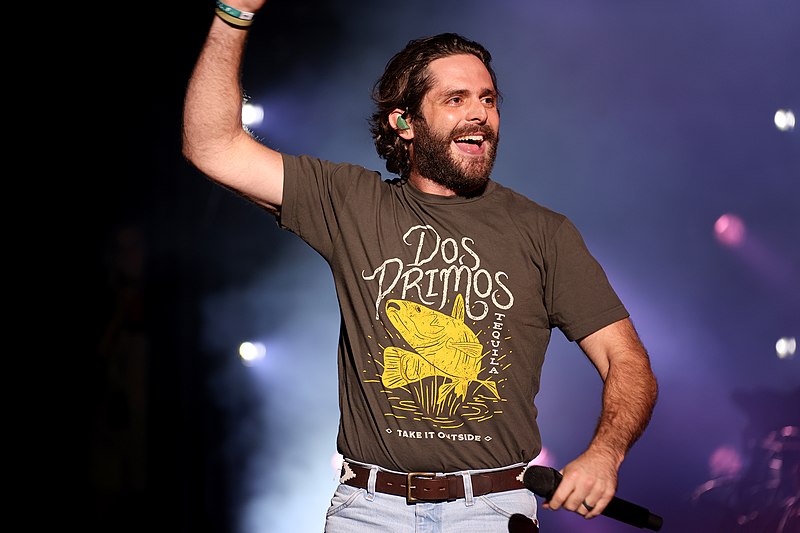
Yesterday someone mentioned to me that a relative had been unable to get a hotel room in Sioux Falls, South Dakota, on Saturday night because “some country singer was in town.” Who was the singer, I wondered? Turns out it was Thomas Rhett. But I had never heard of Thomas Rhett, so I was curious. After all, the venue at which he appeared can accommodate 12,000 people for a concert, so who is this guy?
Well, his full name is Thomas Rhett Akins Jr., he is the son of country singer Rhett Akins and he has released six records. (I guess by now you can tell I don’t pay much attention to country music). But I wanted to know more. Why would every hotel room in the city that is home to slightly more than one-fifth of South Dakota’s entire population be booked for this concert?
Beyond the fact that he is obviously a popular act on the country circuit I don’t think I have found the answer to that question. But I have found out enough about Rhett’s music to know that it is disappointing that he is so popular.
What do I mean by that?
That his current tour is titled the “Bring the Bar to You Tour” was my first clue that alcohol is clearly an important part of his persona. His website includes a link to the site for Dos Primos Tequila (which you actually have to enter your birthdate to access), a tequila that Rhett and his cousin “dreamed up” in order “to create a tequila that blended Mexican tradition with southern sensibility.” VIP tickets for Rhett’s current tour include “dedicated cash bar service throughout the show” when the concert is in an arena, one drink ticket and a tasting experience of Dos Primos Tequila where permitted.
Skimming through the lyrics of Rhett’s songs makes it clear that both alcohol and sex play a prominent role in his writing. When I googled Thomas Rhett, I was helpfully provided with a link to a list of his top 20 songs on the website Taste of Country. Here’s what I found:
- Number 1 is “Die a Happy Man,” which references how happy “last night” made him, between the bottle of wine, the look in her eyes and dancing in the rain. The second stanza says, “that that red dress brings me to my knees/ Oh, but that black dress makes it hard to breathe” before calling her “a saint, you’re a goddess, the cutest, the hottest, a masterpiece.” The good news is, Rhett (along with some help) wrote this song for, and about, his wife.
- Number 2 is “Life Changes” which is a song about changes Rhett has experienced in life, including becoming a successful singer, getting married, adopting a child and then his wife getting pregnant. Nice enough song and nothing at all objectionable. With a few exceptions, that’s about where the good news ends, sadly.
- Number 3 is “Marry Me,” which starts out okay—saying “she” wants to get married, she wants her grandfather to do the service and she wants to keep it small so as to save her father some money. But then we find out that the guy singing the song is not the guy she wants to marry, so he will have to take “a strong shot of whiskey straight out the flask” in order to get through the wedding. This could be an okay song—yet another song about the guy who misses out on the love of his life, songs that can be found in numerous genres. But the line about whiskey, and the implication that liquor can help someone get through life’s hard times is a sign of a recurring theme in Rhett’s songs.
- Number 4 is “Death Row.” Could have been good. Includes the lines, “How Jesus is the ticket/And narrow is the road/About how all we need’s forgiveness/’Fore we see them streets of gold.” Near the end, the song says, “I can’t say that he’s in Heaven, who am I to judge his soul?/But Jesus don’t play favorites, ain’t a name that He don’t know.” It is true that Jesus doesn’t “play favorites” and someone on death row could go to heaven—but it would have been nice if the conclusion had made clear that doing so depends on that needed forgiveness.
- Number 6 is “Unforgettable.” There are other songs by that title and there are other songs with the same storyline as this one—a memorable first meeting with a beautiful girl. The problem is, the guy in this one who is remembering that meeting says, “I was drunk, said I was sober.”
- Number 7 is “Look What God Gave Her,” a song that one could quibble about in parts but that is mostly about seeing a beautiful woman.
- Number 8 is “T-shirt.” Somehow, remarkably, it doesn’t mention alcohol, but it is a song about making out. Heavily. With very little left to the imagination.
- Number 9 is called “Beer with Jesus.” The idea behind the song has merit—imagine being able to have a conversation with Jesus, hanging out with Him one on one, asking things like how to turn the other cheek and what happens when earthly life comes to an end. The problem is, this song has all of that taking place over a few rounds of beers.
- Number 10, “Star of the Show,” is an ode to Rhett’s wife and is basically a song about how good looking she is, no matter where or when or in what. Fairly typical country fare, but it does still manage to include a reference to ordering a drink.
- “Ya Heard,” which is Number 11, is a song about all of the prayers Rhett has seen answered—being married to his wife, having a successful singing career, having children. The only real issue I have with this song is that it clearly implies that we know God hears our prayers when we get what we prayed for, and that is certainly not accurate.
- Number 12 is “Be a Light.” This is an inspirational song that encourages listeners to make difference in the world. This is a good song that could, with a more clearly stated message be a great song. What is it missing? The reason for being a light—and the source of the ability to do it.
- Rhett’s Number 13 song is a duet with his father entitled “Drink a Little Beer.” The title is pretty self-explanatory; the song is all about unwinding and having a good time with friends while drinking. The lyrics include “a Yeti full of iced-down booze” and “a jar full of lightning juice.” To be honest, I am not certain what “lightning juice” is, but I feel certain it is alcoholic. The moral of the song? The recipe for fun is beer, music and girls.
- “To the Guys That Date My Girls” is the Number 14 song. It is a quintessential tale of a dad threatening the guy who shows up to date his daughter. Interestingly enough the song includes a warning about the need for the guy to mind his manners around the mom but makes no real reference to minding manners around the daughter. The only real instruction, other than showing up early and getting home on time, comes immediately after a tacit acknowledgement that sex is on the guy’s mind, and says “But when you pull her close/just save some room for Jesus/’Cause if you ever cross that line/I swear, boy, you’re gonna need him.” Here’s hoping that most fathers give a bit more meaningful instruction.
- Number 15 is “It Goes Like This.” Fairly typical country song about a boy meeting a girl, and there is no mention of booze, but the song clearly implies that the very first meeting goes well beyond a hello and a conversation.
- “Craving You,” at Number 16, is a duet with Maren Morris, another singer I’ve never heard of before. The song itself is about the undeniable allure a girl can have on a guy. But there are some problems. First, the lyrics compare the effect to that of a cigarette or 100 proof liquor. The song also says, “Well, girl, my self control’s so paralyzed/When it comes to you, no, I ain’t got no patience.” It does not require any creativity to realize the danger in lyrics that embrace the idea that a guy can lose his self-control and his patience because he wants a girl so badly.
- Number 17 is “Things Dads Do” and this could have been a wonderful song about the things that fathers do, and why, while raising their sons. And maybe this is the kind of dad that Rhett had and/or the kind of dad that he wants to be, but he includes some characteristics I think we could gladly do without. For example, the song says that when the son has his first heartbreak, his father will suggest talking it out over a beer. Two problems. One, as I have already mentioned, is the continuous suggestion that we need alcohol to help us cope with the pains and struggles life brings our way. Two, I think every guy I have ever known has experienced their first heartbreak before they were 21, making a discussion over a beer not just a bad idea but against the law. When the son does get married, though, dad will pay for the booze, the song says. Later, when he comes to visit, he’ll ask why your refrigerator has “weird beer” in it. And when he is sitting in the waiting room of the hospital awaiting the arrival of his grandchild, dad will be “chewin’ Red Man.” Here’s hoping these are not the things most dads do.
- “Remember You Young” is Number 18. This, too, could have been a sweet song about the reminiscences that we all have about friends, spouse and children when they were younger. But this song, too, has two glaring problems. First, references to drinking and partying in younger years (I know, no surprise). Two, near the end, the song says, “Yeah, I hope when we get to Heaven/He looks at us all like we’re kids/Shameless and painless and perfect and ageless/Forgives all the wrong that we did.” One should never assume we will all get to Heaven—especially when one follows it by hoping that God will look at us as shameless and forgive us of “all the wrong that we did.” There is indeed a way that that can happen, but it takes admitting ones sins and accepting Jesus as Savior, not hoping God just decides to forget about all of our wrongdoing and let us into Heaven.
- At Number 19 is “Church Boots,” which is basically a celebration of being the same guy all the time no matter where he is or how much money he makes. The problem is this: the song proudly proclaims that his church boots are his work boots and his partying boots and he doesn’t think “the good Lord minds.” I am sure He doesn’t. But I suspect He does mind this: “Go straight from the farm to the bar to the back row pew.” God isn’t concerned with someone wearing dirty boots to church. He is, however, concerned with someone who makes going to church just one more thing they do—and a think that has no impact on how they live their lives the rest of the week.
- “Us Someday,” at Number 20, is harmless and even a fine little country song. It’s too bad, though, that as he sings about what their future would hold Rhett includes kids running around the backyard, family round trips and Little League games—but not church.
It wasn’t in this Top 20 list, bur Rhett also has a song entitled “Beer Can’t Fix,” the point of which is that no matter what you may be going through, it “ain’t nothin’ that a beer can’t fix.”
So… Could it be worse? Definitely. At least there is no profanity or explicit sex as is so prevalent in some other popular music these days. But it could also be better. I am well aware that country music has long included references to alcohol; Garth Brooks’s “Two Pina Coladas” and “Friends in Low Places” come immediately to mind (and also clue you in to the timeframe of when I paid any attention to country music). But for someone to be so popular that he packs out an arena that holds 12,000 people should prompt us to wonder why. What is he singing? What worldview is he promoting? What way of life is he celebrating? Do we really want the awards for Male Artist of the Year and Entertainer of the Year and so on to go to someone who is promoting such pro-alcohol messages? The fact that he seems to be a loving husband and father and he throws Jesus into some of his songs actually serves to make the impact of his songs that much more threatening. If you’re a Thomas Rhett fan, that’s your choice, of course—but in the words of the old children’s song, “be careful little ears what you hear.”
Photo source: Wikimedia Commons
 THINKING OUT LOUD