Why Are You Offended?

It is not a secret that I do not like Donald Trump as a person and I do not think that he is fit to be the President of the United States. That was true when he ran in 2016, when he ran in 2020 and when he sort-of ran in 2024 (I say sort-of since he declined to participate in the GOP debates and the Republican party did not require him to do so). And, since 2016, I have used my Facebook account to point out the concerns that I have with Mr. Trump, including his actions in office.

But suddenly, in the past month, I have had three individuals–all trusted brothers in Christ–approach me to express concern over my posts about Mr. Trump. I appreciate that they were willing to approach me; far too often we believers—especially, I dare say, Christian men—shy away from difficult, iron-sharpening-iron conversations. All three me approached me in the right way, following biblical principles, and all three, I believe, had an appropriate motive. To my knowledge, none of them knew anything about the other talking with me.

I will be the first to admit that if three Christian friends approach you about the same thing, it would be wise to listen. And I did listen. I don’t think I became defensive. I said that I would think and pray about what they had to say, and I have done that. But I should add that within the same time period I received, unsolicited, feedback from two or three people thanking me for taking a stand. I then solicited feedback from three other friends–people I have known for a long time, whose opinions I respect and whom I believe would tell me if they thought I was in the wrong–whether they thought I was out of line or risking offense with my posts. I have reached three conclusions as a result of those conversations and my prayerful reflection on them and I feel it is appropriate to share them here.

First, I care about politics and I like to argue. Debate would sound more polite, but argue may be more accurate. I have followed presidential politics since 1988. My undergraduate degree is in political science. I thought, for a long time, that I would be serving in an elected office or working for an elected official. God showed me that, thus far anyway, that has not been His plan for my life. But I am still interested in politics, I still like to argue and I definitely still have opinions. So maybe I have posted about Mr. Trump more than I should. I will continue to prayerfully evaluate that.

Second, the concern that was expressed, and all of the feedback and pushback that I have received about my posts and comments about Mr. Trump have come from other believers. And I cannot help but wonder why. None of the men who approached me suggested that I have posted anything that was factually wrong or biblically inaccurate. So why are the posts potentially offensive?

Strangely, some people who have taken issues with my posts have pointed out that God appoints leaders to accomplish his purposes on earth. There are two things to consider in regard to that. First, if you believe that, then you have to believe that God also appointed Joe Biden for office and that He had a purpose for having Biden in office for four years. You have to believe that about every office holder in the country. You don’t get to claim God is in charge only when things are going your way; God is in charge all of the time. The vast majority of the people who are now questioning my posts about Mr. Trump are the same people who repeatedly claimed that the 2020 election was stolen, said of Biden that he’s “Not my President!” and proudly wore shirts and flew flags proclaiming “Let’s Go Brandon!” But God put Trump in office for “such a time as this,” they say! Okay. Did he also put Biden in office for such a time as that? And Obama? And Bush? And Warren Harding? You can’t have it both ways.

Second, that argument is, I assume, based on Romans 13. That passage deals with being subject to rulers—including the often-overlooked instruction to pay taxes to whom taxes are due. But it begins with this verse: “Let every person be subject to the governing authorities. For there is no authority except from God, and those that exist have been instituted by God.” The verse says that governing authorities are instituted by God. But who is the governing authority in the United States? It is “we the people.” God, in His sovereignty, has given the citizens of the United States of America the ability to choose our own leaders. That does not mean that God chooses who our leaders will be. He allows them to be in office, because nothing happens that He does not allow, but there is a significant difference between what God allows and what God ordains. Check out 1 Samuel 8. The people of Israel wanted a king. God warned them of the results, but He also let them have what they wanted. The fact that Donald Trump is the President of the United States means that God has allowed Him to be; it does not mean that God ordained Him to be or put Him in that place.

Also interestingly, those questioning my posts repeatedly disregard Mr. Trump’s actions on January 6, 2021, and suggest that he did nothing wrong. It was all a peaceful protest or it was all manipulated or it was all faked. It was none of those things. I, and many, many others, watched it live. The testimonies of many who were there tell us what happened. People died. People were seriously injured. It was an incredibly sad day for America. Yet, they keep trying to claim that the J6 Committee destroyed evidence, which is a sure sign that they faked it all. Except that when I ask, as I have done repeatedly, for any evidence at all that the evidence was destroyed I get…crickets. That’s because there is no truth to that claim. (You can find far more evidence than you probably have time to read on GovInfo.gov—all there for you to look at it whenever you would like).

But what about the assassination attempts? Is God responsible for the fact that Donald Trump is still alive? Of course He is. He is responsible for the fact that I am still alive, and you are still alive and every person who is currently alive is still alive. That’s what it means for Him to be the almighty, sovereign God of the universe. It is not proof positive that God ordained Trump to be the president right now.

As I said, I have been following presidential politics since 1988. Since I have been old enough to vote, my preferred candidate in the primary election has only won the White House once, and that was in 2004 when George W. Bush was reelected. But I have prayed for every one of those presidents. I have prayed for wisdom and discernment and protection. And, when I felt it necessary, I have criticized the actions of every one of those presidents. Therein lies the rub…

The fact that I criticize some of what Donald Trump does, or how he does it, does not mean that I disagree with him on everything. When it comes to substance, I agree with him on more than I disagree with him. But he is not a nice man. He is not a good role model for young people. He does not have habits or leadership skills that anyone would tolerate in almost any other setting. He is arrogant. He is vindictive. He is petty. And he seems to have either forgotten, or not to care, that he is not a dictator and he cannot rule with the squiggle of his Sharpie. I think birthright citizenship for children of illegal immigrants should be reconsidered. I think the Department of Education should be eliminated. But he can’t do that on his own. He has to go about it the right way. This is a republic. We have rules and laws that must be followed. When he does admirable things the right way, I will probably comment on that. But when he does admirable things the wrong way, or things which are not admirable, I will definitely comment on that. Not because I am better than he is or because I enjoy it, but because I cannot sit idly by while so many people who profess to be followers of Christ blindly embrace his every move and follow in lock step his plan to Make America Great Again. I want America to be great, but that’s not what the Lord has called His children to pursue.

So, if you’re a follower of Christ, and my posts offend you, why is that? I am asking sincerely. I would honestly like to know. Are you really concerned about my relationship with the Lord—or are you bothered by the fact that I am not as gung ho about Donald Trump as you are? If it’s the latter, so what? I probably don’t cheer for the same sports team(s) you do either, or watch the same TV shows or prefer the same music. What difference does that make? But if it’s the former, that’s a real cause for concern—unless you’re equating the two. And I’m not being dramatic. I am aware of a church that has informed its congregants that if they do not support Donald Trump, they need to leave the church. That’s heresy. That’s idolatry. That’s elevating Donald Trump to a position of being more important than fidelity to the Word of God. And that cannot be ignored. The Bereans were commended for testing what Paul taught. We are exhorted to do that in our churches. We need to do it in the political sphere, too. Just because Trump says it or posts it on Truth doesn’t mean it’s true. Do some research. Don’t live in an echo chamber. Read, watch and listen widely—even, sometimes, to people you’re sure you disagree with. Be mature enough to admit that Trump makes mistakes and has flaws.

And please, keep in mind that when I post about Trump, I don’t mean it as a personal attack on you.

The third conclusion I have reached is that populism is so dangerous. It is not coincidental that Mr. Trump has a portrait of Andrew Jackson hanging in the Oval Office. It was during Jackson’s presidency that the worst domestic riot at the White House ever occurred—celebrating his election to the White House—and it was during Trump’s first term that the worst domestic riot at the Capitol ever occurred, trying to prevent his loss to Joe Biden from being certified by Congress. At least Jackson had lawfully invited “the public” to the President’s House, but the resulting fiasco resulted in such a mess that it took a week to clean it up. I have never seen—and in my study of history I am not aware of—a U.S. president who has gained such a cult-like following as Donald Trump. Sure, for decades now people have used pins, bumper stickers, t-shirts and signs to demonstrate their support for a political candidate and to encourage others to vote for that candidate. But those things generally disappear after an election other than in museums and in the hands of collectors. Not with Trump, though. People continued to wear MAGA hats and fly Trump flags for the duration of the Biden presidency. Entire MAGA stores sprung up. And Trump has capitalized on the blind loyalty of his followers, making money selling everything from Trump-branded shoes to Bibles to silver coins to cryptocurrency—and that’s not an exhaustive list.

Andrew Jackson would not, historically, be considered a populist, since most historians date the emergence of populism to the end of the 19th century. But the explanation of populism provided by Brittanica fits Mr. Trump to a t.

In its contemporary understanding, however, populism is most often associated with an authoritarian form of politics. Populist politics, following this definition, revolve around charismatic leaders who appeal to and claim to embody the will of the people in order to consolidate their own power. In this personalized form of politics, political parties lose their importance, and elections serve to confirm the leader’s authority rather than reflect the different allegiances of the people. Some forms of authoritarian populism have been characterized by extreme nationalism, racism, conspiracy mongering, and scapegoating of marginalized groups, each of which served to consolidate the leader’s power, to distract public attention from the leader’s failures, or to conceal from the people the nature of the leader’s rule or the real causes of economic or social problems.

Donald Trump’s supporters are no longer about the Republican party—they are about Donald Trump. He claims he has a mandate from the people to enact the sweeping changes he is instigating though his electoral victory was actually quite thin. While he did win a clear electoral vote, he won a bit less than half of the popular vote, making him the first minority president since…oh, Donald Trump, in 2016. When he was elected in 2016, Trump received a smaller percentage of the popular vote than any president since George Bush in 2000. But Trump is all about nationalism, scapegoating and conspiracy mongering. Watch out of you get out of step with him, even if you used to be his buddy. Just ask Nikki Haley, Mark Milley, Christopher Wray and a host of others. He seems to think he’s still starring on The Apprentice, firing people left and right, including the Archivist of the United States.

Since taking office three weeks ago, Trump has issued 59 executive orders. That’s more than any president has averaged per year since Jimmy Carter was in office. Executive Orders were designed to be rare. The first ten U.S. presidents didn’t issue as many combined as Trump has issued already. Not until Andrew Johnson did any single president issue more than Trump has in the past three weeks—and he was definitely serving during uniquely challenging circumstances. Not even Abraham Lincoln, who was widely criticized for expanding the power of the executive branch, possibly illegally, issued as many executive orders in his four-plus years in office as Trump has in the past three weeks—and Lincoln was literally trying to save the Union. No single president averaged as many executive orders per year as Trump has issued in three weeks until Theodore Roosevelt—who was president, interestingly, at the height of populism. Executive orders became a popular means of presidential influence through his cousin Franklin’s three-plus terms in office (he averaged 307 per year) but since then have declined sharply. In fact, Trump has already exceeded in number his own per-year average from his first term.

People have become so angry about the state of affairs in Washington, D.C.—and, in many cases, rightly so—that they don’t care what Trump does to “drain the swamp.” But doing the right thing the wrong way is still wrong. This is the United States of America, not some banana republic. Do you remember the Pledge of Allegiance? It says, “…and to the republic, for which it stands….” The power here resides with the people, not with the president, regardless of who he is.

We’re about to see if the courts will slow Trump’s abuse of power—or if he will even care if they try. If they don’t, or he doesn’t, we the people better care. We better take action—legal action, through our elected representatives—to bring him to heel. Throughout history, no story beginning with someone claiming that they are accumulating power for the good of the country has ended well, and it won’t this time, either.

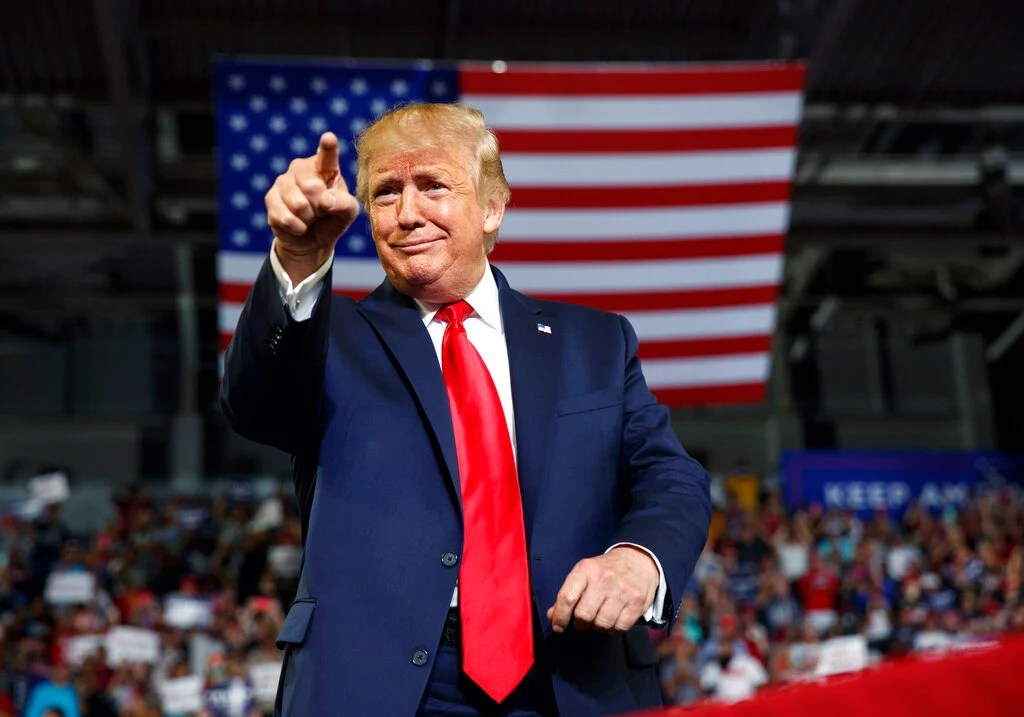
Image credit: John Scott Comedy.
Whiner in Chief

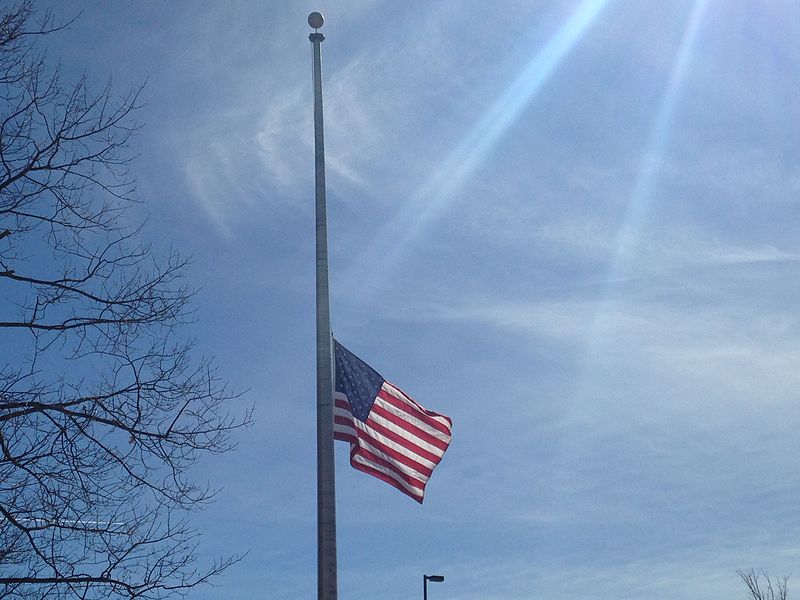
On December 29, 2025, former president Jimmy Carter passed away. In keeping with both precedent and U.S. statute, President Biden ordered that flags fly at half-staff for thirty days. That thirty day period overlaps with the inauguration of Donald Trump on January 20, something Trump simply could not abide. On January 3 he posted on his Truth Social platform:

The Democrats are all ‘giddy’ about our magnificent American Flag potentially being at ‘half mast’ during my Inauguration. They think it’s so great, and are so happy about it because, in actuality, they don’t love our Country, they only think about themselves.

Ignoring the fact that flags only fly at half-mast on a ship, this pathetic rant proves only to demonstrate that Donald Trump is the Whiner in Chief. He thinks of no one but himself and casts anyone and anything that gets in his way as un-American.

President Biden had no control over then Jimmy Carter died. And I cannot imagine even Donald Trump would have the audacity to suggest that Carter timed his own death to somehow cast a shadow over Trump’s inauguration. President Biden did not arbitrarily pick thirty days. As I said, that’s actually stated in U.S. Statute.

The United States Code, 2011 Edition, Title 4, Chapter 1—The Flag states the following:

The flag of the United States shall be flown at half-staff on all buildings, grounds, and naval vessels of the Federal Government in the District of Columbia and throughout the United States and its Territories and possessions for the period indicated upon the death of any of the following-designated officials or former officials of the United States:

(a) The President or a former President: for thirty days from the day of death.

This was signed by President Dwight Eisenhower when little Donald Trump was just eight years old. Surely no animosity toward Trump, or any presidential inauguration, was intended. And I dare anyone to suggest that Dwight Eisenhower didn’t love America.

Yesterday, Speaker of the House Mike Johnson announced, “On January 20th, the flags at the Capitol will fly at full-staff to celebrate our country coming together behind the inauguration of our 47th President, Donald Trump. The flags will be lowered back to half-staff the following day to continue honoring President Jimmy Carter.” Here’s the rub: Johnson has no authority to do that. But rather than display some semblance of a backbone, Johnson—who owes his continuation in the Speaker’s chair to support from Trump—kowtowed to Trump’s bullying and bluster.

Not only Johnson, though; as of today, Alabama Gov. Kay Ivey, Texas Gov. Greg Abbott, Nebraska Gov. Jim Pillen, North Dakota Gov. Kelly Armstrong, Tennessee Gov. Bill Lee, Florida Gov. Ron DeSantis and Iowa Gov. Kim Reynolds—all Republicans—have announced that flags will fly at full staff in their states on the day of the inauguration, too. Like Johnson, they lack the authority to override the order of President Biden that flags will fly at half-staff for thirty days.

Stupidly, those governors are citing sections of the same federal statute in support of their position. Their arguments, however, demonstrate either a severe lack in reading comprehension skills or the presence of deluded legal counsel in their administrations. Maybe both. One section they have touted says this:

It is the universal custom to display the flag only from sunrise to sunset on buildings and on stationary flagstaffs in the open. However, when a patriotic effect is desired, the flag may be displayed 24 hours a day if properly illuminated during the hours of darkness.

I’ve been a teacher for a long time. If I gave those two sentences to a student and asked them to explain them to me only to be told that it means that flags must fly at full-staff during presidential inaugurations I would promptly give the student an F. That section of the statute provides only for a longer-than-usual display of the flag; it says nothing whatsoever about the flag being at full- or half-staff.

The other section they’ve used says this:

The flag should be displayed on all days, especially on New Year’s Day, January 1; Inauguration Day, January 20; Martin Luther King Jr.’s birthday, third Monday in January; Lincoln’s Birthday, February 12; Washington’s Birthday, third Monday in February; Easter Sunday (variable); Mother’s Day, second Sunday in May; Armed Forces Day, third Saturday in May; Memorial Day (half-staff until noon), the last Monday in May; Flag Day, June 14; Father’s Day, third Sunday in June; Independence Day, July 4; National Korean War Veterans Armistice Day, July 27; Labor Day, first Monday in September; Constitution Day, September 17; Columbus Day, second Monday in October; Navy Day, October 27; Veterans Day, November 11; Thanksgiving Day, fourth Thursday in November; Christmas Day, December 25; and such other days as may be proclaimed by the President of the United States; the birthdays of States (date of admission); and on State holidays.

You noticed, I am sure, that Inauguration Day is included. Fine. Of course flags should be displayed on Inauguration Day. But no where in that section is there any suggestion that flags must be displayed at full-staff on any of those days. And no one suggested that flags should be flown at full-staff on January 1 of this year, which was within the thirty days. Were the inauguration not falling on Martin Luther King Jr.’s birthday this year, I am sure no one would have suggested it for that day, either.

This is not about a desire to honor America. It is purely about Donald Trump’s narcissism and the desire of weak politicians—almost always Republican—to get, or stay, on Trump’s good side so that they do not face the recriminations that would otherwise come their way.

Congratulations, America. Next Monday we are returning to office the Whiner in Chief.

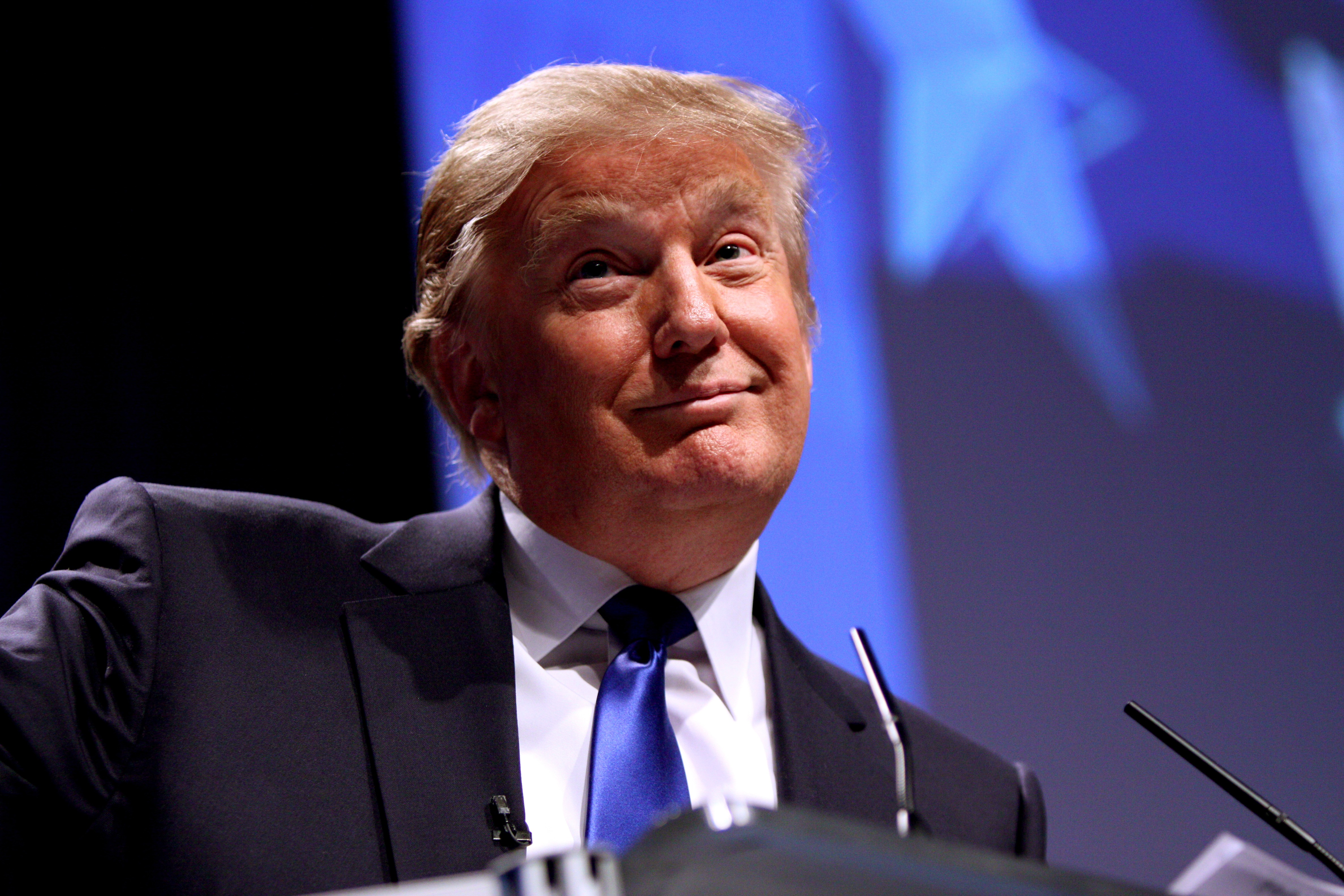
Photo credit: Wikimedia Commons.

Words of Warning

The 2024 election is over. And, I’ll admit, it did not go the way I expected. I doubted Donald Trump would win the White House and I certainly did not expect that Republicans would win the White House, Senate and House of Representatives. Turns out my predictions—or at least my expectations—were wrong. It is no secret that I do not like Donald Trump, but I do prefer the idea of four years of his policies over four years of Kamala Harris policies. That does not at all, however, change the fact that I do not like Donald Trump, that I think his rhetoric is inflammatory and dangerous and that I think it is repugnant that so many professing Christians—including many Christian “leaders”—have attached themselves so firmly to Trump that one could justifiably wonder whether or not they see Trump as a second Messiah.

I am not a prophet by any means and, as mentioned above, my most recent prediction about Mr. Trump proved erroneous. Nevertheless, there are three warnings I want to give as we look ahead to a second Trump administration.

First, I have a number of friends who have suggested—and I have seen it suggested by well-known evangelical figures—that we—America—deserved a Harris administration but God, in His grace, saved us from ourselves. Maybe. But maybe not. Don’t forget that there is another possibility and it is not nearly so exciting. Specifically, it may be that God allowed us what we wanted. Remember in 1 Samuel 8 when the people of Israel demanded a king? It displeased God that they did so. He instructed Samuel to warn them about what they were asking for. Samuel did do, but still the people insisted. “And the Lord said to Samuel, ‘Obey their voice and make them a king,’” verse 22 says. God was not saving Israel from anything. Neither was He blessing them. He was giving them what they asked for, knowing full well that they would reap what they sowed. Pray that is not the case now with Mr. Trump.

Second, we must be very careful not to allow the thrill of victory and the apparent wide-spread support for the Republican party to lead us into that which we would never tolerate from the “other side.” We already know that Trump and the Republican party have zero compunction about pushing things through in order to get their way. (Remember the appointment of Justice Coney-Barrett, anyone?) During the one-term presidency of John Adams the country got whipped into a frenzy of anti-French sentiment following the XYZ Affair. As a result, Congress passed, and Adams signed, what came to be known as the Alien and Sedition Acts, many of which were patently unconstitutional. John Adams, one of the leading figures in the American fight for independence, set aside his commitment to constitutional principles when it benefitted him and his party to do so. Donald Trump has a mean streak and a passion for vengeance that is unseen in the history of the Oval Office—with the possible exception of Richard Nixon. The list of people he might seek to get back at once he is back in office is lengthy. Let’s not forget that what goes around, comes around, and it won’t be a Republican in the White House forever.

Third, now that Trump has won the election, we need to insist that our evangelical leaders get back on track—or step aside. Too many of them have devoted their time, energy and passion to getting Donald Trump back in the White House. They have done so as if their lives and the future of Christianity depended on it. They have lost focus. While voting is a privilege that should never be taken for granted and Christians should exercise that right, getting the right candidate in any office is not what God has called us to do. You can look as long and as hard as you want to, but you will not find anywhere in Scripture where we are instructed to devote our time to politics or winning elections. We are, however, instructed to let our light so shine before men that they may see our good works and glorify God. Too many Christians, including a number of Christian leaders, have behaved in an un-Christian manner in their pursuit of a Trump comeback. We need to remember that leading souls to Christ is our calling, not leading voters to the ballot box. Winning spiritual battles is our calling, not winning elections. Yes, encouraging voters and electing godly candidates is commendable and even important. But not when it becomes our focus. Those are good things but not the best thing. Too many Christians and too many churches have lost their first love. They have become modern day examples of the church at Ephesus. If they are not careful, the Lord will come and remove their lampstand.

Evangelical Sellouts

Robert Jeffress prays in the Oval Office. (The White House, Public domain, via Wikimedia Commons)

While I have not blogged in months, I have continued to use my social media account to bring attention to Donald Trump’s unsuitability to be the President of the United States, something that increased exponentially when he finally started making it clear that he isn’t really pro-life. Along with my posts aimed at Trump, however, have been many aimed at the evangelical leaders who have so staunchly and adamantly endorsed him. In response to those posts, I have had several people ask me, “Well who are we supposed to vote for? Voting for Kamala Harris would be even worse.” And, from a conservative political perspective, that’s true. The policies that Harris has supported and would pursue were she to be given the keys to the Oval Office are not, for the most part, policies that an evangelical Christian could support—certainly not when it comes to the issues of abortion and homosexual marriage and transgender rights. As a result, more than one person has essentially suggested that I am criticizing Trump without offering any alternative.

So, let me set the record straight. First of all, my position on voting for Trump in November 2024 is the same as it was when it came to voting for Trump in November 2016. If you want to read what, exactly, that position was, you can read this post. How I felt about Hillary Clinton then is essentially how I feel about Kamala Harris now.

Secondly, the reason that I keep posting about Trump and criticizing the support for him is two-fold. One is to call out the evangelical leaders who have supported him all along, essentially joining with the GOP establishment to ensure that none of the other candidates for the Republican nomination in 2024 had a chance. Second is to remind those of us who are conservative Republicans that we have to do better.

In an August 2023 article for Christianity Today, Jonny Williams wrote,

Trump’s political career has been morally fraught from the start, and a plurality of evangelical supporters stuck with him through the Access Hollywood tape, the white supremacist Unite the Right rally in Charlottesville, revelations of Trump paying hush money to Stormy Daniels, his impeachments, and the Capitol insurrection.

That is, incomprehensibly, true. And, let’s be honest, the selection of Mike Pence as his running mate in 2016 and 2020 helped soothe the fears of many evangelicals and non-evangelical conservatives. But even if we want to give the benefit of the doubt to those who supported him in 2016 and decided to again in 2020, Trump should have all but eliminated himself as a consideration for those voters with his reprehensible behavior on January 6, 2020. But it seems that historian John Fea, as quoted by Williams, is right: “‘most conservative evangelicals gave up on the politics of character in 2016’ and still consider their relationship to Trump as a pragmatic bargain.”

And therein lies the rub. So many people who used to, I thought, be intelligent and intentional about deciding who to cast a vote for have, for reasons that I still do not comprehend, decided to follow Trump no matter what. Even when the Republican party had numerous candidates throw their hats in the ring in pursuit of the GOP nomination in 2024, the majority of Republican voters never even gave any of them a serious thought. And Trump not only knows that, he is counting on it.

Marc Short, a long-time aid to Mike Pence, told NOTUS, “Partnering with Pence gave assurances to a lot of Christian conservatives. And I think today he sort of assumes they have nowhere to go and perhaps takes their support for granted.” Short is correct about Trump’s assumptions and Trump has proven to be correct in taking their support for granted. What is not correct in that scenario is that Christian conservatives have nowhere else to go. They do. Or at least did. Had they shifted to another candidate when they had the chance, Trump’s political career would be over. And while they should be informed enough and smart enough to figure that out for themselves, the real blame lies, I believe, with those leaders who should have known better but stayed loyal to Trump anyway.

In the September 18, 2023, episode of The Briefing, Albert Mohler said that Trump’s position on abortion was “becoming increasingly clear and increasingly troubling.”  In that same episode, Mohler said, “We just need to track these issues very accurately, seek above all things to think consistently according to a biblical worldview, and try to understand all these swirling and controversial headlines around us, seeking actual words to understand actual arguments and to understand the actual consequences of policies once someone is elected President of the United States in November of 2024.”

Now, keep in mind that this was just a few weeks after the first GOP debate of the 2024 election cycle. Eight candidates had participated in that debate—including Pence—and there were several other candidates who had not been allowed to participate in the debate. So it is not as if Mohler and others did not have options. Yet, Mohler never supported anyone but Trump in the 2024 cycle. And even though he has called out Trump’s increasingly pro-choice positions, he has given no indication that he will vote for anyone but Trump.

Franklin Graham did not endorse any candidate during the Republican primaries, but he has continued to support Trump, too. In fact, he spoke just before Trump did at the Republican National Convention in July and, according to the Wall Street Journal, even owns one of the Bibles that Trump hawked to raise money for his campaign.

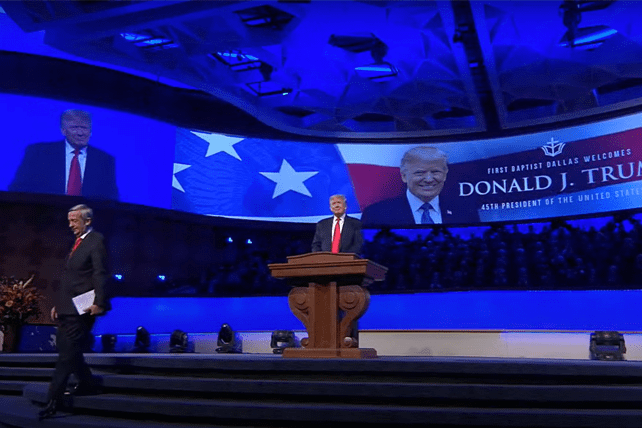
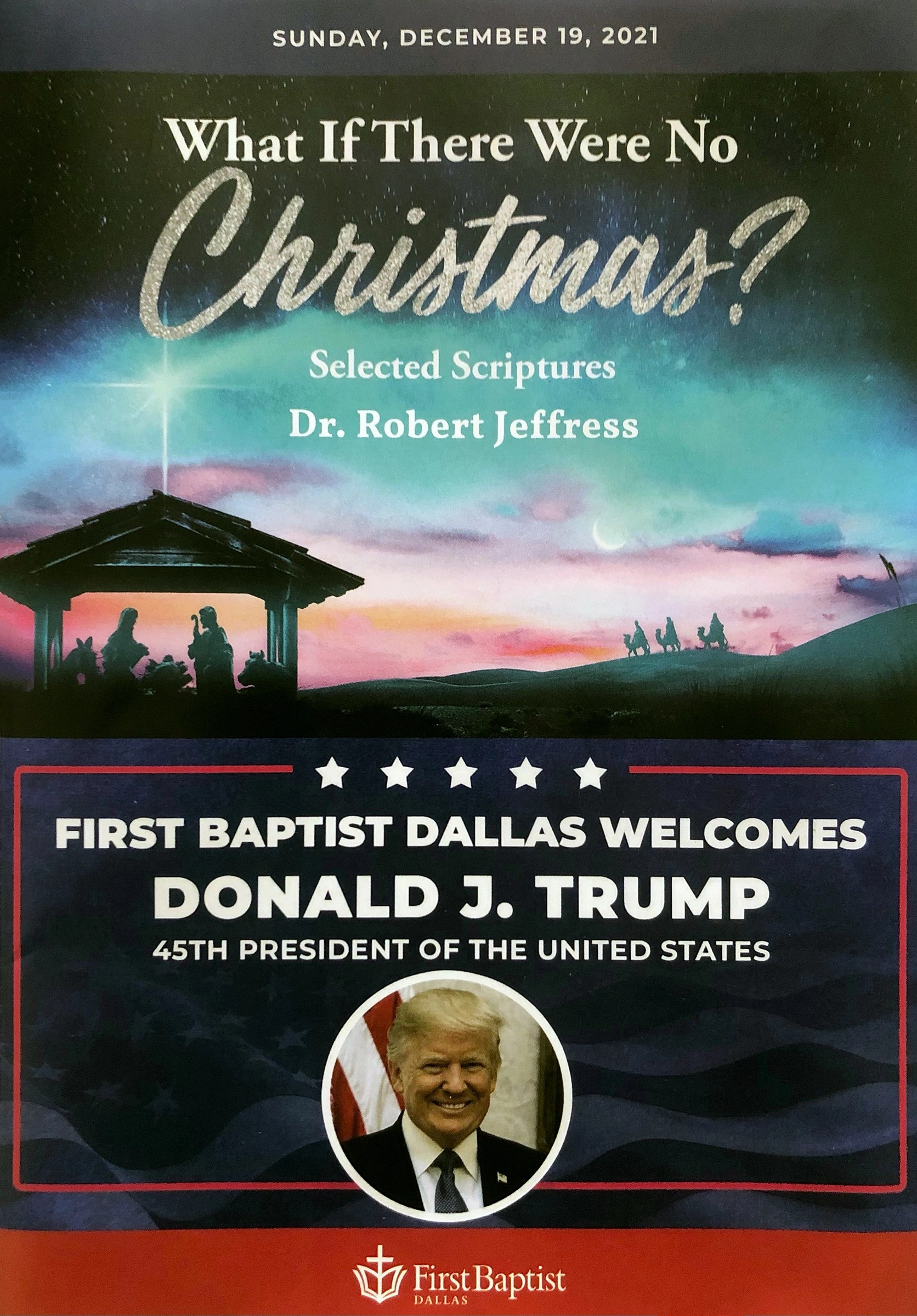
Robert Jeffress is such a Trump acolyte that he turned over the pulpit of his First Baptist Church in Dallas to Trump for Christmas Sunday in 2021. And he has endorsed Trump again this go-round, too. In fact, Tim Alberta has written about Jeffress’s “shrine” to Donald Trump.

Glancing to my right, his left, I took note of the irony. The corner of Jeffress’s office was a shrine–his secretary used that specific word to describe it–to President Donald J. Trump. There was an eight-foot tall poster memorializing the “Celebrate Freedom” concert in D.C. (the one where the choir sang “Make America Great Again”). There were boxes of Trump cuff links and a golden Trump commemorative coin. There were dozens–dozens–of framed photos of Jeffress and Trump: praying over him, talking with him, shaking hands with him, giving thumbs-up with him…In the sweep of my reporting on the former president and his many sycophants, I had never seen such a temple to Trumpism.

Of course, in 2019 Jeffress said on a radio program that Christians who do not support Trump are “spineless morons.” And in July 2023, Jeffress said that conservative Christians would continue to support Trump because “They are smart enough to know the difference between choosing a president and choosing a pastor.” Maybe. But it sure would be nice if the pastors of evangelical megachurches would have at least some moral expectations for the candidates they are going to throw all of their weight behind.

Tim Clinton, who has been the head of the American Association of Christian Counselors (AACC) for years, is another Trump devotee. Like Jeffress, he was often pictured praying over Trump in the Oval Office. His support of Trump led to a change.org petition to separate the AACC from politics. The petition rightly called out Clinton for his silence in response to the release of the infamous Access Hollywood tape, saying, “As the leader of the flagship Christian Counseling organization, it seemed unconscionable to me that Dr. Clinton refused to condemn such harmful words and behaviors – the very kinds of words and behaviors that we work against in our offices and with our clients every day.” The petition did not generate much support, and it did not seem to have any impact, because Clinton is still head of the AACC and still passionately promoting Trump. He has even invited prominent evangelical Trump supporters to speak at the AACC World Conference. Clinton may not be a well-known name in some circles but he is considered to be a potential successor to James Dobson, so his influence is significant. Clinton and Dobson were both part of Trump’s “evangelical advisory board.”

Jack Graham is the pastor of Prestonwood Church in Plano, Texas, and a large radio ministry. He is an unabashed supporter of Trump, too, and posted on X before the Trump-Harris debate this month, “Last night Donald Trump gathered with thousands of Christians for prayer in preparation for the debate tonight. This is the best preparation imaginable. America needs God and @realDonaldTrump knows it.” The last part is debatable—no pun intended. And while prayer would indeed be wonderful preparation for a debate, Trump really didn’t do very well. According to a report from Baptist News, Graham was one of several pastors on an ”emergency call” with Trump the night before the debate with Biden in June and Graham told the others on the call that they knew that CNN’s moderators would not be fair during the debate. He further said of Trump, “He is a warrior for us. He’s standing for us and always has and representing the principles and the precepts of God’s word that we so strongly believe.” That Graham could still contend, after everything that the world has seen and heard of Donald Trump, that Trump represents the principles and precepts of God’s word is absolutely astounding.

Sadly, I could go on for quite a while with examples of evangelical leaders unapologetically supporting Trump. Ralph Reed, Tony Perkins, Gary Bauer, Mike Huckabee, Ben Carson and Eric Metaxas are all solidly behind Trump despite the fact that all have made comments about other politicians in the past that, if applied to Trump, who disqualify him from getting their support. But there are other prominent pastors, academics and theologians supporting Trump, too. According to Christianity Today, fully half of all Protestant pastors in the United States plan to vote for Trump. That means his support goes far beyond the pastors named here and the other recognizable names.

Trump does not play nicely with others, so to speak. He has zero respect for anyone who does not agree with him completely, for anyone who does not back him regardless of how preposterous he gets, for anyone who dares to suggest that he might not be the best option. He will turn on someone with lightning speed if they cross him. Just look at what he did to Mike Pence—who had been incredibly loyal to him throughout his presidency—once Pence refused to go along with the idea of not certifying the electoral votes. Look what he did to Nikki Haley when she had the audacity not to drop out of the GOP race. But not only does Trump not respect such people, he talks about them like a playground bully would speak of the class nerd or misfit. Suddenly Haley, upon whom Trump had lavished praise which she was ambassador to the UN, became “Birdbrain.” Even worse, Trump has no qualms about mocking someone’s ethnicity; he frequently made fun of and intentionally messed up Haley’s given first name, Nimarata (Nikki is her given middle name).

Back in January Trump announced that anyone who gave a contribution to Haley’s campaign would be permanently barred from the MAGA camp. I was so excited by the possibility that I gave Haley a donation. In fact, I gave one large enough to get one of the t-shirts she had made in response to Trump’s comments—t-shirts that read, “Permanently Barred.” Sadly, Trump couldn’t even keep his word on that threat, as I have been inundated by Trump’s campaign via e-mail, text and postal mail ever since Haley dropped out.  

Today is Constitution Day. Unfortunately, the Constitution does not give many requirements for being president. The only stipulations the framers included were that the president be 35 years old, a natural-born U.S. citizen and have resided in the U.S. for fourteen years. But it is also important to remember that the framers never intended for the people to choose the president anyway. The Electoral College was put in place precisely to prevent what we are seeing in the U.S. in recent years. In Federalist No. 68 Alexander Hamilton wrote that the Electoral College was designed to “afford as little opportunity as possible to tumult and disorder” and to “promise an effectual security against this mischief.” No one could look back on the last six presidential elections and suggest that there has not been tumult, disorder and mischief.

The people were to have some influence in who the president would be, Hamilton wrote, but  it was determined by the framers “that the immediate election should be made by men most capable of analyzing the qualities adapted to the station, and acting under circumstances favorable to deliberation, and to a judicious combination of all the reasons and inducements which were proper to govern their choice. A small number of persons, selected by their fellow-citizens from the general mass, will be most likely to possess the information and discernment requisite to such complicated investigations.”

While we could, and should, discard the restriction of men being the only ones involved, Hamilton correctly anticipated that the public at large has proven ineffective at deliberation and discernment. The media, which should aid in that endeavor, has done anything but. Hamilton has a lot more to say that is worth considering; I would encourage you to read—or read again—Federalist No. 68.

Historian Stephen Knott, author of The Lost Soul of the American Presidency, is correct about where we have arrived. He said, “the president represents the will of an impassioned majority. The president has become a cheerleader for popular feelings, putting at risk those who don’t share them.” That has, sadly, become true of presidents of both parties. In fact, it has become true of both parties, period.

Our republic is in trouble, and Donald Trump is not going to Make America Great Again even if he wins the election in November (which I actually see as increasingly unlikely). If there is to be any chance of making America great again it will require more than just the election of the right person to the White House, but it will certainly require that, too. And until the majority of Americans decide that character in the White House matters more than cheap gas or lower taxes, we will likely continue to see browbeating and intimidation.

Our framers would be sad but, more importantly, God has to be disappointed in those who are giving their all, and using His name in the process, to support the election of such a thug.

Sell Out

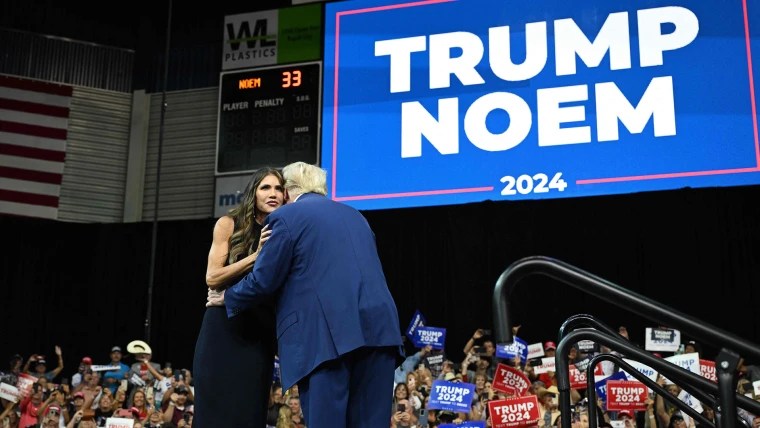
Donald Trump hugs Kristi Noem after being introduced at Monumental Leaders Rally on September 8

Last Friday evening, Kristi Noem, Governor of South Dakota, gave her endorsement to Donald Trump for the 2024 presidential election.

Last Friday evening, Kristi Noem, Governor of South Dakota, officially became a sell out.

No, I am not talking about the crowd of 7,000 people that Noem and Trump attracted to the rally in Rapid City, SD. I am talking about the betrayal of her principles for political gain. I am talking about the betrayal of what she has purportedly stood for and fought for in exchange for the opportunity to hitch her wagon to the man that she thinks will help expand her own political horizons. I am talking, sadly, someone who revealed herself as a hypocrite—live, in front of 7,000 people, but, by extension, in front of the United States of America.

In her introduction of Trump, Noem said, “It is my honor to present to you the man in the arena. He is a man of significance. He is the leader, the fighter, that our country needs. He has my full and complete endorsement for President of the United States of America. I will do everything I can to help him win and save this country.”

Less than a year ago, following the atrocious outcome for Trump-endorsed candidates in the 2022 midterm elections, Noem told The New York Times that she did not believe that Trump offered the best chance for Republican victory in 2024. In June 2023, Noem commented that Doug Burgum, governor of neighboring North Dakota, had asked for her support. And while she called him a “good guy,” she said, when asked if she was going to endorse any candidate, “No, I don’t think so. President Trump is in the race and right now I don’t see a path to victory for anybody else with him in the race and the situation as it sits today.”

But just last month, doing an interview for the Fox News show “Breakfast with Friends,” she tried to get cute. First, when the interviewer commented that a lot of governors were running for president, she said, “Almost all of ‘em” before laughing at her own joke. It wasn’t really all that funny though—nor was the question all that astute—since there are exactly two governors running for the nomination—Ron DeSantis of Florida and Doug Burgum of North Dakota. There are twenty-six Republican governors right now. Saying that two of twenty-six is “almost all of ‘em” is, well, pitiful. Funnily enough, there are more GOP governors who have already endorsed Trump than there are running for president (Noem’s endorsement makes her at least the fourth sitting governor to endorse Trump).

Math difficulties and attempts at humor aside, though, Noem explained that no one else had a chance to win the nomination as long as Trump was running. She added that Trump “did some great things for our state and our country,” and stressed that he let her do her job as governor. Then she made another attempt at humor and this one was even worse, cracking that President Biden would be offended by some of the flags being flown at Sturgis. Some of the flags said “Let’s Go Brandon,” based on the next comment, but some, no doubt, had a more explicit sentiment. That Governor Noem would joke about such flags rather than condemn them is deeply disappointing. She was then asked if she would endorse Trump at the rally in September. She demurred, of course, saying that the tickets sold out in a day and that people always hear “something interesting” from Trump. No resounding endorsements there. When asked if she would consider being Trump’s VP, she said that he hadn’t asked her and she does not answer hypothetical questions. Apparently she has changed her position on that, because when Newsmax asked her last week if she would consider it she replied, “Oh, absolutely. I would in a heartbeat.”

Way back in January, Noem was asked by Robert Acosta of CBS News if she felt “a rush…to make a decision on 2024” to which she replied, “No, I think it’s important that people focus on governing rather than going out and making big, broad statements and going out and taking action for their own political futures.”

Oddly enough, then, Noem decided to do exactly that on Friday night. Equally as hypocritical, Kari Lake then took the opportunity to attack Noem’s obvious angling for the VP spot on a 2024 Trump ticket, saying, “Anyone who’s talking about a position and dreaming about a position in Trump’s second administration really needs to get off their high horse,” to which she added that the focus need to be working “in the grassroots and start making sure Trump has a second administration.” This came in the same conversation in which Lake stressed the fact that she had been supporting Trump even before he had entered the race.

Lake, of course, is not even remotely qualified to be VP, having never held any elected office. But then Trump wasn’t remotely qualified to be president in 2020, either. But Lake is bizarrely committed to Trump, a commitment revealed when she kissed a painting of Trump on the stage at the CPAC convention last March. Marjorie Taylor Greene is rumored to be under consideration for Trump’s running mate, too. I cannot imagine Kristi Noem would find it to her advantage to be mentioned in the same breath as Lake and Greene; they’re so extreme that they might accurately be described as wacko. Fortunately for Noem, Elise Stefanik, Nancy Mace and Nikki Haley have also been mentioned as possibilities, though I think it is safe to say that Haley would decline if asked. Sarah Huckabee Sanders has also been rumored to be a possibility but, interestingly, she has declined to even endorse Trump so far, despite having been directly asked by Trump to do so according to The New York Times.

Which, actually, leads to another point. If Trump was so wonderful, why are Mike Pence, Nikki Haley and Chris Christie running against him for the nomination? Pence was Trump’s VP, Haley was his UN Ambassador and Christie was one of his strongest supporters. Vivek Ramaswamy has said that he thinks Trump as the best president of the 21st century to this point, yet he, too, is running against him! Really only once in American history has someone who had been the vice president run against the president under whom they served, and that was when Thomas Jefferson ran against John Adams. Given the way that vice presidents were selected then, that really doesn’t even count; Jefferson was only Adams’ vice president because Adams had received more electoral votes than Jefferson had when they were both running for president in 1796. The only other instance was John Nance Garner running against FDR in 1940—but Roosevelt was not an announced candidate when Garner announced his candidacy, or for most of the campaign season. And given that no president had ever served more than two terms before that point, and FDR was finishing his second term, it really isn’t fair to say that Garner was running against FDR, either. In other words, Mike Pence is really the first person who ever served as a vice president to knowingly and intentionally run against a president whom he willingly served.

Over a year and a half ago, James Downie, writing in The Washington Post, said that “the [Republican] party’s most prominent figures are willingly empty vessels in thrall to the GOP base. Until that changes, the GOP will stay the party of Trump.” He included Noem in that accusation. Until recently, I was a supporter of Noem. I voted for her governor twice. To be perfectly honest, I wrote her name when I cast my vote for president in 2022 despite the fact that I know that South Dakota does not count write-in votes. I could not vote for Trump. Or Biden. I have openly and publicly supported the way that she handled COVID as well as her general approach to governing. When she vetoed a bill passed by the state legislature dealing with transgender athletes because of some specific concerns, I thought she demonstrated a willingness to stand up to the GOP base and do something that was right rather than something that was politically popular. She did, of course, later sign a measure that corrected those concerns. But Noem has now shown that she would rather go along with the guy who is popular than do the right thing. She has shown that Downie may have been right. And she has certainly shown that she is no Nikki Haley, who has been willing to speak honestly about Trump and to stake realistic positions on issues such as abortion that do not cater to the fringe wing of the republican party.

I have made absolutely no secret of the fact that Donald Trump is not fit to serve as President of the Unted States—and that was all before the 2016 election, let alone the insurrection of January 6, 2021. So, Noem pretty well ruled out any future support from me when she endorsed Trump, a man who lacks every one of the character qualities that Noem has expressed are needed to be a true leader. Very early in her book Not My First Rodeo, Noem writes, of her decision to pursue public service, “I would not follow the glittery distractions of whatever was popular or convenient at any given moment.” Four sentences later she said, “…what matters is not how hard life is, but rather how hard you fight for what is right—and how tall you stand against what is wrong.”

Well, Governor, there is no greater “glittery distraction” in the Republican party these days than Donald Trump. It’s too bad that you have decided not to fight for what is right.

Image: Screen capture

Much Ado

I should start by acknowledging that until the two songs I am about to address became big news I could not have picked Jason Aldean or Oliver Anthony out of a lineup. I had heard of Jason Aldean but could not have named one of his songs. I am confident I had never even heard of Anthony.

I’m a little late to the game in commenting on Jason Aldean’s “Try That In a Small Town” and that is actually by design. I almost jumped in as soon as the song started making headlines and I decided to wait and see if my thinking changed any as the hullabaloo dissipated. It hasn’t, and since Anthony song “Rich Men North of Richmond” is now also getting a lot of attention I decided I would address them both at once.

It is my understanding that Aldean’s song was released a couple of months before the video for the song and that it attracted little attention until the video was released. I think that the images used in the video went a long way toward contributing to the level of attention that the song received—and can specifically be credited with the accusation that the song is pro-lynching—but the song has real issues even if there had never been a video made.

Aldean tried to downplay the possibility that he was endorsing lynching by claiming, rightfully, that there was not a “single clip that isn’t real news footage.” The video, however, was filmed in front of the Maury County Courthouse in Columbia, Tennessee. According to a number of reports, Aldean did not choose the location of the filming and I have no reason to doubt that, but someone did—and it seems unlikely that it was chosen at random. That courthouse was the location of a lynching in 1927. Columbia was also the location of a race riot in 1946.

The song’s lyrics reference “good ‘ol boys, raised up right.” That, too, makes Tennessee a poor choice for filming the video, since southeastern Tennessee was the location for annual gatherings of law enforcement officials known as the “Good ‘Ol Boys Roundup” in the 1980s and ‘90s. Eventually the Department of Justice’s Office of the Inspector General released a 314-page report finding that those gatherings included “shocking racist, licentious, and puerile behavior by attendees occurring in various years. We also found that an atmosphere hostile to minorities — and to women — developed over time because inadequate action was taken by the Roundup’s organizers to appropriately deal with instances of racial or other kinds of misconduct.” The investigation “found substantial credible evidence of blatantly racist signs, skits, and actions in 1990, 1992, and 1995. We also found substantial credible evidence of racially insensitive conduct in 1985, 1987, 1989, and 1993.”[1]

Aldean has said that the song is about “the feeling of a community that I had growing up, where we took care of our neighbors, regardless of differences of background or belief.” He also told a crowd in Cincinnati, shortly after the ruckus about the video began, “I know a lot of you guys grew up like I did. You kind of have the same values, the same principles that I have, which is we want to take our kids to a movie and not worry about some a**hole coming in there shooting up the theater.”

That may be all well and good, but Aldean did not grow up in a small town. Some news reports referenced Aldean’s “native Tennessee” but he is not native to the Volunteer State. He was born in Macon, GA, and grew up splitting time between Macon and Homestead, FL, after his parents divorced. Macon is not a “small town.” Its population exceeded 100,000 for the entirety of Aldean’s growing up years, with Macon usually among the top-five largest cities in the state. Homestead, FL, is actually a small town itself, but given that it is a suburb of Miami, it would be difficult to argue that it fits the definition most people think of when they think “small town”—or that the lyrics of the song have in mind. Aldean now lives in Nashville, a city of nearly 700,000. It would seem that the smallest town he ever lived in was Centerville, TN. Of course, it is not really accurate to say that he lived in Centerville. After all, his residence was over 4,000 square feet and sat on 1,400 acres. Aldean also lived in a home in Columbia for about three years—a home of almost 9,000 square feet with a custom fish tank, a detached bowling alley of more than 4,000 square feet and a 10,000 square foot barn—a property that he sold for some $7+ million. Suffice it to say that Aldean has really never lived in a small town and has not, for quite some time, lived anything like the majority of Americans.

Now that doesn’t mean that he cannot have what one might call small town values. That is, after all, what the song is purportedly about. But like it or not, there is no way around the fact that the song distinctly implies a violent response to undesirable behavior even if it does not say one word about lynching. After all, how else might one interpret “…try that in a small town/see how far ya make it down the road”? It is safe to say that car trouble is not being suggested. The second stanza pretty much threatens a violent response should there be any effort to take away the gun that his grandad gave him. I support the Second Amendment, and I don’t know of any serious effort at gun control measures that would threaten to take away the kind of gun Aldean or most anyone else would have inherited from a grandfather.

Sheryl Crow was one of many celebrities to speak out against the song. She tweeted that the song is “not American or small town-like. It’s just lame.” The problem, though, is that it isn’t lame. It is tapping into the fomenting sense that violence is the answer that is stoked by Donald Trump and those who think he is the savior of the United States. In February 2016 Trump said, at an Iowa rally, “If you see somebody getting ready to throw a tomato, knock the crap out of them, would you? Seriously. Just knock the hell out of them. I promise you, I will pay for the legal fees.” Three weeks later, at a rally in Nevada, he said of a protester, “I’d like to punch him in the face,” and then, “We’re not allowed to punch back anymore. I love the old days. You know what they used to do to guys like that when they were in a place like this? They’d be carried out on a stretcher, folks.” When, a few weeks later, a Trump support did punch a protester in the face at a Trump rally in North Carolina, Trump called the action “very, very appropriate” and the kind of action we need more of. I could, sadly, go on at length referencing Trump’s tendency to encourage violence. Not surprisingly he has called Aldean’s song “great” and shared on Truth, “Support Jason all the way. MAGA!” Donald Trump, Jr. and Lauren Boebert were among others to publicly support the song. My own governor, Kristi Noem, has strongly endorsed the song, even inviting Aldean to perform on the front lawn of the governor’s mansion. In a video she posted to social media, Noem said that Aldean “and Brittany [his ife] are outspoken about their love for law and order and for their love of this country, and I’m just grateful for them.” She also said that the lyrics represent “the feeling of a community that I had growing up, where we took care of our neighbors. There is not a single lyric in the song that references race or points to it.” Later, on Fox News, Noem said, “All it does is love America, love the flag, love our law enforcement, and it’s everything we should all be proud of.”

Now, Noem did grow up in a small town, graduating from Hamlin High School—in a town of about 6,000. And the majority of South Dakota is what you would think of when you think small town. The problem is that Aldean’s song does not actually say anything about taking care of neighbors or loving law enforcement or loving America. It implies respect for law enforcement but including cussing out a cop or spitting in his face among the behaviors one ought not try in a small town. It also implies love for America by including stomping on our burning the flag as behaviors that one won’t get away with. But nowhere is there any mention of calling law enforcement or supporting law enforcement as they deal with such behavior. Nowhere is there mention of neighbors coming to the aid of a threatened or injured neighbor. While the chorus says “we take care of our own,” the lyrics indicate that such care comes in the form of avenging any wrongs done to them.

There is an obvious question in all of this: what are small town values? What are the characteristics and standards that are seemingly being assumed by Crow and Noem, though reacting oppositely to Aldean’s song? On “Daily Kos” a writer identified as The Choobs wrote in late July that small town values include, or result in, higher rates of gun deaths, suicide, spousal abuse, child abuse, LGBTQ discrimination, drunk driving, vehicular deaths, teenage alcohol use, methamphetamine addiction, cigarette smoking, teen pregnancy and obesity. I don’t know anyone who claims any of those things as values, though, and while there is room for some honest debate over the claim, I am certain that isn’t what anyone in this conversation really has in mind.

Scott LaForest, writing for “Medium” in June, called small town values “the bedrock of all communities.” His article is worth reading—and he gets at what no doubt Crow, Noem and even Aldean all had in mind despite coming at it differently. “Whether it’s rallying together in the face of natural disasters, standing in solidarity against injustice, or pooling resources to help those in need,” LaForest wrote, “the heart of these actions lies in the values fostered in small towns: community involvement, neighborliness, and a deep-seated sense of empathy.” His article elaborates on these and a few others. I don’t have space to give them a full exploration here, but it is not hard to imagine why a community that has high involvement, neighborliness and empathy would be both less likely to experience the behaviors that Aldean’s song references and more likely to address them if they did occur. But by address them I don’t mean with violence, and no matter what Aldean or anyone else may say, there is simply no denying that “try that in a small town” is not an invitation but rather a challenge or even a threat. It is a thinly-veiled assertion that doing so will result in consequences. That’s not liberal interpretation or projecting anything—that’s what “try it” means and anyone who understands the English language and is honest with themselves will acknowledge that.

I am quite willing to grant that there is nothing in the lyrics about race and certainly not about lynching. I am equally willing to grant that Aldean may not have selected the location of the video shoot. But it strains credulity to suggest that another location could not have been chosen. After all, Columbia is almost 50 miles from Nashville; how many other courthouses are there between Nashville and Columbia—or within a 50-mile radius of Nashville? Centerville, for example—the town outside of which Aldean had his 1,400-acre spread, is home to the Hickman County Courthouse and is 60 miles from Nashville. A 2020 article in the Williamson Herald, a newspaper out of Franklin, TN, indicates that there are 95 county courthouses in Tennessee. The one in Columbia is included among the eight that the author says are the state’s most attractive, but that leaves seven more even if one wanted to argue that aesthetics was part of the reason the Maury County Courthouse was chosen. One of those eight is the Cannon County Courthouse in Woodbury, 58 miles from Nashville. Another is the Montgomery County Courthouse in Clarksville, TN—53 miles from Nashville. The Giles County Courthouse in Pulaski is just 73 miles from Nashville.

There are indeed small-town values that could and should be celebrated and about which songs could be, and have been, written. This particular song, however, has connotations and implications that are not anything that should be celebrated. Having said that, there are many songs that have lyrics and messages that should not be celebrated and many of them are far more offensive and blatant than “Try That In a Small Town.”

One last note before moving on. Aldean graduated from Windsor Academy, a Christian school in Macon, in 1995. There is no evidence that the school has any issue with the lyrics or the video for “Try That In a Small Town,” and apparently the school is more than happy to tout Aldean’s affiliation with the school, including his picture and a brief biographical comment on its website as part of “Our Team,” a section in which everyone else pictured is a current member of the school’s faculty and staff. It’s too bad that the school has not seen fit to issue a statement clarifying why the song does not represent the kind of values that we should be seeking to embrace.

Now, what about Anthony Oliver’s “Rich Men North of Richmond”? Well, it’s become an overnight viral sensation. Sadly. Political protest songs are nothing new and neither are lyrics that portend to speak for the downtrodden, the working class and the politically ignored. But this song has very little going for it for anyone who gives it serious consideration. It doesn’t have much in common with Aldean’s song other than the inclusion of profanity, which has become increasingly—and depressingly—common. What the two songs do have in common is the base to which they appeal, despite Oliver claiming that he is a political centrist. But when Marjorie Taylor Greene and Kari Lake both come out in support of the song, you can quickly identify the audience with which is resonates.

The song starts with these lyrics: “I’ve been sellin’ my soul, workin’ all day / Overtime hours for bullsh*t pay / So I can sit out here and waste my life away / Drag back home and drown my troubles away.”

Well, hmmm. I am not sure how working full time equates with selling one’s soul. Usually selling your soul implies doing something that is wrong, or morally dubious at best, in order to achieve a goal or obtain a want. By that definition, Anthony would be suggesting that not working is what he desires but he has to work in order to achieve what he wants. In Facebook posts, Anthony has discussed the lousy wages he earned working third shift in a paper mill. But apparently he also dropped out of high school. Sometimes we do indeed reap what we sow. We’ll come back to the not working shortly, but if he is working—not just full-time, but overtime—what is he doing that for? What goal is he trying to reach? Apparently not much, since the lyrics indicate that he is doing it so that he can sit “out here” (wherever that may be) and waste his life, drowning his troubles away. Though is doesn’t say so explicitly, one can easily imagine that drowning of troubles after dragging back home to involve copious amounts of alcohol.

The next lines say, “It’s a damn shame what the world’s gotten to / For people like me and people like you / Wish I could just wake up and it not be true / But it is, oh, it is.” This is a line that makes little sense since the listener is left wondering who exactly “people like you” is and what precisely it is that Anthony would like to not be true. Presumably, based on the chorus, Anthony would prefer a world with a lower tax rate, since it goes like this:

Livin’ in the new world / With an old soul / These rich men north of Richmond / Lord knows they all just wanna have total control / Wanna know what you think, wanna know what you do / And they don’t think you know, but I know that you do / ‘Cause your dollar ain’t sh*t and it’s taxed to no end / ‘Cause of rich men north of Richmond.

There is seemingly unanimous agreement that the “rich men north of Richmond” are the politicians in Washington, D.C, though it could possibly refer to the wealthy D.C. suburbs, too. Not that I cannot relate to wanting to keep more of my money, but current U.S. tax rates for someone making the kind of money Anthony sings about are not all that high historically speaking. BUt high taxes is not the only thing that Anthony thinks they are wrong about. The song continues:

I wish politicians would look out for miners / And not just minors on an island somewhere / Lord, we got folks in the street, ain’t got nothin’ to eat / And the obese milkin’ welfare.

Well, God, if you’re 5-foot-3 and you’re 300 pounds / Taxes ought not to pay for your bags of fudge rounds / Young men are puttin’ themselves six feet in the ground / ‘Cause all this damn country does is keep on kickin’ them down.

One cannot help but ask how Anthony would like politicians to look out for miners. Does he want less emphasis on “green energy” or more safety protocols for mining? Or does he think miners should make more money? It would be hard to imagine more government oversight and safety requirements and benefit funds than there are already in place for current and former miners. And miners are not generally low-income earners, either. In fact, the median salary for a coal miner is almost exactly the same as the median salary for all U.S. workers. Many coal miners don’t go to college not because they couldn’t but because they do not need to. ABC News ran a story in 2010 touting the ability of a beginning coal miner in Appalachia to earn $60,000 or more—and according to Mint, $70,000 is still the average salary of a U.S. coal miner.

What is clear is that whatever it is that Anthony wants for miners, it is more important to him than protection for sexually-abused minors—a commentary that is truly sad. Of course, it also seems out of place for Taylor Greene to endorse the song with this lyric since she is such an adherent of QAnon and the thus-far unproven rumors that there is a vast pedophile ring in existence among the world’s wealthy elite. Suggesting that too much attention is paid to minors on an island somewhere doesn’t fit with the QAnon narrative.

The next few lines don’t make much sense, either. Anthony goes from lamenting that there are folks in the street without food to chastising the existence of welfare programs that provide food for those who cannot afford it. Now, it is clear that by referencing the “obese milkin’ welfare” and the grossly-overweight person eating fudge rounds that Anthony thinks that those receiving what is commonly known as food stamps are often abusing the system.

According to a story on NBC’s “Today,” Anthony acknowledges struggling with mental health and drowning it with alcohol. He said that is sad to see a world in which everyone is fighting with each other. Chastising those on welfare seems an odd way to try to bring about peace—especially when one listener commented on X that the line about a 5-foot-3 person weighing 300 pounds is the “best lyrics in the history of music.”

Anthony drew lots of attention for selling out a concert he will be doing in Farmville, VA, in three minutes. News reports indicate that people are driving from as far away as Ohio and New Hampshire to attend. I cannot help but ask, “Why?” Anthony is a flash in the pan, the current unknown-makes-it-big story that most everyone seems to love. But the reality is that while he might have a decent voice, it’s a lousy song. Anthony has been open about saying that he wrote it while suffering from poor mental health and depression. I do not intend this to be funny, and certainly not to mock the reality of depression and mental health challenges, but that might explain why the song doesn’t make sense.

As this post is already rather long, I will not go further into disingenuous lyrics of the song in terms of the political arguments it attempts to make. Others have done that already, including Kenan Malik in The Observer and Eric Levitz in The Intelligencer. Jamelle Bouie, in an opinion piece for The New York Times, sums up well what I think of Anthony’s politics when he writes, “For my part, I can’t help but think there’s something ironic about the fact that, despite sitting close to this history, the latest populist voice to come out of the commonwealth has chosen, in the end, to give comfort to those with the boot on his neck and scorn to those who might try to help lift it.”

The article in response to Anthony’s song that perhaps struck me the most was Hannah Anderson’s piece for Christianity Today. Anderson takes strong issue with Anthony’s lines about welfare, saying that she was instantly reminded of the time when her family was on food stamps and the shame that she felt about that reality. Anderson rightly makes points about the judgment that others so often place on those receiving government assistance and about the way that those on assistance often feel about it.

However, she has several missteps in her column, as well. For one, she uses the term “food insecurity” in a way that I would consider inaccurate, despite the fact that it is consistent with the way that the U.S. Department of Agriculture uses it. That, however, is mostly a matter of semantics and opinion. Anderson wisely points out that she and her husband were both college-educated at the time that they were on food stamps, and that her husband was employed, highlighting the fact that not all of those on government assistance programs are just moochers unwilling to work. She does not acknowledge, though, that some of the reasons why her family could not make ends meet were of their own doing. Anderson states that she was not employed; rather, she stayed at home with their children. There’s nothing wrong with that, of course, but she references the fact that once they had their third child they could no longer make her husband’s salary cover their needs. (Her husband was a pastor and I’ll come back to the church’s culpability in a moment). Is it responsible to have another child if someone knows they will not be able to afford to care for that child? I would suggest that it is not. Once they qualified for SNAP (Supplemental Nutrition Assistance Program, the federally-funded program commonly referred to as food stamps), Anderson said the money that they had previously used for food was “relocated” to pay for things like gas and preschool for her daughter. Preschool? I’m sorry…I thought Anderson was a stay-at-home mom? Why would she and her husband pay to enroll her daughter in preschool if they could not afford food? That too, was irresponsible.

Anderson also commented that there were limits to what SNAP would cover, specifically mentioning that paper products, toiletries and cleaning supplies were not included. Well, that’s good. They shouldn’t be covered. After all, they are not nutritional items and SNAP is decided to ensure access to proper nutrition. SNAP also does not cover alcohol, tobacco or pet foods. Neither will it cover food that is hot at the point of sale or vitamins.

That last one doesn’t seem to make much sense, particularly given that SNAP will cover snack foods. It is the snack foods coverage that gives rise to Anthony’s line about fudge rounds, the chocolate frosting between two chocolate cookies made by Little Debbie. While they’re tasty, they are not nutritious, and I absolutely can relate to the frustration of seeing someone purchase junk food with government assistance funds. I don’t approve of the body shaming that is clearly included in Anthony’s lyric, but I share the opinion that fudge rounds—and snack foods in general—ought not be covered by SNAP.

Anderson does rightly call out the casually-used language of some within the Church that uses too wide a stoke when condemning government assistance programs. Should there be work requirements for welfare recipients? Absolutely. But are there some people who are working hard and still struggling to make ends meet? For sure.

That is, by the way, where the Church should come in, and that is actually the most offensive part of the story that Anderson tells. Her husband, at the time that their family was receiving SNAP benefits, was a pastor. His salary was only $28,000. Anderson does not say whether their housing was provided and she does not say how long ago this was, either; she references being 30 years old but there is no indication of when that was. She said that they asked the church board for a raise in order to better provide for their family but were given half of what they asked for and were told that social services were available. Unless the church could honestly not afford to pay any more, this is appalling. A church has an obligation—a biblical responsibility—to provide for its pastor. If the church truly could not support the Andersons full-time, then Anderson’s husband should have sought a second job and become bi-vocational or sought some other way to provide for his family if that was where he believed God wanted him to serve, but the fault in this story lies with the church board. Directing someone within their congregation to utilize government assistance should never be the first reaction of a church body; the congregation should care for its own—and certainly for its pastor.

Anderson is correct when she writes, “The price of accessing food through SNAP or a church food pantry must not be the poor’s dignity and self-worth.” I can relate to the shame she felt and the desire to keep it under wraps that their family needed government help. When I was a young teenager my father left a well-paying job to enroll full-time in Bible college. He worked at the college, too, but our family’s needs were beyond his income and we qualified for free lunches at school and WIC benefits for my younger sisters. Later, as an adult, I lost my job suddenly and experienced the sudden change in circumstance that many people experience when losing a job. I went from taking students to volunteer at a Salvation Army shelter to serve meals to, not too many weeks later, going to a church food pantry to get some food when the pastor extended to us the offer. It was humbling. We never had to accept any government assistance at that time beyond the unemployment payments I received, but it did cause me to rethink the judgment that can easily come into one’s mind—and be reflected in one’s attitude—when we see someone not able to provide for themselves or their family.

So, Mr. Anthony, I agree—fudge rounds should be out. But SNAP and similar government programs do serve a legitimate purpose—one too often neglected today by the Church. And no one who legitimately needs such government services should ever be scorned or belittled. The odds are good that they hate needing it already; the last thing they need is for you or me to condemn them for that need. But most importantly, it is a sad day when professing believers cannot even see that “love your neighbor as yourself” would certainly include ensuring that your pastor’s family can afford to eat.

Ultimately, these two songs are getting a lot of attention–much ado, one might say. In the case of the Aldean song, it is not much ado about nothing because there is, and should be, a legitimate debate over the kinds of things the song is about. While he is correct that the behaviors he sings about should not be tolerated or go without consequence, he is wrong to suggest or imply that they should be dealt with by some kind of vigilante justice. In the case of the Anthony song, though, I think it really is much ado about nothing. After all, the song has no discernible point.


[1] https://oig.justice.gov/sites/default/files/archive/special/9603/exec.htm

Photos: YouTube captures.

Reality Check

Donald Trump and Kari Lake at “Save America” rally in Florence, Arizona.

A day after the 2022 midterm elections it is looking like the projected Red Wave turned into a Red Swell. I have spent many hours in the Atlantic Ocean and many times what looked like it might be a wave while it was still way out ended up being nothing more than a swell by the time it reached us. That certainly seems to be the case with these elections.

Two weeks ago, Oliver Wiseman, writing for The Spectator World, headlined his column “All signs point to a red wave.” He began with, “It’s now just under two weeks until the midterms. Judging by the mood music on both sides of the aisle, all signs point to a very good night for the Republican Party.” He concluded his comments on the midterm with this: “Midterms tend to be a referendum on the party in power, and Democrats have every reason to believe that the verdict will be unfavorable.”

While not all results are yet in, and which party will control the Senate is still unclear, we do know that the verdict was actually not unfavorable for the Democrats—or at least not very unfavorable. It was, however, unfavorable for the Republican party as a whole and for Donald Trump and his minions in particular.

Someone suggested to me today that the media had done a good job of gaslighting everyone—that the best way to discourage people from voting is to make them think that the outcome was in the bag. He was specifically suggesting that some voters who would have voted Republican did not bother to vote because they were sure the Red Wave was coming. I disagree, though.

There really was every reason to expect a Red Wave. And I will even go so far as to suggest that without Donald Trump, there would have been one. President Biden currently has an approval rating of 41.4% according to FiveThirtyEight. That means that almost three out of every five Americans do not approve of the job that he is doing as president. Every president since Franklin D. Roosevelt had a higher approval rating at this point in his administration than Joe Biden currently has—with the president closest to Biden’s rating being Donald Trump. By the way, I suspect FDR’s approval rating was higher, too, and probably many other presidents, but FiveThirtyEight only has data back to Truman.

The makeup of the Senate is currently 50-50 (including two Independents who caucus with the Democrats), with the Democrats being in the majority thanks to Vice President Kamala Harris being the tiebreaker. That means that the Republicans needed a net gain of only one seat in order to take the majority. Politico rated ten Senate races as toss-ups or likely narrow wins. As of right now, Democrats held three and flipped one, Republicans held three and three are still undecided—Arizona, Georgia and Nevada. Georgia is all but certain to be headed to yet another run-off, since neither incumbent Raphael Warnock nor Herschel Walker managed to get a majority of the vote. Somehow only two-thirds of the vote in Arizona have been counted thus far, but Democratic incumbent Mark Kelly currently has a lead of five percentage points (roughly 90,000 votes). In Nevada, 77% of the vote has been counted. Adam Laxalt, the Republican challenger, has a narrow lead over Catherine Cortez Masto (less than 23,000 votes). Interestingly, Laxalt leads in every county but one, yet his victory is by no means certain. He does not currently have a majority of the vote, either; as of the most recently reported results, 24,608 people voted for one of three other candidates or for “None of These Candidates,” an option Nevada has offered since 1975.

The Republicans retained the seat in Wisconsin, but Ron Johnson barely defeated Mandela Barnes, winning by about 27,000 votes out of more than 2.6 million cast. Barnes actually achieved the exact same percentage of the vote as Joe Biden did in 2020—49.5%. That was enough for Biden to carry the state and pick up Wisconsin’s 10 electoral votes, but not enough for Barnes to win; 1.7% of the voters in 2020 cast their votes for one of several third party candidates, whereas only Barnes and Johnson were on the ballot for Senate yesterday.

That the GOP did so poorly yesterday is certainly not a sign of confidence in or approval of Joe Biden. Instead, it is, mostly, a refutation of Donald Trump. Don’t get me wrong—Trump candidates did well in several races. Ron Johnson, for example, was linked to some election shenanigans in 2020 and originally said he would not vote to certify Biden’s victory, though he changed his mind after the January 6 riots. And J.D. Vance, a political newcomer who said that the election was stolen from Trump, won in Ohio. Sarah Huckabee Sanders was one of the earliest candidates endorsed by Trump, having served as his Press Secretary, and she won handily in Arkansas—but she is also the daughter of a popular former Arkansas governor.

But in Arizona, it is a different story. Kari Lake, the Trump-endorsed candidate for governor and a political newcomer who thought she was such an influential figure that she made campaign ads for candidates in other states, is not leading with two-thirds of the vote in. She is at least close. Secretary of State candidate Mark Finchem, however, who has ties to QAnon and the Oath Keepers, is considerably behind Adrian Fontes for Secretary of State.

In Alaska, with about 75% of the vote in, it seems that either Kelly Tshibaka or Lisa Murkowski will win the Senate race, but it is not clear which one. And Alaska has an interesting new ranked voting system in place. Trump has been clearly, consistently and adamantly opposed to Murkowski; if she wins, it will be a clear repudiation for Trump by Alaskans. And Trump-endorsed Sarah Palin has a slight lead over fellow GOP candidate Nick Begich for the a House seat, Democrat Mary Peltola has a sizable lead over both of them.

In Michigan, Democrats swept the statewide offices. Gretchen Whitmer, one of the most authoritarian governors amidst the COVID pandemic, won handily over Trump-endorsed Tudor Dixon. Incumbent Secretary of State Jocelyn Benson defeated Trump-endorsed Kristin Karamo, who denies the legitimacy of the 2020 election, even more handily.

In New Hampshire, Karoline Leavitt lost her bid to unseat incumbent Chris Pappas. Leavitt’s website proclaims that she “worked tirelessly” to get a position in the Trump White House and she later served as Assistant Press Secretary to Kayleigh McEnany. After that she was Communications Director for Congresswoman and House Republican Conference Chair, Elise Stefanik. But she came up short. Trump also endorsed Donald Bolduc in the New Hampshire Senate race, but he came up a full 9 percentage points behind incumbent Maggie Hassan.

In Pennsylvania, Trump-picked Mehmet Oz lost the Senate race to John Fetterman. While it is true that Fetterman is the incumbent lieutenant governor, the fact that he defeated Trump’s guy is noteworthy. Trump received 48.58% and 48.84% of the vote in Pennsylvania in 2016 and 2020 respectively. Oz received 46.8%. Fetterman’s own website describes him this way: “John doesn’t look like a typical politician, and more importantly, he doesn’t act like one. He supported legalizing marijuana before it was popular, officiated a same-sex marriage before it was legal, and pushed for single payer healthcare long before it was mainstream.” He regularly appears in a black hoodie. He did put on a suit and tie for his one debate with Oz, but the tie was not cinched up all the way. Oh, and because of a stroke, Fetterman had the assistance of a closed captioning device for the debate. Still, his performance was rough—so rough that Axios called the reaction to the debate “brutal.” Last Thursday, a poll done by Emerson College and The Hill showed Oz leading Fetterman. And yet….

Donald Trump held a big shindig at Mar-a-Lago last night to watch the election results. Earlier in the day, he released what CNBC called “a four-page press advisory detailing how much he had done to help Republicans up and down the ballot.” During the evening, radio host Jason Miller said that Trump should get the credit for GOP victories because “he is the inspiration and he is the one who has recruited a number of the MAGA candidates to run…no one has been out working harder for the candidates, he is still the kingmaker when it comes to the primaries and he’s the one who can turn people out in the general election.”

Hmmm. Sadly, Trump is a credit hog but spurns any responsibility at all when things go poorly. To his credit, he at least acknowledges it. He said, in an interview with NewsNation that was shown yesterday, “Well, I think if they win, I should get all the credit. And if they lose, I should not be blamed at all. But it will probably be just the opposite.”

In a column posted at 3:30 a.m. today, David Siders wrote, “Trump’s place in the party is far weaker after Tuesday. Truth is, if not for the former president’s interventions, the night could have been a lot better for the GOP.” What does he mean by that? Consider…

In New Hampshire, Bolduc lost to Hassan, receiving 267,594 votes, while Chris Sununu, a Republican not endorsed by Trump, won re-election to the governor’s office with 341,907 votes. In Georgia, Herschel Walker received 1,906,246 votes while Governor Brian Kemp, a Republican not endorsed by Trump (in fact, Trump endorsed someone to run against Kemp in the primary) received 2,109,105 votes. In Ohio, where Trump-endorsed J.D. Vance did prevail in his senate race against Tim Ryan, Vance received 2,147,898 votes, while Mike DeWine, the incumbent Republican governor, won re-election with 2,528,018 votes. In Vermont, Republican governor Phil Scott won re-election, receiving 201,316 votes. He was not endorsed by Trump. Gerald Malloy was endorsed by Trump for the Senate, but he garnered only 80,330 votes, losing badly to Peter Welch. In Maryland, Larry Hogan is the incumbent. He is term-limited and cannot run again, but he won with 51% of the vote in 2014 and with 55% of the vote in 2018. In 2018 he became the second Republican ever to be re-elected governor in Maryland, receiving the most votes of any governor in Maryland history in so doing. For 2022, he endorsed Kelly Shulz. Given his track record, you would think Republicans would pay attention. But Hogan is not a Trump lapdog, and Trump instead endorsed state delegate Dan Cox. Hogan refused to support Cox, calling him a “QAnon whack job.” How did that work out for the Republicans? Cox lost in a landslide, picking up only 37% of the vote, while Wes Moore, who has never before held political office, collected just shy of 60%. In Arizona, which has not yet been called, Trump tapped Kari Lake, who won the GOP primary over Karrin Taylor Robson. At the moment Lake is trailing Democrat Katie Hobbs. Chuck Coughlin, a GOP strategist in Phoenix, said, “I mean, come on. This should be a walk in the park for Republicans … If Karrin Taylor Robson was the [gubernatorial] nominee, it would be an a**-kicking this cycle.”

Kevin McCarthy is in line to become the Speaker of the House if the Republicans do, in fact, gain the majority. But if they do, it will be with a much smaller majority than McCarthy previously predicted. In fact, a year ago he suggested a 60-seat gain for the GOP. There are 46 House races that have not yet been called, and the Republicans only need to win 12 of those to take the majority, so it seems that that will happen. But even if they won all 46 of those races—which will not happen—they would not pick up the 60 seats McCarthy predicted last year.

It’s time for a reality check. Any efforts to truly make America great again will not involve Donald Trump. The sooner the Republican party realizes that the better.

Photo credit: Gage Skidmore

The Final Nail?

Donald Trump speaking at CPAC in 2011

The Republican party—or at least a significant, influential and very vocal part of those who claim to be the Republican party—have been drinking the Trump-provided MAGA Koolaid for years now, including the almost-two years since Donald Trump failed to win reelection. Any Republican who dares to cross Trump does so at his or her own risk, as has been seen, most notably, by Rep. Liz Cheney of Wyoming, who not only spoke out against Trump and called for his impeachment, but served on the January 6 Committee (officially, the U.S. House Select Committee to Investigate the January 6th Attack on the United States Capitol).

As one would expect from Mr. Trump, he has since made Cheney a target of his adolescent name calling, saying that she is a “warmongering fool” (April 2021) and a “despicable human being” (July 2022) among other things. When she lost her primary race against Trump-backed Harriet Hageman, Trump said Cheney “can finally disappear into the depths of political oblivion” (August 2022). Last weekend, Cheney made headlines when she said at an event in Texas that if Trump wins the GOP’s nomination in 2024, “I won’t be a Republican.” And I have to say, I do not think that Cheney is alone in that. She may be the only one, or one of the only ones, saying that out loud right now, but there are very good reasons to be extremely concerned about both Donald Trump’s possible nomination and about many of the candidates that he has been endorsing over the past year.

And he has been endorsing like crazy, issuing more than two hundred endorsements in campaigns for House, Senate and executive offices at the state level. The Washington Examiner said that Trump was embracing the role of kingmaker, but NPR said that while Trump-endorsed candidates did have an overwhelmingly winning record, three-fourths of them were likely to win anyway, with many of them running unopposed in their primaries. That is an important observation, because, as of the beginning of September, while 99% of Trump-endorsed incumbents won and 91% of Trump-endorsed candidates in open races won, only 40% of Trump-endorsed challengers won their races (4 out of 10)—and none of the four Trump-endorsed candidates for state executive office won their races. It is also important to note that some of the Trump-endorsed candidates who won likely would have won without that endorsement—or did, in the cases of J.R. Majewski, an Ohio candidate endorsed by Trump thirty days after he won the primary; Katie Britt, an Alabama Senate candidate endorsed by Trump 17 days after the primary (and after Trump had retracted his endorsement from Mo Brooks, who urged Trump to move past his claims that the 2020 election was fraudulent); and Markwayne Mullin, an Oklahoma Senate candidate Trump endorsed 11 days after he won the primary. Trump’s chosen candidates faired particularly poorly in Georgia—especially David Perdue, whom Trump tapped to take on Gov. Brian Kemp, whom Trump is known to loathe, but who was defeated by Kemp 74% to 22%. Trump-endorsed Morgan Ortagus, who was Trump’s State Department spokesperson and who moved to Tennessee last year and intended to run for the House in Tennessee’s 5th District, was removed from the ballot by the Tennessee Republican Party after its Executive Committee ruled that Ortagus (and two others) failed to meet the requirements of being a bona-fide Republican according to the party’s bylaws.

Of the candidates Trump endorsed, 58 of them had his endorsement for less than a week, including 13 who received his endorsement the day before their win and six who received it the day of their election. In those cases for sure it looks much more like Trump wanting to attach his name to a winner than it does that his endorsement had any impact on the outcome. There were a dozen or so candidates who carried Trump’s endorsement for more than 400 days, including his former press secretary Sarah Huckabee Sanders, who is running for governor in Arkansas. One of those candidates was Madison Cawthorn, who was defeated in his re-election bid, and one was Jody Hice, candidate for Georgia Secretary of State who was defeated by the incumbent Brad Raffensberger—he of the infamous phone call with Trump.

Side note – Trump has also endorsed Brazilian President Jair Bolsonaro, who is not expected to win reelection, though he is advancing to the runoff.

All of this is essentially a recap; what’s the point? Why would I start this post clearly implying that Trump’s endorsements are not a positive thing for the Republican party (or the country)? Well, the same reason why Eric Lutz said that the Republican party has nominated “a bunch of bozos” (August 2022). I am no fan of Mitch McConnell, but he is a wily political operative, and he has seen the handwriting on the wall. He told a Kentucky group in mid-August, “I think there’s probably a greater likelihood the House flips than the Senate. Senate races are just different. Candidate quality has a lot to do with the outcome.” Unspoken but still crystal clear: many Republican Senate candidates are not high quality.

Why would McConnell, who stands to regain his position as Majority Leader if the Republicans do retake the Senate, say such a thing? Well, because it’s true. And, whatever else he may be, he is pragmatic. (Which is why he also, just recently, showered praise on Arizona Democratic senator Kyrsten Sinema at the McConnell Center at the University of Louisville. McConnell called Sinema, who has riled her Democratic colleagues by protecting the filibuster and pursuing a moderate course, “the most effective first-term senator I’ve seen.”)

So, what about the Republican candidates? Well, here’s a look at just a few of them…

Mehmet Oz, the celebrity doctor who became famous in no small part thanks to Oprah, is running for Senate from Pennsylvania. He shot a pretty horrible video in April in which he claimed to be shopping for elements of a “crudité,” which is a French appetizer consisting basically of raw vegetables and a dip. Nothing wrong with that per se, setting aside the fact that very few people use the word crudité, and his use of it did not help Oz in his effort to be relatable. He also mispronounced the name of the store where he was shopping, picked up salsa for the crudité, which I am pretty sure no one else does, and then, after lamenting the price of his veggies and salsa, added, “And that doesn’t include the tequila.” Again, I don’t know of anyone who commonly pairs tequila with veggie platters. To make matters worse, when attention was brought to the cringeworthy video, the Oz campaign fired back at Oz’s opponent, Lt. Gov. John Fetterman, by saying, “If John Fetterman had ever eaten a vegetable in his life, then maybe he wouldn’t have had a major stroke and wouldn’t be in the position of having to lie about it constantly.” Elsewhere, Oz asserted that he owns two homes, when it was later revealed that he in fact owns ten. The bottom line is that Oz fits the Trump mold—he became popular through TV, because he has been as much an entertainer as a doctor he has said a lot of things he probably now regrets, he has more money than he needs, and he really has no business serving in elected office.

Kelly Tshibaka is the Trump-endorsed opponent of Republican incumbent Lisa Murkowski. A video of her talking about speaking in tongues and God finding itso cute that the only person in the world who can understand me is him” raised some eyebrows among Alaska voters, but Tshibaka is certainly not the only person who believes in speaking in tongues—and that belief is consistent with her position as co-pastor, along with her husband, of Foursquare churches. Perhaps more concerning than that would be her claim in 2015 that God has told her, “I’ve made you a Deborah. I’ve made you a mother to a nation.”

J.D. Vance is the Trump endorsed candidate for Senate from Ohio. Vance is a political newcomer; he has no previous political experience at all, at any level. He is a former Marine and a venture capitalist who wrote the New York Times bestseller Hillbilly Elegy: A Memoir of a Family and Culture in Crisis, which also became a Netflix film directed by Ron Howard. TIME called the book one of six books to read to help understand Donald Trump’s election to the presidency. And Vance once called himself a “never-Trump guy.” But none of that means that he is a viable candidate for the Senate. In May, Axios said that if he wins the election, Vance will be “arguably the hardest-edged populist nationalist in the Senate GOP.” That’s quite a statement. A July 2021 article in The Atlantic was entitled “The Moral Collapse of J.D. Vance,” with a subtitle calling him “a contemptible and cringe-inducing clown.” But none of that necessarily means he is not a good candidate for the Senate. But last month many GOP leaders in Ohio were questioning where Vance was and how effective—or not—his campaign had been. CNN quoted one Ohio Republican saying that Vance was “like the dog who caught the car,” that he did not know what to do after he won the primary election. A Cincinnati-area radio talk show host said that winning the general election would be easier if one of Vance’s primary opponents had won—and that if Vance does not win, “it’s his own damn fault. Worse than that, in an August column on Cleveland.com, Brent Larkin called Vance’s campaign “a stain on the GOP,” writing that Vance “has awful political instincts, not an ounce of class and a tendency to embrace views parroted by political maggots he considers friends.” What’s most troubling of all, though, is some of the things that Vance has said himself. In May 2021, on The Federalist Radio Hour, he said, “We really need to be really ruthless when it comes to the exercise of power.” In September 2021, on the podcast of Jack Murphy, Vance said, “We need like a de-Baathification program, a de-woke-ification program,” and that is Trump wins the presidency in 2024, he should “fire every single midlevel bureaucrat, every civil servant in the administrative state, replace them with our people. And when the courts stop you, stand before the country, and say—quoting Andrew Jackson—‘the chief justice has made his ruling. Now let him enforce it.’” Last October he tweeted that Indigenous Peoples’ Day is a “fake holiday created to sow division.” In February, talking to Steve Bannon, he said, “I gotta be honest with you, I don’t really care what happens to Ukraine one way or another.” There is definitely a question of “candidate quality” here.

Herschel Walker is a familiar name to football fans, especially in Georgia, where he won the Heisman while playing for the University of Georgia. He is also a friend of Donald Trump and was endorsed by Trump for the Senate to defeat incumbent Rafael Warnock. Like Trump, Walker has a spotty record when it comes to his relationships with women, his business dealings and his ability to tell the truth. He claims to have been in law enforcement, including working for the FBI, neither of which is true (though he evidently did spend a week in training at Quantico). In May Walker told an Atlanta radio station that he had never heard Donald Trump claim that the 2020 election was stolen. If that’s true, he’s the only person in the country who can make the claim. Walker acknowledged in his 2008 book Breaking Free that he has struggled with dissociative identity disorder, claiming to have twelve alternate personalities. There is a lengthy list of allegations against Walker pertaining to violence and domestic abuse, and he has admitted holding a gun to the head of his ex-wife. Twenty years ago he was accused of stalking a woman who has been identified as a former Cowboys cheerleader. He supposedly talked about having a shootout with the police in 2001. Now, just days ago, a woman who has a son with Walker has claimed that Walker both encouraged her to abort that pregnancy in 2011 and paid for her to have an abortion in 2009. Walker has denied that he paid for an abortion, saying in a statement, “I deny this in the strongest possible terms.” I obviously do not know if that happened or not, but it is troubling—and does not, sadly, seem implausible given Walker’s record and the things he has admitted to doing. Also sad is the response of some Republican leaders. Ralph Reed, who founded the Christian Coalition and later the Faith and Freedom Coalition, said last week that reports of Walker paying for an abortion are “unlikely to resonate with voters in Georgia. It’s based on an anonymous allegation that is 13 years old.” Being translated, that means, “We’re not letting anything stand in the way of retaking the Senate.” Many prominent Republicans have been supporting Walker, including Nikki Haley, former governor of South Carolina and Ambassador to the U.N., who is considered a possible candidate for the GOP nomination in 2024. Senators Rick Scott, Tom Cotton and Lindsey Graham have expressed support, as has RNC chair Ronna McDaniel. Pitifully, Dana Loesch, a conservative radio host, said, “What I’m about to say is in no means a contradiction or a compromise of a principle. And please keep in mind that I am concerned about one thing, and one thing only at this point. I don’t care if Herschel Walker paid to abort endangered baby eagles. I want control of the Senate.”

Fivethirtyeight.com is calling the Georgia race a toss-up, but projecting Warnock to win. Oz is projected to lose in Pennsylvania. Ohio is leaning Republican. Alaska is considered solid Republican, but it is unclear if Tshibaka or Murkowksi will be the winner. I didn’t talk about Trump protégé Blake Masters here, but he is projected to lose decidedly in Arizona. Leora Levy doesn’t seem to have a chance in Connecticut. Nevada is a toss-up but seems to be leaning slightly to incumbent Democrat Catherine Cortez Masto.

Bottom line: if I had to make a prediction one way or the other, I would not pick the Republicans to take control of the Senate. And to be honest, there’s really no excuse for that. With the current president’s issues and the state of the economy, it should have been a no-brainer to say that the Republicans would take control. The American Presidency Project posted in August that “In the 22 midterm elections from 1934 -2018, the President’s party has averaged a loss of…four Senate seats.” Furthermore, based on historical trends, the site said, “we would expect Democratic seat losses of around 30 in the House and 3 in the Senate.” The president’s party has only gained seats in the Senate six times since 1934, and it has not gained more than two Senate seats since 1934. If the Democrats gain three or more seats in the Senate—which I am not necessarily predicting, but also would not rule out—they would do something that neither party has managed to do since the first midterm election following Franklin D. Roosevelt’s first election to the presidency. If that happens, I hope it it’s the final nail in Donald Trump’s political coffin.

Image credit: Gage Skidmore/Wikimedia Commons

A Division of the Republic

Today is January 6. I would love to say that is only noteworthy for those who celebrate Epiphany, those who, like my nephew, have a birthday today, or because of the historically significant events that occurred that day prior to last year. There are several of those by the way—Samuel Morse unveiled the telegraph, Theodore Roosevelt died, New Mexico joined the U.S. as the 47th state, and it is the day on which both George Washington and George H.W. Bush got married. For pop culture fans, it is the day on which “Wheel of Fortune” premiered. For sports fans, it is the day that Nancy Kerrigan got attacked in 1994. Hopefully in the long run at least some of those events will prove more memorable than what happened one year ago today.

On January 6, 2021, something happened in Washington, D.C. Sadly, what you think of the event, even what you call the event, seems to be heavily influenced by your political leanings. A riot seems to be the most frequently used term, as well as the term that I find to be accurate. Dictonary.com gives three definitions for the noun riot: “a noisy, violent public disorder caused by a group or crowd of persons, as by a crowd protesting against another group, a government policy, etc., in the streets; a disturbance of the public peace by three or more persons acting together in a disrupting and tumultuous manner in carrying out their private purposes; violent or wild disorder or confusion.” All three are fitting for what happened on that day.

History.com says that “a mob of President Donald Trump’s supporters descend on the U.S. Capitol, attempting to interfere with the certification of electoral votes from the 2020 presidential election. The rioters assaulted the Capitol police force and ransacked the complex, destroying property and sending members of Congress and their staff into hiding in officers and bunkers. A protester who was shot by police, died in the chaos, and more than 100 police were injured.” None of that is really debatable, though there are plenty of attempts being made to spin those events.

Mike Huckabee, writing yesterday, said, “Get ready for a surreal couple of days during which the Capitol Hill breach will be presented as ‘one of the darkest days of our democracy’ (quoting Colorado Rep. Jason Crow) and worse than the Civil War, Pearl Harbor and 9/11. Combined.” Huckabee is noted for his wit and sarcasm, but trying to minimize what happened last year through hyperbole is not only ineffective, it smacks of disregard for the reality of what occurred. To be fair, Vice President Kamala Harris did say in her speech this morning, “Certain dates echo throughout history, including dates that instantly remind all who have lived through them where they were and what they were doing when our democracy came under assault. Dates that occupy not only a place on our calendars, but a place in our collective memory. Dec. 7, 1941. Sept. 11, 2001. And Jan. 6, 2021.” I don’t think last year’s riot rises to the level of Pearl Harbor or 9/11 in its magnitude or long-range impact, but at the same time, January 6, 2021 was the act of U.S. citizens and cannot be minimized.

 At least Huckabee used the word riot when describing the events later in his piece. Just that word sets some people off. One of the commentors on Huckabee’s web site is a perfect example; he wrote, “it distresses me to the point of anger when anyone refers to what happened last Jan 6 as an ‘insurrection’ or ‘riot’ Both of those involve violence and destruction of property of which there was little if any… at least not at the Capitol building.” Such is the denial of reality we see among Trump followers.

But Huckabee took issue with Brit Hume’s comments two days ago. ““We are not living in normal times. What we need is for people to calm down. The bitter divisions that we see in this country are exacerbated by this tendency to exaggerate, and to do so grossly,” Hume said. Huckabee seemed okay with that part of it. But he took exception (his words) with Hume saying, “It was a cockamamie scheme by Trump that was bound to fail and did.” Huckabee countered that with, “He had called for a peaceful protest that was PRO-democracy. And we certainly can’t blame him for the riot.”

That, of course, is the recurring theme among Trump supporters—he cannot be blamed for the riot.

In An AP article by Jake Coyle, published yesterday, it was reported that a Quinnipiac poll found that 93% of Democrats considered the riot an attack on the government while only 29% of Republicans felt that way. A separate poll found that 40% of Republicans saw the riot as violent while 90% of Democrats did so. In what has to be the most idiotic statement I have come across about the entire event, Representative Andrew Clyde, a Republican from Georgia who is in the pictures of a door to the House chamber being barricaded by men with guns drawn against the mob, said last May, “Watching the TV footage of those who entered the Capitol and walked through Statuary Hall showed people in an orderly fashion staying between the stanchions and ropes, taking videos, pictures. You know, if you didn’t know the TV footage was a video from January the 6th, you would actually think it was a normal tourist visit.” Florida Representative Matt Gaetz has uttered plenty of baloney about that day, but then uttering baloney is what Gaetz does best.

I am not going to get into whether or not Trump provoked, or inspired, the riot. There are plenty of others out there who have commented on both sides of that. It is a fact, though, that as he concluded his speech that morning, Trump said, ““We fight like hell, and if you don’t fight like hell, you’re not going to have a country anymore. So we are going to walk down Pennsylvania Avenue – I love Pennsylvania Avenue – and we are going to the Capitol.” We do know that Trump did not act to deter the riot or to distance himself from it. His first tweet during the event was to say that “Mike Pence didn’t have the courage to do what should have been done to protect our Country and our Constitution….” Not until 4:17 p.m. did Trump release a video asking those in the Capitol to go home, while also calling them “very special.” That was more than two hours after the Capitol was breached and five minutes shy of two hours after Pence was escorted out of the Senate chamber. Trump’s tweet about Pence lacking courage went out, by contrast, two minutes after Pence was escorted out.

Albert Mohler, who has maintained his support for Donald Trump, opined about the riot in his WORLD Opinion piece posted today. He writes of three Americas revealed by discussions of the January 6 events and rightly suggests that “mainstream America” is probably in agreement that “the events were a national embarrassment, a riot against lawful order, a stark portrait of political violence, and a sobering vision of a crowd out of control.” I am pleased that Mohler has the courage to call the events “horrifying, and bizarre,” and to acknowledge the Capitol was broken into by force, that the lives of elected officials were threated and that the Capitol was desecrated. He said that American witnessed a mob “expressing total disdain for our constitutional order. A nation that tolerates this kind of behavior and lawlessness undermines its own legitimacy.” He even said that “the passions behind those events were incited and flamed by the 45th president of the United States, Donald J. Trump. The mob was encouraged by the president….”

Trump and others are trying to downplay the event even today. Conservative radio host Jesse Kelly tweeted that “All the January 6th stuff this week is a distraction technique….” Matt Braynard has asserted that “January 6th was America’s Tiananmen Square.” Trump himself said that President Biden’s speech this morning “used my name…to try to further divide America.”

In the midst of the riot I posted this on Facebook: “This nonsense in Washington, D.C. is not okay, folks…. Storming the Capitol is not a protest. This is no different, and no more excusable, than the CHOP foolishness in Seattle last summer. Anyone who really loves this country and really believes in the principles on which this country is founded should condemn this. Looking through the pictures of the hooligans inside the Capitol makes me sick…both angry and painfully sad.” I feel no differently now. The riot was exactly that—a riot. It was not a protest, it was not peaceful and it is nothing to be proud of, by any stretch of the imagination. I believe that there were peaceful individuals and events in D.C. that day, and I am sure that there were some people who got swept up into the crowd and even went into the Capitol who had no intention of defacing property, attacking anyone or engaging in criminal behavior. There is, though, a reason why “wrong place, wrong time,” is a cliché. The bottom line is that our nation is deeply divided. Donald Trump plays a considerable role in that division but neither he nor anyone else can bear the blame alone. Every one of us who truly cares about our country, about the ideals upon which it was founded and about basic, common decency must stand up for our convictions. We have to speak the truth and we have to demand the truth. We cannot allow ourselves to go along with unscrupulous individuals or to contribute to the division because it seems to be the best available option or the candidate most likely to win at the time.

Please note that I am not suggesting that we compromise on our convictions or beliefs. (Quite the opposite, in fact. Had more conservatives not compromised by deciding to support Donald Trump we would probably not be in this position right now). Convictions are good. The United States government was designed to allow for disagreement and to work slowly so as to prevent quick changes and knee-jerk reactions. Amy Gutmann, in the Fall 2007 issue of Daedalus, wrote, “In a democracy, controversy is healthy,” adding, shortly thereafter, “The public interest is well served by robust public argument.” She was absolutely right. But she was just as right when she said later, “when disagreements are so driven and distorted by extremist rhetoric that citizens and public officials fail to engage with one another reasonably or respectfully on substantive issues of public importance, the debate degenerates, blocking constructive compromises that would benefit all sides more than the status quo would.” That was published before Donald Trump was elected, indeed before Barack Obama was elected. And yet, in the fourteen years since it was published, we have seen her words come alive. Disagreements are distorted. Extremist rhetoric is used on both sides. Politics has become a zero-sum game, with both leading parties casting aside members who dare to hold to their convictions rather than party demands. Just look at Tulsi Gabbard, Liz Cheney and Mitt Romney as three recent examples or consider the opposition Kyrsten Sinema and Joe Manchin have faced for refusing to support the repeal of the filibuster or the passage of Biden’s bloated spending plan.

Last year, shortly after the riot, John Horgan, Distinguished University Professor of Psychology at Georgia State, said in an interview, “The United States is in a very precarious spot right now. We’ve witnessed a steady erosion of democratic norms, with increased polarization and radicalization that has reached a boiling point.” He later added, “The country is now so polarized it will take years to heal. It will require positive, constructive leadership at many levels, bipartisan reconciliation and a very basic recognition that we came close to losing a sense of what it means to be a democracy. I don’t believe we realize just how perilous things are right now.”

Gutmann was right and so was Horgan. Sadly, President Biden has not brought positive, constructive leadership. Sadly, Donald Trump has not only continued to demonstrate the same kind of attitude he had while in office, but he is considered the front runner for the Republican nomination in 2024. We don’t need Joe Biden and we don’t need Donald Trump. Nor do we need political parties that pursue victory at any cost.

In 1780 John Adams wrote, “There is nothing which I dread so much as a division of the republic into two great parties, each arranged under its leader, and concerting measures in opposition to each other. This, in my humble apprehension, is to be dreaded as the greatest political evil under our Constitution.”  Two hundred and forty years later, I think we have seen that he was right.

Photo credit: Blink O’fanaye, Flickr.

The Wrong Message

Robert Jeffress leaves the platform at First Baptist in Dallas after introducing Donald Trump.

Robert Jeffress, pastor of First Baptist Church in Dallas, welcomed Donald Trump to their service this past Sunday morning. The church’s website proclaimed: “The focus of the music and message this Sunday will be on the most important event in human history—the birth of Jesus Christ. President Trump is known for his love for Christmas and what it represents. We are thrilled to have him join us this Sunday morning.” Apparently Trump was in Dallas for a rally that afternoon with Bill O’Reilly, but Jeffress seized the opportunity to have him at First Baptist.

Readers of this blog know that I am not a fan of Donald Trump. In the interest of full disclosure, I should say now that I am not a fan of Robert Jeffress, either. To give you an idea why, consider the biography of Jeffress that appears on the First Baptist web site. It begins, “Dr. Robert Jeffress is Senior Pastor of the 14,000-member First Baptist Church, Dallas, Texas and a Fox News Contributor. He is also an adjunct professor at Dallas Theological Seminary.” It then proceeds to tout his “more than 4,000 guest appearances on various radio and television programs” before listing some of the shows he has appeared on. After mentioning his radio program, TV program and books, it says, “Dr. Jeffress led the congregation in the completion of a $135 million re-creation of its downtown campus. The project is the largest in modern church history and serves as a “spiritual oasis” covering six blocks of downtown Dallas.” Presumably that means First Baptist’s modern church history because if it means modern church history in the broader, worldwide sense then it is an outright lie, but either way…brag much? Jeffress seems to fully embrace the notion of “celebrity pastor.”

Having said that, Jeffress does seem to teach biblical truth. I may not like his personality, his arrogance or his priorities, but I am unaware of any heresy he preaches.

Before preaching his sermon, Jeffress said that Trump’s remarks would be the “climax and conclusion of the service.” While Trump spoke of the biblical account of Christmas, in words he admitted were prepared for him by the church, he added references to Afghanistan, police reform, America first and his never-ending crusade to “make America great again.” He even managed to work in his irritation with the press that Melania Trump received for her selection of White House Christmas decorations while Trump was president. Trump then received a standing ovation that included some chanting “U.S.A.!”

The bulletin at Fist Baptist on December 19

Absurdly, the church’s executive pastor then took the stage and said, “While we were very honored to have the 45th president of the United States with us today, I must remind you that it is our longstanding policy as a church that we do not endorse or oppose any political candidate for public office or otherwise intervene or engage in any political campaign.”

Uh huh…

Interestingly enough, the church’s website even contains a small-print disclaimer that appears on every page and reads, “First Baptist Church of Dallas does not endorse or oppose any candidate for political office. Instead, any information, videos, appearances, posts, etc. related to any political topic are provided for informational purposes only, and represent the personal views or opinions of the individual expressing them, but do not necessarily represent the views or opinions of First Baptist Church of Dallas.”

Trump made it clear that he was going well astray of the remarks that had been prepared for him, but since Jeffress has been an unabashed supporter of Trump all along there is no way he could truly have been surprised. After all, Donald Trump has never stuck to a script in his life and he is not going to pass up any opportunity to make something about him. I am not embellishing here, either; while introducing Trump, Jeffress called him one of his closest friends. He even said that Trump was “the most consequential president since Abraham Lincoln.” After the service Jeffress had the temerity to say that he did not think that Trump had said anything political and that the “full house” at First Baptist was evidence of Trump’s popularity.

Trump’s visit to First Baptist is certainly not the first time a political figure has attended a church service. That happens often and on both sides of the aisle. It is not the first time a political figure has been acknowledged at or given the opportunity to speak at a church service. Again, happens on both sides of the aisle. But a politician should never be the center of attention at a church service. Indeed, no human should ever be the center of attention.

It is incredibly sad that Robert Jeffress would preach a message that was, by all accounts, biblically accurate and invited unbelievers to salvation, yet call Trump’s remarks the climax. That absolutely sends the wrong message. Intended or not, Jeffress essentially declared that the account of Christ’s birth is nice, but Donald Trump is better. There is no greater climax than the birth of Jesus Christ in human form, coming to earth as a baby, knowing He would grow up to die on the cross for the sins of humanity. How tragic that minutes after that truth was proclaimed—and thankfully it was proclaimed—the congregation was chanting about human politics. A church service should never become a political rally. Chants of “U.S.A.!” in a worship service should sadden any true believer.