
While I have not blogged in months, I have continued to use my social media account to bring attention to Donald Trump’s unsuitability to be the President of the United States, something that increased exponentially when he finally started making it clear that he isn’t really pro-life. Along with my posts aimed at Trump, however, have been many aimed at the evangelical leaders who have so staunchly and adamantly endorsed him. In response to those posts, I have had several people ask me, “Well who are we supposed to vote for? Voting for Kamala Harris would be even worse.” And, from a conservative political perspective, that’s true. The policies that Harris has supported and would pursue were she to be given the keys to the Oval Office are not, for the most part, policies that an evangelical Christian could support—certainly not when it comes to the issues of abortion and homosexual marriage and transgender rights. As a result, more than one person has essentially suggested that I am criticizing Trump without offering any alternative.
So, let me set the record straight. First of all, my position on voting for Trump in November 2024 is the same as it was when it came to voting for Trump in November 2016. If you want to read what, exactly, that position was, you can read this post. How I felt about Hillary Clinton then is essentially how I feel about Kamala Harris now.
Secondly, the reason that I keep posting about Trump and criticizing the support for him is two-fold. One is to call out the evangelical leaders who have supported him all along, essentially joining with the GOP establishment to ensure that none of the other candidates for the Republican nomination in 2024 had a chance. Second is to remind those of us who are conservative Republicans that we have to do better.
In an August 2023 article for Christianity Today, Jonny Williams wrote,
Trump’s political career has been morally fraught from the start, and a plurality of evangelical supporters stuck with him through the Access Hollywood tape, the white supremacist Unite the Right rally in Charlottesville, revelations of Trump paying hush money to Stormy Daniels, his impeachments, and the Capitol insurrection.
That is, incomprehensibly, true. And, let’s be honest, the selection of Mike Pence as his running mate in 2016 and 2020 helped soothe the fears of many evangelicals and non-evangelical conservatives. But even if we want to give the benefit of the doubt to those who supported him in 2016 and decided to again in 2020, Trump should have all but eliminated himself as a consideration for those voters with his reprehensible behavior on January 6, 2020. But it seems that historian John Fea, as quoted by Williams, is right: “‘most conservative evangelicals gave up on the politics of character in 2016’ and still consider their relationship to Trump as a pragmatic bargain.”
And therein lies the rub. So many people who used to, I thought, be intelligent and intentional about deciding who to cast a vote for have, for reasons that I still do not comprehend, decided to follow Trump no matter what. Even when the Republican party had numerous candidates throw their hats in the ring in pursuit of the GOP nomination in 2024, the majority of Republican voters never even gave any of them a serious thought. And Trump not only knows that, he is counting on it.
Marc Short, a long-time aid to Mike Pence, told NOTUS, “Partnering with Pence gave assurances to a lot of Christian conservatives. And I think today he sort of assumes they have nowhere to go and perhaps takes their support for granted.” Short is correct about Trump’s assumptions and Trump has proven to be correct in taking their support for granted. What is not correct in that scenario is that Christian conservatives have nowhere else to go. They do. Or at least did. Had they shifted to another candidate when they had the chance, Trump’s political career would be over. And while they should be informed enough and smart enough to figure that out for themselves, the real blame lies, I believe, with those leaders who should have known better but stayed loyal to Trump anyway.
In the September 18, 2023, episode of The Briefing, Albert Mohler said that Trump’s position on abortion was “becoming increasingly clear and increasingly troubling.” In that same episode, Mohler said, “We just need to track these issues very accurately, seek above all things to think consistently according to a biblical worldview, and try to understand all these swirling and controversial headlines around us, seeking actual words to understand actual arguments and to understand the actual consequences of policies once someone is elected President of the United States in November of 2024.”
Now, keep in mind that this was just a few weeks after the first GOP debate of the 2024 election cycle. Eight candidates had participated in that debate—including Pence—and there were several other candidates who had not been allowed to participate in the debate. So it is not as if Mohler and others did not have options. Yet, Mohler never supported anyone but Trump in the 2024 cycle. And even though he has called out Trump’s increasingly pro-choice positions, he has given no indication that he will vote for anyone but Trump.
Franklin Graham did not endorse any candidate during the Republican primaries, but he has continued to support Trump, too. In fact, he spoke just before Trump did at the Republican National Convention in July and, according to the Wall Street Journal, even owns one of the Bibles that Trump hawked to raise money for his campaign.
Robert Jeffress is such a Trump acolyte that he turned over the pulpit of his First Baptist Church in Dallas to Trump for Christmas Sunday in 2021. And he has endorsed Trump again this go-round, too. In fact, Tim Alberta has written about Jeffress’s “shrine” to Donald Trump.
Glancing to my right, his left, I took note of the irony. The corner of Jeffress’s office was a shrine–his secretary used that specific word to describe it–to President Donald J. Trump. There was an eight-foot tall poster memorializing the “Celebrate Freedom” concert in D.C. (the one where the choir sang “Make America Great Again”). There were boxes of Trump cuff links and a golden Trump commemorative coin. There were dozens–dozens–of framed photos of Jeffress and Trump: praying over him, talking with him, shaking hands with him, giving thumbs-up with him…In the sweep of my reporting on the former president and his many sycophants, I had never seen such a temple to Trumpism.
Of course, in 2019 Jeffress said on a radio program that Christians who do not support Trump are “spineless morons.” And in July 2023, Jeffress said that conservative Christians would continue to support Trump because “They are smart enough to know the difference between choosing a president and choosing a pastor.” Maybe. But it sure would be nice if the pastors of evangelical megachurches would have at least some moral expectations for the candidates they are going to throw all of their weight behind.
Tim Clinton, who has been the head of the American Association of Christian Counselors (AACC) for years, is another Trump devotee. Like Jeffress, he was often pictured praying over Trump in the Oval Office. His support of Trump led to a change.org petition to separate the AACC from politics. The petition rightly called out Clinton for his silence in response to the release of the infamous Access Hollywood tape, saying, “As the leader of the flagship Christian Counseling organization, it seemed unconscionable to me that Dr. Clinton refused to condemn such harmful words and behaviors – the very kinds of words and behaviors that we work against in our offices and with our clients every day.” The petition did not generate much support, and it did not seem to have any impact, because Clinton is still head of the AACC and still passionately promoting Trump. He has even invited prominent evangelical Trump supporters to speak at the AACC World Conference. Clinton may not be a well-known name in some circles but he is considered to be a potential successor to James Dobson, so his influence is significant. Clinton and Dobson were both part of Trump’s “evangelical advisory board.”
Jack Graham is the pastor of Prestonwood Church in Plano, Texas, and a large radio ministry. He is an unabashed supporter of Trump, too, and posted on X before the Trump-Harris debate this month, “Last night Donald Trump gathered with thousands of Christians for prayer in preparation for the debate tonight. This is the best preparation imaginable. America needs God and @realDonaldTrump knows it.” The last part is debatable—no pun intended. And while prayer would indeed be wonderful preparation for a debate, Trump really didn’t do very well. According to a report from Baptist News, Graham was one of several pastors on an ”emergency call” with Trump the night before the debate with Biden in June and Graham told the others on the call that they knew that CNN’s moderators would not be fair during the debate. He further said of Trump, “He is a warrior for us. He’s standing for us and always has and representing the principles and the precepts of God’s word that we so strongly believe.” That Graham could still contend, after everything that the world has seen and heard of Donald Trump, that Trump represents the principles and precepts of God’s word is absolutely astounding.
Sadly, I could go on for quite a while with examples of evangelical leaders unapologetically supporting Trump. Ralph Reed, Tony Perkins, Gary Bauer, Mike Huckabee, Ben Carson and Eric Metaxas are all solidly behind Trump despite the fact that all have made comments about other politicians in the past that, if applied to Trump, who disqualify him from getting their support. But there are other prominent pastors, academics and theologians supporting Trump, too. According to Christianity Today, fully half of all Protestant pastors in the United States plan to vote for Trump. That means his support goes far beyond the pastors named here and the other recognizable names.
Trump does not play nicely with others, so to speak. He has zero respect for anyone who does not agree with him completely, for anyone who does not back him regardless of how preposterous he gets, for anyone who dares to suggest that he might not be the best option. He will turn on someone with lightning speed if they cross him. Just look at what he did to Mike Pence—who had been incredibly loyal to him throughout his presidency—once Pence refused to go along with the idea of not certifying the electoral votes. Look what he did to Nikki Haley when she had the audacity not to drop out of the GOP race. But not only does Trump not respect such people, he talks about them like a playground bully would speak of the class nerd or misfit. Suddenly Haley, upon whom Trump had lavished praise which she was ambassador to the UN, became “Birdbrain.” Even worse, Trump has no qualms about mocking someone’s ethnicity; he frequently made fun of and intentionally messed up Haley’s given first name, Nimarata (Nikki is her given middle name).
Back in January Trump announced that anyone who gave a contribution to Haley’s campaign would be permanently barred from the MAGA camp. I was so excited by the possibility that I gave Haley a donation. In fact, I gave one large enough to get one of the t-shirts she had made in response to Trump’s comments—t-shirts that read, “Permanently Barred.” Sadly, Trump couldn’t even keep his word on that threat, as I have been inundated by Trump’s campaign via e-mail, text and postal mail ever since Haley dropped out.
Today is Constitution Day. Unfortunately, the Constitution does not give many requirements for being president. The only stipulations the framers included were that the president be 35 years old, a natural-born U.S. citizen and have resided in the U.S. for fourteen years. But it is also important to remember that the framers never intended for the people to choose the president anyway. The Electoral College was put in place precisely to prevent what we are seeing in the U.S. in recent years. In Federalist No. 68 Alexander Hamilton wrote that the Electoral College was designed to “afford as little opportunity as possible to tumult and disorder” and to “promise an effectual security against this mischief.” No one could look back on the last six presidential elections and suggest that there has not been tumult, disorder and mischief.
The people were to have some influence in who the president would be, Hamilton wrote, but it was determined by the framers “that the immediate election should be made by men most capable of analyzing the qualities adapted to the station, and acting under circumstances favorable to deliberation, and to a judicious combination of all the reasons and inducements which were proper to govern their choice. A small number of persons, selected by their fellow-citizens from the general mass, will be most likely to possess the information and discernment requisite to such complicated investigations.”
While we could, and should, discard the restriction of men being the only ones involved, Hamilton correctly anticipated that the public at large has proven ineffective at deliberation and discernment. The media, which should aid in that endeavor, has done anything but. Hamilton has a lot more to say that is worth considering; I would encourage you to read—or read again—Federalist No. 68.
Historian Stephen Knott, author of The Lost Soul of the American Presidency, is correct about where we have arrived. He said, “the president represents the will of an impassioned majority. The president has become a cheerleader for popular feelings, putting at risk those who don’t share them.” That has, sadly, become true of presidents of both parties. In fact, it has become true of both parties, period.
Our republic is in trouble, and Donald Trump is not going to Make America Great Again even if he wins the election in November (which I actually see as increasingly unlikely). If there is to be any chance of making America great again it will require more than just the election of the right person to the White House, but it will certainly require that, too. And until the majority of Americans decide that character in the White House matters more than cheap gas or lower taxes, we will likely continue to see browbeating and intimidation.
Our framers would be sad but, more importantly, God has to be disappointed in those who are giving their all, and using His name in the process, to support the election of such a thug.

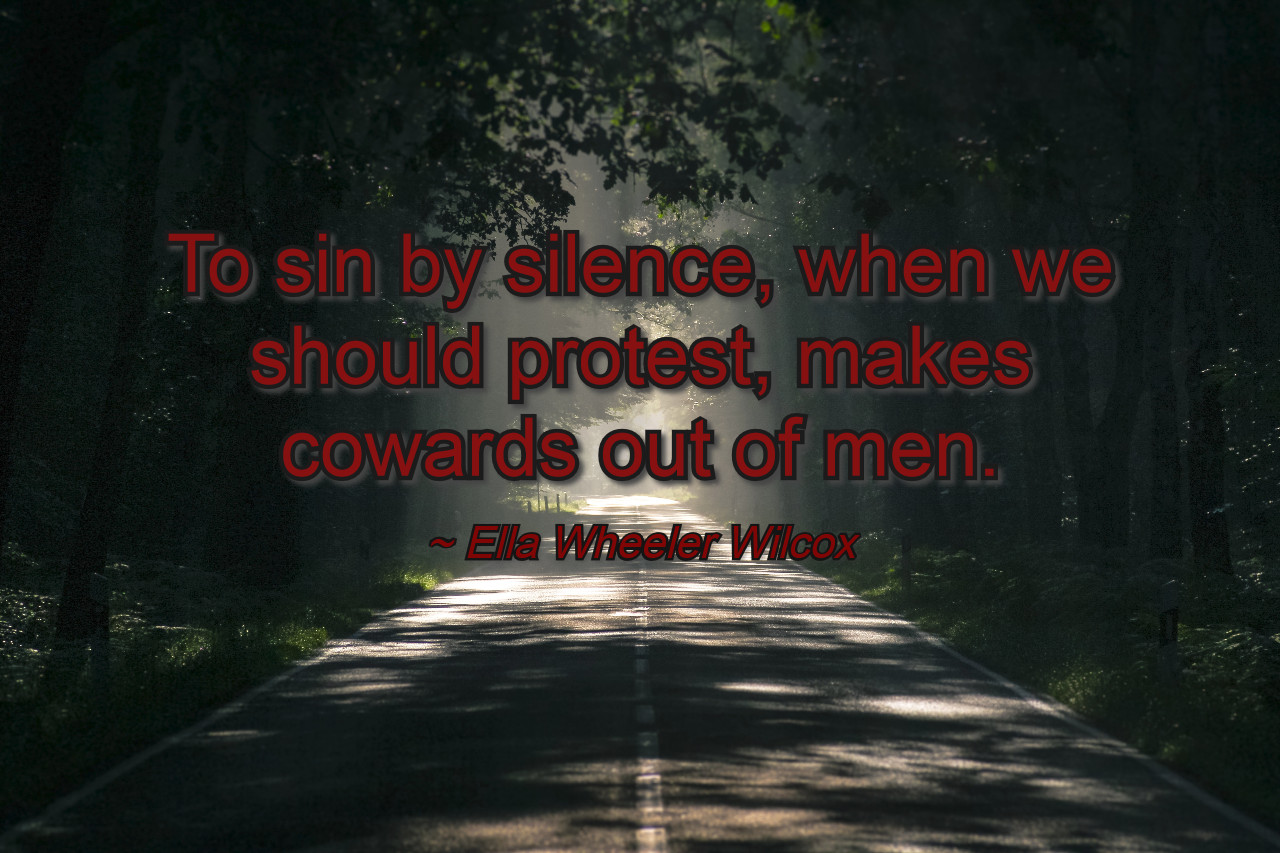 I know I am not the only one that has continued to read and think about the death of George Floyd and the protests that continue to spread around our nation. Just about everyone has had something to say and you cannot spend any time online at all without encountering something related to Floyd’s death and /or the protests. But in the past 24 hours I have been intentionally seeking and reading what African Americans have to say about it all. I have been doing that not because I think they have a monopoly on offense at the actions of Derek Chauvin, because I do not. Nor have I been doing it because I think that African Americans somehow have a more valuable or more relevant perspective or insight on the tragedy of Floyd’s death. I do, however, recognize that many African Americans have a different perspective and different insight into the situation than I do, and considering them has value.
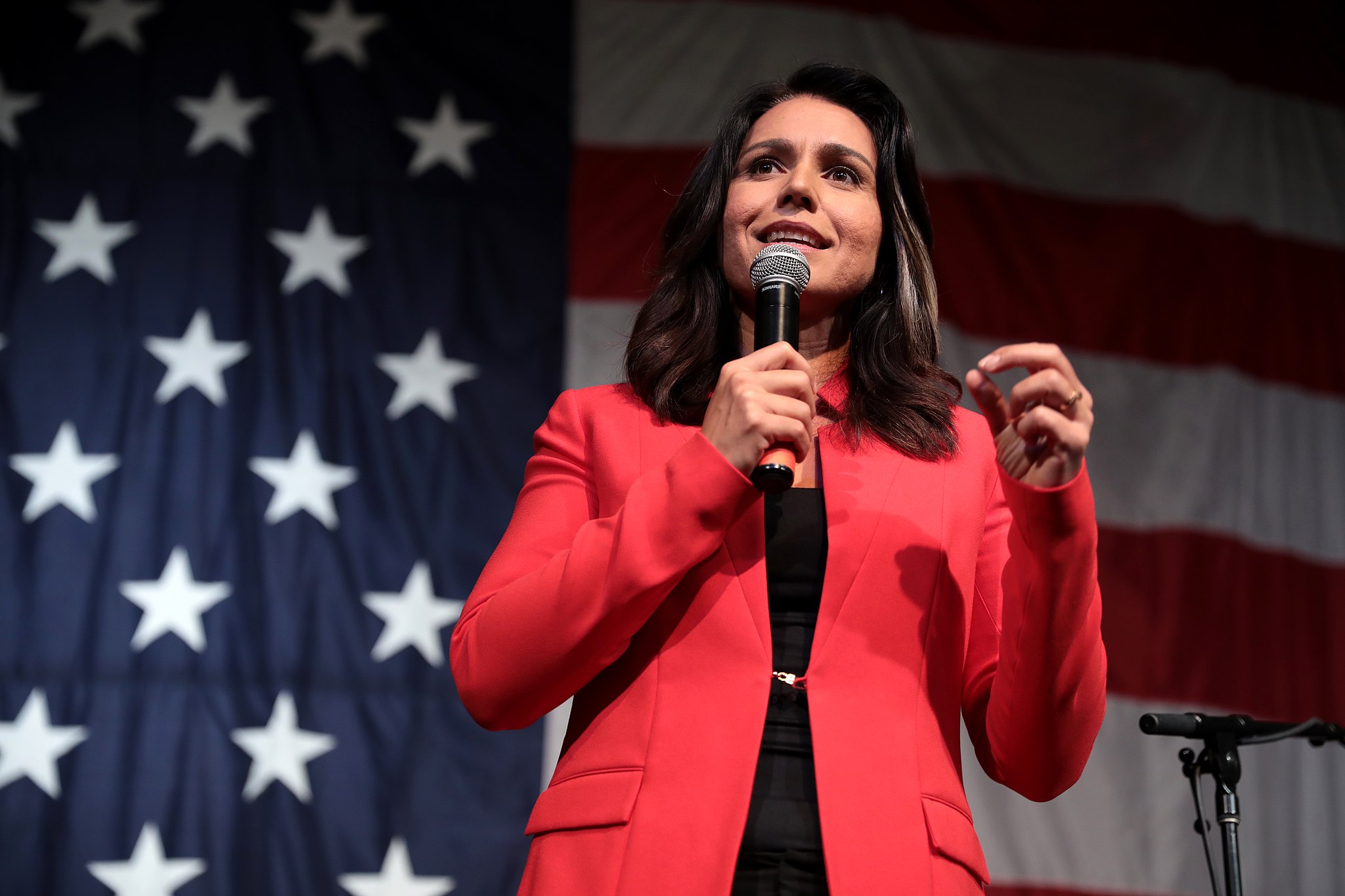 Super Tuesday did not go so well for Michael Bloomberg and today he, too, dropped out. The DNC plan to have Joe Biden win the nomination went quite well yesterday and though Bernie Sanders still won several states and is, for all intents and purposes, tied with Joe Biden in the delegate count right now, the race is not over. There are four candidates remaining, though you would be hard pressed to know that from the limitations one of them is facing. Tulsi Gabbard, congresswoman from Hawaii, has not given up her quest for the Democratic nomination—and frankly, I doubt she will anytime soon.
 THINKING OUT LOUD