What Should We Do With Columbus Day?

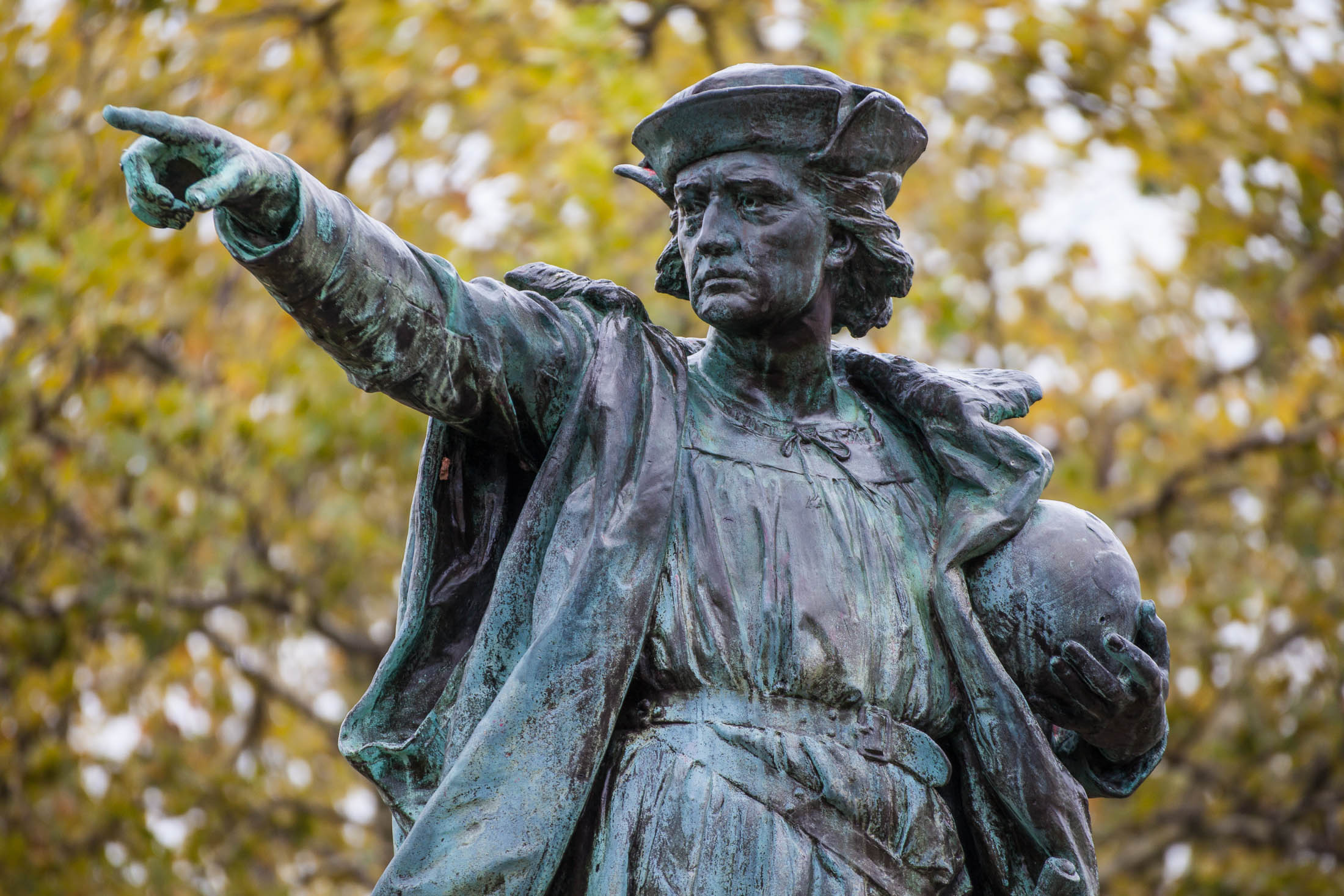
Statue of Christopher Columbus, formerly at the corner of Elmwood Ave and Reservoir Ave in Providence, RI, removed by the city in 2020. This statue is on the National Register of Historic Places.

Today is Columbus Day according to the calendar. It is also Indigenous Peoples’ Day. Two years ago, Robert Reich tweeted, “Today is Indigenous Peoples Day. Please remove Columbus Day from your vocabulary. May this year be the last we even have to make that distinction.” Well, that obviously has not happened. On Friday, President Biden issued a proclamation declaring October 10, 2022, to be Columbus Day—but he also issued a proclamation declaring today to be Indigenous Peoples’ Day, making it only the second time that Indigenous Peoples’ Day has been designated as a national holiday, though it has been recognized as a holiday in South Dakota since 1989.


In the first proclamation he directed “that the flag of the United States be displayed on all public buildings on the appointed day in honor of our diverse history and all who have contributed to shaping this Nation” and in the second he called upon the people to “observe this day with appropriate ceremonies and activities. I also direct that the flag of the United States be displayed on all public buildings on the appointed day in honor of our diverse history and the Indigenous peoples who contribute to shaping this Nation.”

One could certainly argue that both of these celebrations have merit. Of course, it would be quite possible to celebrate them on different days. Tennessee and California, for example, have Native American Day in September. Planning Indigenous Peoples’ Day on the same day as—and it would actually be the preference of many for it to take the place of—Columbus Day, however, is not by mistake. It was at a 1977 UN conference on discrimination that an Indigenous Peoples’ Day was first discussed, and in 1990, at the International Conference on Discrimination Against Indigenous Populations in the Americas, again sponsored by the United Nations, replacing Columbus Day with Indigenous Peoples’ Day was suggested. Columbus Day has been a federal holiday since 1937.

In order to grasp the reasons for possibly replacing Columbus Day with Indigenous Peoples’ Day it is necessary to evaluate the reasons for Columbus Day. By every indication, there are two. The first reason is to celebrate Columbus’s accomplishments, specifically, his “discovery” of the New World vis-à-vis his arrival in what we today know as the Bahamas and Cuba in October of 1492. Columbus never set foot on mainland North America, though, so that creates a bit of argument against the commemoration. Why not celebrate Leif Eriksson Day? After all, he beat Columbus to the New World by some 500 years—and he actually landed on North America. Well, there actually is a Leif Eriksson Day; it is October 9, and was first so proclaimed by President Lyndon Johnson in 1964. Obviously, though, it doesn’t get much attention and I would guess you have never seen it on a calendar.

Again, it was Columbus’s “discovery” that led to European exploration of the western hemisphere, but it was probably Juan Ponce de León who was the first explorer after Columbus to set foot on the North American continent. He landed, in 1513, on the coast of what today is known as Florida; in fact, he named it La Florida. The oldest continuously occupied settlement of European origin in the continental United States is St. Augustine, Florida, founded in 1565 by Spanish admiral Pedro Menéndez de Avilés. The first attempted English settlement in North America was the Roanoke Island colony, founded by Sir Walter Raleigh in 1585. That colony famously disappeared. The first permanent English colony was founded at Jamestown in the early 17th century by the Virginia Company. So why isn’t there a Juan Ponce de León Day? Or a Pedro Menéndez de Avilés Day? A Sir Walter Raleigh Day? A Virginia Company Day? All valid questions. Seemingly they would each have claims at least as good as any that Columbus might make. Columbus, after all, “discovered” the New World by accident. He rightly believed the earth to be round, but he had no idea that North and South America existed and he mistakenly believed that he was in the Indies when we arrived.

The second reason for Columbus Day is to celebrate Italian heritage. Italian immigrants were facing some significant persecution in the U.S. in the early 20th century, so this holiday was seen as a possible way to counter some of that. But that ignores the fact that while Columbus was Italian by birth, having been born in Genoa, he was sailing for Spain when he “discovered” the New World. History.com asserts that when President Franklin D. Roosevelt proclaimed Columbus Day a national holiday, he did so “largely as a result of intense lobbying by the Knights of Columbus, an influential Catholic fraternal organization,” meaning that the celebration was as much for Columbus’s Catholic faith as for his nationality.


Scott Stevens, who serves as the director of the Native American and Indigenous Studies Program at Syracuse University, told USA Today that he sees Indigenous Peoples’ Day “as an opportunity to have more critical discussion about our American history.” I, for one, would find it difficult to argue against having such a discussion. A thorough and accurate understanding of history is important. However, Stevens also said, “To have had American colonialism looked at throughout history as not being a problem and celebrated as a good thing is deeply problematic to any of us who live in a (Native-American) community or reservation.” But that’s a more complicated issue. Looking back with twenty-first century eyes, it is easy to say that colonialism was a problem or was not a good thing. But in the 15th and 16th centuries it was both normal and accepted. It is neither realistic nor appropriate to hold our ancestors to the same standards that we hold today. After all, there would also be plenty of things that Native American peoples did at that time that we would not approve of today, either. And we must not allow ourselves to forget that there was plenty of warfare and conquest among the indigenous people groups already in the Western Hemisphere when Columbus arrived. While it does not excuse the way they were treated by Europeans, the Native American peoples who were already in the Americas were not always peace-loving peoples. An article entitled “Warfare on Pre-Columbian North America” on the website of the Canadian Department of National Defence says,


Despite the myth that Aboriginals lived in happy harmony before the arrival of Europeans, war was central to the way of life of many First Nation cultures. Indeed, war was a persistent reality in all regions though, as Tom Holm has argued, it waxed in intensity, frequency and decisiveness. The causes were complex and often interrelated, springing from both individual and collective motivations and needs.


What’s more, the same article explains that while many have tried to claim that Europeans introduced to Native Americans the practice of scalping, that is not actually the case—though Europeans were by no means above promoting it among the tribes with which they allied themselves.


Some aspects of indigenous warfare shocked the European settlers. For example, the custom of scalping the enemy, which consisted in removing his hair by cutting off his scalp, scandalized many European observers. While some scholars have suggested that the Europeans themselves during first contact introduced this practice, it now appears certain that scalping existed well before colonization.


The article also states that the torture of prisoners was not uncommon among indigenous peoples, nor was the practice of giving captured women and/or young boys to the families of those who had lost a family member in warfare. While “giving” sounds nicer, and this was certainly better than torture or death, this was really just a form of slavery.


So, while I do not say this very often, I agree with what President Biden said last year: “We also acknowledge the painful history of wrongs and atrocities that many European explorers inflicted on tribal nations and Indigenous communities.” We should acknowledge that and teach history realistically. We also, though, must not allow for an inaccurate portrayal that makes it seem like bad things were only perpetrated by the Europeans.


According to Almanac.com, Indigenous Peoples’ Day “honors the histories, cultures, and perspectives of Indigenous peoples and their ancestors who lived on the land now known as North America. They existed in these areas thousands of years before the first European explorers arrived.” I have no problem with that, and I think Indigenous Peoples and their “histories, cultures, and perspectives” should be acknowledged, studied and even celebrated just as should any other culture that is part of what makes America. To be frank, I think Indigenous Peoples’ Day has a stronger claim to celebration than does Columbus Day.


Why? Well, as I have already said, Columbus never even set foot on the continent of North America. But more importantly is the fact that Columbus used his own desire for fame and fortune, and his desire to “convert” the indigenous peoples to Catholicism, as an excuse for horrific treatment of them. David Barton’s WallBuilders organization claims, in a post entitled “Celebrate Columbus Day!” that “It is especially because of Columbus’ religious motivations and convictions that today he has become a villain for most modern educators and writers, who regularly attack and condemn him.” I disagree with that completely. It is because of his enslavement of the indigenous peoples that Columbus is regularly attacked and condemned—and his motive for that enslavement is of little consequence. But if it was, I would be the first in line to say that Columbus’s methods of “converting” the indigenous peoples to Catholicism was no better than the tactics currently utilized by the Taliban and other similar groups. “Convert or die” can never be celebrated.


On another page of its website, entitled “Discovering Columbus,” WallBuilders has created what it calls “the port of departure for people who want to explore past and find the truth about Columbus.” One of the “modern lies” the page identifies is that Columbus sought gold so that he could get rich. The truth, WallBuilders claims, is that Columbus sought gold both for evangelism and to lead a crusade to retake Jerusalem from the Muslims—that Columbus “put God over gold.” That’s quite a stretch. While it is true that Columbus pointed to a desire to convert those in the Far East to Catholicism as one of his motives, one could argue just as easily, if not more easily, that he did so through an effort to get Ferdinand and Isabella to pay for his voyage and/or to increase his own standing in the Catholic church than through any pure motivation related to the souls of those unconverted peoples. After all, Columbus had some serious demands for Ferdinand and Isabella, as well, demands designed to ensure both wealth and titles for himself and his descendants. In his 1494 letter to Ferdinand and Isabella, Columbus did suggest that a portion of all gold found on the “Island of Espanola” should “be set aside for building churches and adorning the same, and for the support of the priests or friars belonging to them.” How much? A whopping one percent. Depending on the agreement you look at, Columbus expected to receive anywhere from one-tenth to one-eighth of all of the gold for himself. In his book Columbus: The Four Voyages, Laurence Bergreen describes the tribute system that Columbus and his brothers established that required “every Indian over the age of fourteen” to pay “the equivalent of a hawk’s bell filled with gold” and had to do so “on pain of death.” Since the area was not rich in gold, what was there was soon depleted, and the result was that the tribute system “obliterated any chance that the Indians would assist or cooperate with the Spanish in any other endeavor besides the pointless tributes of gold.” Even when Guarionex, one of the chiefs of the indigenous people, “argues that the land used to provide a minimal amount of gold could grow enough wheat to feed all of Spain, not just once, but ten times…Columbus refused to consider the idea.”


On Kenneth Copeland’s “Believers Voice of Victory” program in 2020, David Barton delivered a lecture entitled “The Truth About Christopher Columbus.” You can find it on YouTube if you want to watch it but I can give you the short version: Barton does what he always does, which is handpick quotes, anecdotes and sources, talk really fast and present himself as the bastion of truth in order to make the audience believe that anyone who disagrees with him is a fool. He cites Washington Irving’s multivolume A History of the Life and Voyages of Christopher Columbus as a definitive source for the truth about Columbus. The problem with that is simple—it is a work almost universally recognized as part truth and part fiction, or at best creative license. Many consider it to be more of a historical novel than any kind of accurate history. In 1956, William Hedges, who spent much of his career as an English professor and, and eventually as the chair of American studies, at Goucher College, wrote an article published in The America’s entitled “Irving’s Columbus: The Problem of Romantic Biography.” He kindly notes that Irving’s work is “not so much falsification as the reflection of a certain point of view,” ending his article with this statement: “One is thus at least consistent in calling Irving’s Columbus a history which finally manages to transform itself into fiction.” Thus, with respect to Mr. Barton, not a source upon which we should be depending for our understanding of Christopher Columbus.


So, what should we do with Columbus Day? I do not personally see any need to observe it. Columbus never set foot on what is today the United States and to use him as the symbol of the influence of Italians on American culture seems a stretch at best. I think there are many other individuals with Italian ancestry who would be better candidates. As a historical figure, he was certainly influential, but his “discovery” of the New World was an accident; how much credit should he get for that? It seems that the negative outweighs the positive when it comes to Columbus, even when setting presentism aside. Columbus should surely be studied in history classes, but I don’t think he needs a national holiday. I am not advocating that all of the many statues of Columbus need to be torn down or all of the cities named after him need new monikers; I just don’t think he needs a federal holiday. Bartolomé de las Casas would seem a better candidate, really. Indigenous Peoples’ Day has a stronger case for a holiday than Columbus, but I think Native American Heritage Month (which is in November) is sufficient in that regard. Maybe on the second Monday in October we should all just go to work and school.

Photo credit: Wikimedia Commons
A Booze-Soaked View of the World

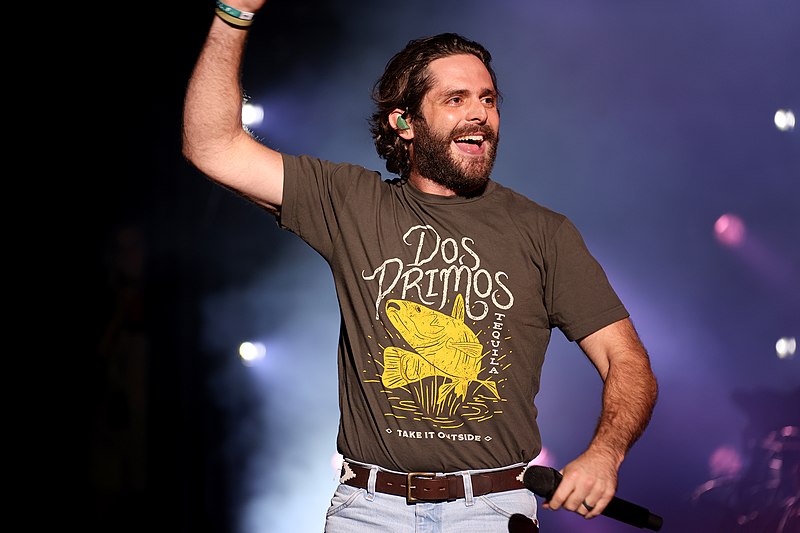
Thomas Rhett at Merriweather in 2021

Yesterday someone mentioned to me that a relative had been unable to get a hotel room in Sioux Falls, South Dakota, on Saturday night because “some country singer was in town.” Who was the singer, I wondered? Turns out it was Thomas Rhett. But I had never heard of Thomas Rhett, so I was curious. After all, the venue at which he appeared can  accommodate 12,000 people for a concert, so who is this guy?

Well, his full name is Thomas Rhett Akins Jr., he is the son of country singer Rhett Akins and he has released six records. (I guess by now you can tell I don’t pay much attention to country music). But I wanted to know more. Why would every hotel room in the city that is home to slightly more than one-fifth of South Dakota’s entire population be booked for this concert?

Beyond the fact that he is obviously a popular act on the country circuit I don’t think I have found the answer to that question. But I have found out enough about Rhett’s music to know that it is disappointing that he is so popular.

What do I mean by that?

That his current tour is titled the “Bring the Bar to You Tour” was my first clue that alcohol is clearly an important part of his persona. His website includes a link to the site for Dos Primos Tequila (which you actually have to enter your birthdate to access), a tequila that Rhett and his cousin “dreamed up” in order “to create a tequila that blended Mexican tradition with southern sensibility.” VIP tickets for Rhett’s current tour include “dedicated cash bar service throughout the show” when the concert is in an arena, one drink ticket and a tasting experience of Dos Primos Tequila where permitted.

Skimming through the lyrics of Rhett’s songs makes it clear that both alcohol and sex play a prominent role in his writing. When I googled Thomas Rhett, I was helpfully provided with a link to a list of his top 20 songs on the website Taste of Country. Here’s what I found:

  • Number 1 is “Die a Happy Man,” which references how happy “last night” made him, between the bottle of wine, the look in her eyes and dancing in the rain. The second stanza says, “that that red dress brings me to my knees/ Oh, but that black dress makes it hard to breathe” before calling her “a saint, you’re a goddess, the cutest, the hottest, a masterpiece.” The good news is, Rhett (along with some help) wrote this song for, and about, his wife.
  • Number 2 is “Life Changes” which is a song about changes Rhett has experienced in life, including becoming a successful singer, getting married, adopting a child and then his wife getting pregnant. Nice enough song and nothing at all objectionable. With a few exceptions, that’s about where the good news ends, sadly.
  • Number 3 is “Marry Me,” which starts out okay—saying “she” wants to get married, she wants her grandfather to do the service and she wants to keep it small so as to save her father some money. But then we find out that the guy singing the song is not the guy she wants to marry, so he will have to take “a strong shot of whiskey straight out the flask” in order to get through the wedding. This could be an okay song—yet another song about the guy who misses out on the love of his life, songs that can be found in numerous genres. But the line about whiskey, and the implication that liquor can help someone get through life’s hard times is a sign of a recurring theme in Rhett’s songs.
  • Number 4 is “Death Row.” Could have been good. Includes the lines, “How Jesus is the ticket/And narrow is the road/About how all we need’s forgiveness/’Fore we see them streets of gold.” Near the end, the song says, “I can’t say that he’s in Heaven, who am I to judge his soul?/But Jesus don’t play favorites, ain’t a name that He don’t know.” It is true that Jesus doesn’t “play favorites” and someone on death row could go to heaven—but it would have been nice if the conclusion had made clear that doing so depends on that needed forgiveness.
  • Number 6 is “Unforgettable.” There are other songs by that title and there are other songs with the same storyline as this one—a memorable first meeting with a beautiful girl. The problem is, the guy in this one who is remembering that meeting says, “I was drunk, said I was sober.”
  • Number 7 is “Look What God Gave Her,” a song that one could quibble about in parts but that is mostly about seeing a beautiful woman.
  • Number 8 is “T-shirt.” Somehow, remarkably, it doesn’t mention alcohol, but it is a song about making out. Heavily. With very little left to the imagination.
  • Number 9 is called “Beer with Jesus.” The idea behind the song has merit—imagine being able to have a conversation with Jesus, hanging out with Him one on one, asking things like how to turn the other cheek and what happens when earthly life comes to an end. The problem is, this song has all of that taking place over a few rounds of beers.
  • Number 10, “Star of the Show,” is an ode to Rhett’s wife and is basically a song about how good looking she is, no matter where or when or in what. Fairly typical country fare, but it does still manage to include a reference to ordering a drink.
  • “Ya Heard,” which is Number 11, is a song about all of the prayers Rhett has seen answered—being married to his wife, having a successful singing career, having children. The only real issue I have with this song is that it clearly implies that we know God hears our prayers when we get what we prayed for, and that is certainly not accurate.
  • Number 12 is “Be a Light.” This is an inspirational song that encourages listeners to make difference in the world. This is a good song that could, with a more clearly stated message be a great song. What is it missing? The reason for being a light—and the source of the ability to do it.
  • Rhett’s Number 13 song is a duet with his father entitled “Drink a Little Beer.” The title is pretty self-explanatory; the song is all about unwinding and having a good time with friends while drinking. The lyrics include “a Yeti full of iced-down booze” and “a jar full of lightning juice.” To be honest, I am not certain what “lightning juice” is, but I feel certain it is alcoholic. The moral of the song? The recipe for fun is beer, music and girls.
  • “To the Guys That Date My Girls” is the Number 14 song. It is a quintessential tale of a dad threatening the guy who shows up to date his daughter. Interestingly enough the song includes a warning about the need for the guy to mind his manners around the mom but makes no real reference to minding manners around the daughter. The only real instruction, other than showing up early and getting home on time, comes immediately after a tacit acknowledgement that sex is on the guy’s mind, and says “But when you pull her close/just save some room for Jesus/’Cause if you ever cross that line/I swear, boy, you’re gonna need him.” Here’s hoping that most fathers give a bit more meaningful instruction.
  • Number 15 is “It Goes Like This.” Fairly typical country song about a boy meeting a girl, and there is no mention of booze, but the song clearly implies that the very first meeting goes well beyond a hello and a conversation.
  • “Craving You,” at Number 16, is a duet with Maren Morris, another singer I’ve never heard of before. The song itself is about the undeniable allure a girl can have on a guy. But there are some problems. First, the lyrics compare the effect to that of a cigarette or 100 proof liquor. The song also says, “Well, girl, my self control’s so paralyzed/When it comes to you, no, I ain’t got no patience.” It does not require any creativity to realize the danger in lyrics that embrace the idea that a guy can lose his self-control and his patience because he wants a girl so badly.
  • Number 17 is “Things Dads Do” and this could have been a wonderful song about the things that fathers do, and why, while raising their sons. And maybe this is the kind of dad that Rhett had and/or the kind of dad that he wants to be, but he includes some characteristics I think we could gladly do without. For example, the song says that when the son has his first heartbreak, his father will suggest talking it out over a beer. Two problems. One, as I have already mentioned, is the continuous suggestion that we need alcohol to help us cope with the pains and struggles life brings our way. Two, I think every guy I have ever known has experienced their first heartbreak before they were 21, making a discussion over a beer not just a bad idea but against the law. When the son does get married, though, dad will pay for the booze, the song says. Later, when he comes to visit, he’ll ask why your refrigerator has “weird beer” in it. And when he is sitting in the waiting room of the hospital awaiting the arrival of his grandchild, dad will be “chewin’ Red Man.” Here’s hoping these are not the things most dads do.
  • “Remember You Young” is Number 18. This, too, could have been a sweet song about the reminiscences that we all have about friends, spouse and children when they were younger. But this song, too, has two glaring problems. First, references to drinking and partying in younger years (I know, no surprise). Two, near the end, the song says, “Yeah, I hope when we get to Heaven/He looks at us all like we’re kids/Shameless and painless and perfect and ageless/Forgives all the wrong that we did.” One should never assume we will all get to Heaven—especially when one follows it by hoping that God will look at us as shameless and forgive us of “all the wrong that we did.” There is indeed a way that that can happen, but it takes admitting ones sins and accepting Jesus as Savior, not hoping God just decides to forget about all of our wrongdoing and let us into Heaven.
  • At Number 19 is “Church Boots,” which is basically a celebration of being the same guy all the time no matter where he is or how much money he makes. The problem is this: the song proudly proclaims that his church boots are his work boots and his partying boots and he doesn’t think “the good Lord minds.” I am sure He doesn’t. But I suspect He does mind this: “Go straight from the farm to the bar to the back row pew.” God isn’t concerned with someone wearing dirty boots to church. He is, however, concerned with someone who makes going to church just one more thing they do—and a think that has no impact on how they live their lives the rest of the week.
  • “Us Someday,” at Number 20, is harmless and even a fine little country song. It’s too bad, though, that as he sings about what their future would hold Rhett includes kids running around the backyard, family round trips and Little League games—but not church.

It wasn’t in this Top 20 list, bur Rhett also has a song entitled “Beer Can’t Fix,” the point of which is that no matter what you may be going through, it “ain’t nothin’ that a beer can’t fix.”

So… Could it be worse? Definitely. At least there is no profanity or explicit sex as is so prevalent in some other popular music these days. But it could also be better. I am well aware that country music has long included references to alcohol; Garth Brooks’s “Two Pina Coladas” and “Friends in Low Places” come immediately to mind (and also clue you in to the timeframe of when I paid any attention to country music). But for someone to be so popular that he packs out an arena that holds 12,000 people should prompt us to wonder why. What is he singing? What worldview is he promoting? What way of life is he celebrating? Do we really want the awards for Male Artist of the Year and Entertainer of the Year and so on to go to someone who is promoting such pro-alcohol messages? The fact that he seems to be a loving husband and father and he throws Jesus into some of his songs actually serves to make the impact of his songs that much more threatening. If you’re a Thomas Rhett fan, that’s your choice, of course—but in the words of the old children’s song, “be careful little ears what you hear.”

Photo source: Wikimedia Commons

Values We Hold Dear

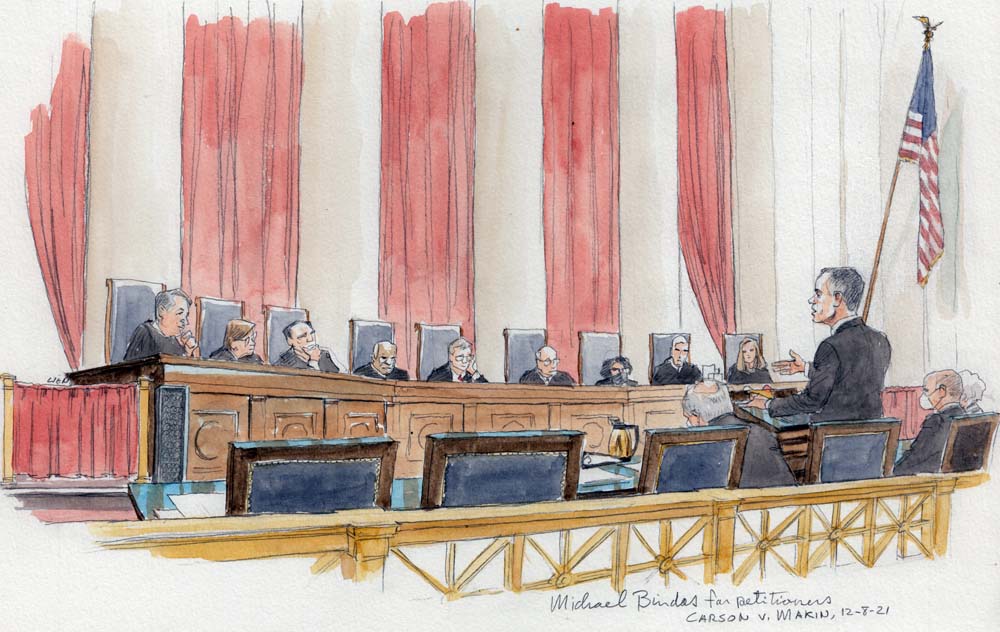
Michael Bindas at lectern arguing for petitioners

The Supreme Court’s decision in Dobbs v. Jackson Women’s Health Organization has, rightly, been getting most of the attention recently, but there have been other significant decisions by the Court recently, too. On June 21 the ruling was issued in the case of Carson v. Makin. The case stems from a provision in Maine that allows families who live in school districts that do not have a public secondary school and do not contract with one in another district to choose where their children will attend secondary school and the state will pay some of the tuition for those students. The payments are made by the state directly to those schools. There are some restrictions; namely, the schools must be accredited by the New England Association of Schools and Colleges (NEASC) or be approved by the Maine Department of Education. But since 1981, Maine has limited the use of the funds to attendance at non-sectarian schools.

On June 21, the Supreme Court struck down that restriction. And rightly so. But to see why I say “rightly so” it is important to understand some specific details.

On the day the decision was released, Maine’s Attorney General, Aaron Frey, issued a statement lamenting the ruling. In the process, however, he revealed both why it was the correct decision legally and why public education is increasingly dangerous.

Frey’s statement indicates that about 5,000 students in Maine live in areas without secondary schools, thus making them eligible for the program. “To ensure that these children have access to a free public education, they are permitted to attend at public expense a public or private school of their choice,” Frey said, continuing, “Public funds cannot be used to attend a private school that promotes religion because such schools, by definition, do not provide the equivalent of a public education.”

Notice that Frey said that eligible students could attend the public or private school of their choice—but then attempted to restrict that choice (which Maine has been doing for more than 40 years). In other words, parents could send their children to the school of their choice as long as the state approves of the choice. Is state-sanctioned choice really a choice? It is, but definitely a limited one.

Notice, as well, that Frey said that private schools that promote religion (that is what a sectarian school is) were not eligible for the program because those schools “by definition, do not provide the equivalent of a public education” (emphasis added).

The most easily addressed issue here is the use of state funds for attendance at a sectarian school. Writing in a dissent, Justice Stephen Breyer, citing a 1948 case, said “that a State cannot use ‘its public school system to aid any or all religious faiths or sects in the dissemination of their doctrines and ideals.’” Well, with all due respect to Justice Breyer, Maine is not using its public school system to aid any religious faith. Precisely because it does not have a public school system adequate to meet the needs of all Maine students, the state is allowing parents to choose where their students will attend school with the state paying part of the cost—since the state is required to provide students with an education.

Breyer further states that the Court has previously held that states may use public funds for the funding of religious schools so long as they choice of school was the “deliberate choice” of the recipient (the parents). He then stated this:

But the key word is “may.” We have never previously held what the Court holds today, namely, that a State must (not may) use state funds to pay for religious education as part of a tuition program designed to ensure the provision of free statewide public school education.

But Breyer is way off here. If Maine’s provision said that parents could choose any public school then this would not be an issue. Frey stated, “the purpose of the tuition program was to provide a public education for students who would otherwise be without.” But if that was the real purpose of the program, then it was written horribly. By definition, attendance at any private school is not public education. And since the program allows the choice of private schools, it cannot then restrict which private schools can be chosen. That is clearly discriminatory, as Chief Justice Roberts notes in the majority opinion. He wrote,

…there is nothing neutral about Maine’s program. The State pays tuition for certain students at private schools— so long as the schools are not religious. That is discrimination against religion. A State’s antiestablishment interest does not justify enactments that exclude some members of the community from an otherwise generally available public benefit because of their religious exercise.

I could cite more cases and reference more of the majority and dissenting opinions, but this is sufficient to demonstrate why the Court made the correct decision legally. The deeper concern, in my opinion, is the clear demonstration provided in Breyer’s dissent and Frey’s statement about the anything-but-neutral instruction being provided in public schools. Consider Frey’s words:

Public education should expose children to a variety of viewpoints, promote tolerance and understanding, and prepare children for life in a diverse society. The education provided by the schools at issue here is inimical to a public education. They promote a single religion to the exclusion of all others, refuse to admit gay and transgender children, and openly discriminate in hiring teachers and staff. One school teaches children that the husband is to be the leader of the household. While parents have the right to send their children to such schools, it is disturbing that the Supreme Court found that parents also have the right to force the public to pay for an education that is fundamentally at odds with values we hold dear. I intend to explore with Governor Mills’ administration and members of the Legislature statutory amendments to address the Court’s decision and ensure that public money is not used to promote discrimination, intolerance, and bigotry.

In case you’re not sure, inimical means to obstruct or harm; unfriendly or hostile. In other words, because sectarian schools teach things that are not neutral, they are not consistent with a public education. To an extent I could agree with that. That is, after all, why sectarian schools exist—so that they can state clearly their positions, their beliefs and their convictions when it comes to issues like religion, marriage, sex, gender identity, family and more. So that they can employ faculty and staff who are likeminded when it comes to those issues. But to a larger extent, Frey reveals in no uncertain terms that public education also has a position and, dare I say it, convictions on these issues—and they happen to be contrary to those of many sectarian schools.

It does not require reading between the lines or inferring anything to grasp what Frey is saying; he comes right out and says it. Teaching that the husband is to be the leader of the household is inimical to a public education. Teaching anything other than acceptance and approval of homosexuality and transgender identities is discriminatory, intolerant and bigoted. Breyer wrote in his dissent, “Maine denies tuition money to schools not because of their religious affiliation, but because they will use state funds to promote religious views.” That’s a pitiful attempt to split a fine hair; what Breyer is really saying is that if there was a religious school that taught exactly what the public schools teach, it wouldn’t be a problem. The problem is what is being taught. The problem, in other words, is that the religious schools actually have a “religion” that means something and has real-life application. “The very point of the Establishment Clause is to prevent the government from sponsoring religious activity itself, thereby favoring one religion over another or favoring religion over nonreligion,” Breyer continued. But again, he undercuts his own argument. What he is saying he really wants is not fairness or equality but to favor nonreligion over religion. Prior to this decision, Maine would fund attendance at a sectarian school as long as the school did not promote the faith or belief system with which it is associated or deliver academic instruction through the lens of that faith. So, as long as it wasn’t really a sectarian school.

Breyer specifically included in his dissent that one of the schools in question has as an educational objective “develop[ing] within each student a Christian world view and Christian philosophy of life.” The other school “is based on a thoroughly Christian and Biblical world view.” These things, apparently, cannot be because they are not consistent with a public education. A public education has to be neutral right?

Oh, wait.

No, Frey said that a public education “should…promote tolerance and understanding” and apparently that means not teaching that parents should be heterosexual and married or that homosexuality is a sin or that God created men and women and that gender is not a multiple choice question. Teaching those things will “promote discrimination, intolerance, and bigotry.” Such belief and teaching “is fundamentally at odds with values we hold dear,” Frey said.

Hmmm… Who is being intolerant now?

In fact, remember that full sentence. Frey said, “it is disturbing that the Supreme Court found that parents also have the right to force the public to pay for an education that is fundamentally at odds with values we hold dear.”

Funny, it seems to me there have been a lot of parents saying that for a long time—how disturbing it is that public funds are used to pay for so-called education that is fundamentally at odds with the values they hold dear.

The Supreme Court made the right decision; the legal reasoning of the majority is sound. But if other attorneys general and state boards of education feel at all like Aaron Frey, parents who really have values they hold dear will want to strongly consider abandoning public schools.

A “Sickening” Overreaction

I did not watch the Oscars, but I do not live in a cave, either, so I know about Will Smith slapping Chris Rock. I do not condone Smith’s actions. Oscar hosts and presenters have always been expected to taunt, tease and, sometimes, humiliate, those in attendance. Whether you think that is right or wrong, that’s the way it has been…and what Rock said about Jada Pinkett-Smith was quite mild compared to what I have heard from some hosts and presenters in the past.

I have heard some people suggest that the reason behind Pinkett-Smith’s shaved head might be a factor in Smith’s response, but that doesn’t seem to hold much weight. She shaved her head last July after encouragement from her daughter to do so. She apparently acknowledged several years ago that she had struggled with hair loss issues and the tests to try to determine the reason revealed no medical issues. Relieved by that, Pinkett-Smith said that she “put it into a spiritual perspective, like the higher power takes so much from people,” like cancer, for example, and she was grateful that she was only losing her hair.

I realize that it is more common and probably less attention-getting for men to lose their hair than women, and I am not going to suggest, as someone who began losing his hair before he even graduated from college and has been “bald” for many years now, that I can empathize with what Pinkett-Smith went through in dealing with hair loss. But, whether appropriate or not, a bald head does tend to attract some wisecracks. For Rock to make a passing reference to G. I. Jane 2 in regard to Pinkett-Smith is pretty tame.

In 2013, Seth MacFarlane uttered what may be the worst attempted joke in Oscar history, saying, “The actor who really got inside Lincoln’s head was John Wilkes Booth.” The crowd wasn’t amused, and MacFarlane tried to blow it off. Of course, neither Lincoln nor his wife was present. A close second came in 1955, when Bob Hope said, “The winners will take home an Oscar. The losers will all be presented with monogrammed do-it-yourself suicide kits.” In 2010 Steve Martin asked, inexplicably, of Meryl Streep, “What’s with all the Hitler memorabilia?” In 2014, Ellen DeGeneres called Liza Minelli, who was in the audience, a Liza Minelli impersonator and then added, “Good job, sir.” Chris Rock himself has said worse—see 2005’s crack about Jude Law and his 2016 introduction of Stacey Dash as examples.

Referring to director Alejandro González Iñárritu, a citizen of Mexico, Sean Penn said, in 2015, “Who gave this son of a [expletive] his green card?” Yikes. But Iñárritu said later that he thought it was “hilarious” and that he and Penn had that kind of a relationship, a “brutal relationship” that included some “very tough jokes.” Maybe Rock and Smith don’t have that kind of relationship. Maybe Will Smith really just was not okay with someone making fun of his wife. I don’t know.

If the outrage over Smith’s slap of Rock results in less mockery, that may well be a good thing. Despite Smith’s action being wrong, though, and condemnation of him slapping Rock being appropriate, other parts of the response to it by some has been simply outlandish. Wanda Sykes, who co-hosted the Oscars, called it “sickening,” said she felt “physically ill” and three days later said she was still “traumatized” by it. Sykes also complained that no one had apologized to her as the co-host. Sorry, Ms. Sykes, but I don’t think you are the one deserving an apology.

Another of the co-hosts was Amy Schumer, who took to Instagram two days after the event to declare that she was “still triggered and traumatized” and “waiting for this sickening feeling to go away from what we all witnessed.”

Let’s put this in a bit of perspective, shall we. Last fall, Schumer marched in the Rally for Abortion Justice in Washington, D.C. At that time, Schumer posted on Instagram a photo of herself holding a sign proclaiming “Abortion is Essential.” She has also posted on Instagram, “Everyone deserves to have a safe and supported abortion, at any time and for any reason.”

Back in 2006, in response to President George W. Bush’s Supreme Court nominations, Sykes said in a comedy special, “I got two abortions on the way here. I was, like, ‘I got to stock up.’” She said essentially the same thing in her book Yeah, I Said It, writing, “Women and our right to choose were going to be challenged with Ashcroft around. When Bush appointed Ashcroft, I went out and got me four abortions. I stocked up. The doctor was like, ‘Listen, you’re not pregnant.’ I said, ‘Hey, just shut up and do your job. I’m exercising my right while I can, dammit.’”

As I have already said, Will Smith was in the wrong. But when you joke about the murder of unborn children, you have no standing to claim that you are sickened and traumatized by an adult male slapping another adult male for making fun of his wife. Doing so would seem to put Schumer and Sykes in the running for a Best Overreaction award. I would like to ask Amy Schumer and Wanda Sykes to do a little research into what abortion entails, especially a late-term abortion, since Schumer thinks “everyone” should have the right to an abortion “at any time.” Perhaps then they can get back to us on what is really sickening and traumatizing.

Writing New Rules

On December 1, a bill, Bill C-4, unanimously passed the Canadian House of Commons. On December 7, it passed the Senate and on December 8 it received Royal Assent. On January 8, it took effect.

Bill C-4 is titled, “An Act to Amend the Criminal Code” and it specifically addresses conversion therapy.

Now, in order to be as generous as possible, I am going to give you the definition of “conversion therapy” provided by GLAAD, the organization founded in 1985 as the Gay & Lesbian Alliance Against Defamation. Their definition is, “Conversion therapy is any attempt to change a person’s sexual orientation, gender identity, or gender expression.”

The key words in that definition, and that lead to the problem I am now addressing, is “any attempt.” I will explain in a moment why that is so problematic.

First, however, I want to make it explicitly clear that I do not support anyone being forced to go through any kind of treatment against their will. You have quite possibly heard some horror stories about such so-called therapy and I do not in any way support such activity…nor do I believe that the Bible does so. There is no denying that some people have suffered considerable harm—emotional and in some cases maybe even physical—under someone’s guise of curing them of homosexuality. I condemn that and I believe that Christians have a responsibility to care for such victims if given the opportunity to do so. But conversion therapy can include much more than that—which is why the words “any attempt” are important. And while there may well be many legislators in Canada who were well-intentioned and want only to protect people against coercive so-called therapy, the Canadian legislation certainly includes more than that.

Why is this Canadian legislation such a big deal that I am talking about it—especially since I do not live in Canada?

One, because the U.S. has shown a tendency to follow in Canada’s footsteps in many areas of law. Canada, for example, legalized same-sex marriage ten years before the U.S. did. In 2018, cannabis became legal in all provinces and territories of Canada. Where are we headed?

Two, and more importantly, is that this is a big deal. It is serious. It is more than it initially meets the eye.

Part of why I say that is explained in this quote from CTV News, a Canadian news outlet. It says of C-4, “It includes wider-reaching vocabulary of what constitutes conversion therapy than what the federal government attempted to pass in the last Parliament, and expands beyond the past proposal which focused on outlawing the use of the practice against children and non-consenting adults.”

The article later says that conversion therapy “can take various forms, including counselling….”

The bill makes it a criminal offense to even promote conversion therapy—including counseling.

More than that, however, the bill includes specifically religious terms and attacks.

The preamble to the bill states that conversion therapy “causes harm to the persons who are subjected to it” and “causes harm to society.”

How?

“[B]ecause…it is based on and propagates myths and stereotypes about sexual orientation, gender identity and gender expression, including the myth that heterosexuality…and gender expression that conforms to the sex assigned to a person at birth are to be preferred over other sexual orientations, gender identities and gender expressions.”

I don’t know if you are grasping the significance of that, but a bill, that has now passed the Parliament in Canada, received the approval of the queen, and been enacted into law, says that what the Bible teaches about sexuality and gender is a myth.

Right now, if you are in Canada and you believe what the Bible teaches about sexuality and gender, then, according to Canadian law, you and your belief are wrong. They are nothing more than myths.

So much for freedom of religion. And Canada does, by the way, have freedom of religion. Or at least it did. I am not going to go into the structure of the Canadian constitution, but a significant part of it is the Constitution Act of 1982, which includes the Canadian Charter of Rights and Freedoms, and that states, in Section 2, that everyone has the following fundamental freedoms: freedom of conscience and religion; freedom of thought, belief, opinion and expression, including freedom of the press and other media of communication….

And yet, the law now says that if you think, believe or are of the opinion that heterosexuality is right and homosexuality is not, or bisexuality is not, or that someone’s biological sex should coincide with their gender identity, that you are wrong. And not only are you wrong, but if you express that to anyone else in any form that could be considered therapy—despite the freedoms of expression press and other communication—you are breaking the law!

Later, the bill states that “[e]veryone who knowingly causes another person to undergo conversion therapy — including by providing conversion therapy to that other person — is (a) guilty of an indictable offence and liable to imprisonment for a term of not more than five years.”

The information released by the Canadian Department of Justice about this law, and posted on the official website of the Canadian government, links to a policy statement from the Canadian Psychological Association, which says that conversion therapy includes “prayer or religious rites” and “individual or group counselling.”

A Department of Justice news release says that conversion therapy is discriminatory and proven to be harmful even for adults who consented to it.

And the government’s explanation of the changes to the criminal code says that “These proposed new offences would not criminalize interventions that assist a person in exploring or developing their personal identity, provided that they are not based on the assumption that a particular sexual orientation, gender identity or gender expression is preferable to others.”

So bottom line, what does all of this mean? If you are a pastor or a Christian counselor, and you believe that what the Bible teaches about sexuality and gender is correct, and you allow that to influence your counseling or your prayer with someone—even someone who has consented to counseling and therapy with you—you are breaking the law.

Now, that’s a lot of background. I realize that. But it was necessary because it, I hope, makes clear exactly how serious this matter is. If we sit idly by and bury our heads in the sand and think this is not a big deal we are going to find, very soon, that this is happening here. In fact, I dare say we would find that it would not be very long before what I am saying here would be illegal if I were saying it from a church pulpit or in a counseling session.

That is troubling. I am not, after all, looking to go to prison. Far more dangerous than the possibility of going to prison, however, is the possibility that any pastor, any church or any Christian might shy away from standing firm on biblical truth in the face of such a possibility. We must never allow the fear of persecution—and certainly not the fear of prosecution—to deter us from believing and proclaiming God’s Truth. Should that time ever come, we must, like Peter before the Jerusalem council in Acts 5, says, “We must obey God rather than men.”

That sex is intended for marriage and that marriage is intended to be between a man and a woman and that whether or not someone is a man or a woman is determined by their anatomy and their biology, not by their whims or their feelings…none of that is a myth. All of that is God’s design.

The Bible makes no distinction between biological sex and gender.

Genesis 1:27 – “So God created man in his own image, in the image of God he created him; male and female he created them.”

Genesis 5:2 – “Male and female he created them, and he blessed them and named them Manwhen they were created.”

Mark 10:2-9 – And Pharisees came up and in order to test him asked, “Is it lawful for a man to divorce his wife?” He answered them, “What did Moses command you?” They said, “Moses allowed a man to write a certificate of divorce and to send her away.” And Jesus said to them, “Because of your hardness of heart he wrote you this commandment. But from the beginning of creation, ‘God made them male and female.’ ‘Therefore a man shall leave his father and mother and hold fast to his wife, and the two shall become one flesh.’ So they are no longer two but one flesh. What therefore God has joined together, let not man separate.”

Now, maybe I am missing something, but it seems to me that those three passages make it crystal clear that God created male and female. He did not create entities who could then decide. God, in His sovereignty, by His design, created two sexes. Two genders. Male. Female. If you are a male, you are not a female. If you are a female, you are not a male. You do not get to pick which one you will be—it is not multiple choice. You do not get to change which one you are.

And regardless of how anyone feels, it is a scientific fact that there are genetic differences between males and females. Their bodies are made differently—by design. Neither is better than the other, they are just different.

We see this clearly in sports, when the issue of biological males identifying as women and competing in women’s sports is revealing just how different they are. It has been in the news quite a bit recently with the transgendered swimmer at the University of Pennsylvania. That swimmer, who competed for three years on the UPenn men’s team and, after undergoing hormone therapy is now competing as a woman, has obliterated college records this year. This year, that swimmer has the fastest time by any “female” college swimmer, including a time 0.64 seconds faster than Olympian Torri Huske in the 200m freestyle and a time nearly three seconds faster than Olympian Brooke Forde in the 500-yard freestyle.

A few years ago, a study was done comparing the best elite female athletes to men and boys. That study gave a great example: Allyson Felix, the most highly decorated track athlete in U.S. history, male or female, and who holds the record for most gold medals ever at the track and field World Championships—more than Usain Bolt—and who specialized in the 400m sprint for the latter part of her career and had a lifetime best of 49.26 in that event—in  just the single year of 2017, men and boys around the world beat that time by more than 15,000 times.

Now, do all transgender individuals choose to pursue athletics? No, of course not. But these examples give very clear evidence that there are differences—real differences between men and women.

Of course, the most obvious difference is that men are biologically and anatomically incapable of giving birth. And, despite Alexandria Ocasio-Cortez’s claim to the contrary in September, only women menstruate.

God created male and female. There are only two options, despite what Facebook or others may say—some organizations claim there are as many as 72 gender options. There are two, male and female, and you don’t get to pick. God chooses for you.

The Bible is just as explicitly clear about homosexuality. The passage that we already looked at in Mark 10 makes it clear that marriage is to be between a man and a woman. Clearly, then, homosexual marriage is contrary to God’s design. Even if you were to take marriage out of the picture, however, homosexual activity is also outside of God’s design.

Leviticus 18:22 – “You shall not lie with a male as with a woman; it is an abomination.”

Leviticus 20:13 – “If a man lies with a male as with a woman, both of them have committed an abomination; they shall surely be put to death; their blood is upon them.”

Romans 1:26-27 – “For this reason God gave them up to dishonorable passions. For their women exchanged natural relations for those that are contrary to nature; and the men likewise gave up natural relations with women and were consumed with passion for one another, men committing shameless acts with men and receiving in themselves the due penalty for their error.”

Paul includes homosexuality in I Corinthians 6 when he presents a list of behaviors that are not pleasing to God. Paul addresses homosexuality again in I Timothy 1:8-10. Not only does he specifically name homosexuality in addition to the broader category of sexual immorality, he states that such behavior is “contrary to sound doctrine.”

Homosexuality is not okay. It is not just an “alternative lifestyle.” And certainly no one is made by God to be a homosexual. Homosexual behavior is very real, but that’s what it is—a behavior, not an identity. Not who a person is. And homosexual behavior is sin. There is no other way to honestly and legitimately interpret Scripture.

Plenty of people—some of them prominent and influential—have argued that the Bible’s teaching about homosexual behavior is out of date and no longer relevant, but no one has ever argued sincerely that the Bible does not teach that homosexual behavior is sin.

Back to why I am addressing this even though I do not live in Canada…consider an ordinance under consideration right now in West Lafayette, Indiana. Proposed Ordinance 31-21 has an odd title: “AN ORDINANCE PROHIBITING THE PRACTICE OF CONVERSION THERAPY AND DISCOURAGING ITS USE BY LICENSED PROFESSIONALS.” Hopefully you noticed why I say odd; I do not think it is common to have a law that both prohibits and discourages something! But the ordinance begins with this as the first of its many “Whereas” statements: “contemporary science recognizes that being lesbian, gay, bisexual, or transgender is part of the natural spectrum of human identity.” That is a bizarre statement because all of those things are anything but natural. Indeed, Scripture specifically refers to homosexuality as going against nature.

Further troubling is another assertion, citing the Committee on Adolescence of the American Academy of Pediatrics’ 1993 claim that, “Therapy directed at specifically changing sexual orientation is contraindicated, since it can provoke guilt and anxiety….” Oddly enough, yes, when you tell someone that they are doing something wrong, they might feel some guilt. That is how it is supposed to work in a healthy mind, actually.

But the point of the ordinance is specifically to ban so-called conversion therapy being performed by unlicensed individuals—unlicensed, that is, by the State of Indiana’s Professional Licensing Agency. That would include many pastors and biblical counselors. And what exactly will they be prohibited from doing? The ordinance bans “any practices or treatments that seek to change an individual’s sexual orientation or gender identity, including efforts to change gender expressions or to eliminate or reduce sexual or romantic attractions or feelings toward individuals of the same gender.”

The Lafayette Journal & Courier reported that Dr. Steve Viars, an area pastor, raised concerns about the proposed legislation. “Imagine a scenario where an area teenager voluntarily visits a self-identified faith-based counselor, but because the counselor used the Bible as their source of truth, the local police department imposed a fine of $1000 per day,” Viars said. The article further notes, “Concerns of protecting free speech and freedom of religion have been raised, and [David] Sanders [a council member and co-sponsor of the ordinance] assures that these protections are being considered as the ordinance’s wording is being reworked.”

I do not know anyone in West Lafayette and I am not going to assume anything about anyone’s motives. But the law in Canada and the proposed ordinance in Indiana are both examples of why it is so important to be aware of proposed legislation/ordinances and the consequences, intended or otherwise, of the language they contain. Hopefully the Indiana ordinance can be amended to ban what is truly inappropriate while protecting both the freedom of religion and the freedom to counsel someone from the perspective that homosexuality and alternative gender identities are sin.

Now, let me transition a little bit because there are two other important points to make.

First, plenty of people have criticized the Church for picking on or singling out homosexuality when there are so many other sins. I oppose that sentiment. Yes, there are many other sins in the Bible. And I both believe and hope that I would be just as adamantly opposed to those other sins if our society tried to normalize them and force us to accept them. If this afternoon a movement began to make some other sin acceptable and normal and legally protected—and also to prohibit Christians from speaking out against it and taking a stand for what Scripture teaches, I hope that we would stand up and oppose that.

I am not naïve enough to think that our society is going to embrace the Bible and build our legal code around it completely. In fact, I don’t even know that I would want that completely. After all, if you look at colonial New England where it was against the law to break the Sabbath, that wasn’t a very effective way to win people to Christ or to cultivate sincere faith in Christ.

But I will not—and we as Christians must not—allow the world or the government or any other entity or person to tell us that what God says is sin is not sin. If God calls it sin, it is sin. Period, full stop. It is not up for debate.

Finally, we must be careful not to treat those who support homosexuality or transgenderism as rejected by God. Meaning, therefore, that we cannot reject them. We do not have to approve what they do or stand for. In fact, we cannot approve what they do or stand for. But we must always remember that every human being is created in the image of God, God loves each and every person and He sent His Son to die on the cross for each and every person. We are all sinners who fall short of the glory of God and need a Savior. God detests all sin.

We must never compromise on the truth…and we must always share God’s truth in love.

Image credit: Nick Youngson CC BY-SA 3.0Pix4free.org

A Division of the Republic

Today is January 6. I would love to say that is only noteworthy for those who celebrate Epiphany, those who, like my nephew, have a birthday today, or because of the historically significant events that occurred that day prior to last year. There are several of those by the way—Samuel Morse unveiled the telegraph, Theodore Roosevelt died, New Mexico joined the U.S. as the 47th state, and it is the day on which both George Washington and George H.W. Bush got married. For pop culture fans, it is the day on which “Wheel of Fortune” premiered. For sports fans, it is the day that Nancy Kerrigan got attacked in 1994. Hopefully in the long run at least some of those events will prove more memorable than what happened one year ago today.

On January 6, 2021, something happened in Washington, D.C. Sadly, what you think of the event, even what you call the event, seems to be heavily influenced by your political leanings. A riot seems to be the most frequently used term, as well as the term that I find to be accurate. Dictonary.com gives three definitions for the noun riot: “a noisy, violent public disorder caused by a group or crowd of persons, as by a crowd protesting against another group, a government policy, etc., in the streets; a disturbance of the public peace by three or more persons acting together in a disrupting and tumultuous manner in carrying out their private purposes; violent or wild disorder or confusion.” All three are fitting for what happened on that day.

History.com says that “a mob of President Donald Trump’s supporters descend on the U.S. Capitol, attempting to interfere with the certification of electoral votes from the 2020 presidential election. The rioters assaulted the Capitol police force and ransacked the complex, destroying property and sending members of Congress and their staff into hiding in officers and bunkers. A protester who was shot by police, died in the chaos, and more than 100 police were injured.” None of that is really debatable, though there are plenty of attempts being made to spin those events.

Mike Huckabee, writing yesterday, said, “Get ready for a surreal couple of days during which the Capitol Hill breach will be presented as ‘one of the darkest days of our democracy’ (quoting Colorado Rep. Jason Crow) and worse than the Civil War, Pearl Harbor and 9/11. Combined.” Huckabee is noted for his wit and sarcasm, but trying to minimize what happened last year through hyperbole is not only ineffective, it smacks of disregard for the reality of what occurred. To be fair, Vice President Kamala Harris did say in her speech this morning, “Certain dates echo throughout history, including dates that instantly remind all who have lived through them where they were and what they were doing when our democracy came under assault. Dates that occupy not only a place on our calendars, but a place in our collective memory. Dec. 7, 1941. Sept. 11, 2001. And Jan. 6, 2021.” I don’t think last year’s riot rises to the level of Pearl Harbor or 9/11 in its magnitude or long-range impact, but at the same time, January 6, 2021 was the act of U.S. citizens and cannot be minimized.

 At least Huckabee used the word riot when describing the events later in his piece. Just that word sets some people off. One of the commentors on Huckabee’s web site is a perfect example; he wrote, “it distresses me to the point of anger when anyone refers to what happened last Jan 6 as an ‘insurrection’ or ‘riot’ Both of those involve violence and destruction of property of which there was little if any… at least not at the Capitol building.” Such is the denial of reality we see among Trump followers.

But Huckabee took issue with Brit Hume’s comments two days ago. ““We are not living in normal times. What we need is for people to calm down. The bitter divisions that we see in this country are exacerbated by this tendency to exaggerate, and to do so grossly,” Hume said. Huckabee seemed okay with that part of it. But he took exception (his words) with Hume saying, “It was a cockamamie scheme by Trump that was bound to fail and did.” Huckabee countered that with, “He had called for a peaceful protest that was PRO-democracy. And we certainly can’t blame him for the riot.”

That, of course, is the recurring theme among Trump supporters—he cannot be blamed for the riot.

In An AP article by Jake Coyle, published yesterday, it was reported that a Quinnipiac poll found that 93% of Democrats considered the riot an attack on the government while only 29% of Republicans felt that way. A separate poll found that 40% of Republicans saw the riot as violent while 90% of Democrats did so. In what has to be the most idiotic statement I have come across about the entire event, Representative Andrew Clyde, a Republican from Georgia who is in the pictures of a door to the House chamber being barricaded by men with guns drawn against the mob, said last May, “Watching the TV footage of those who entered the Capitol and walked through Statuary Hall showed people in an orderly fashion staying between the stanchions and ropes, taking videos, pictures. You know, if you didn’t know the TV footage was a video from January the 6th, you would actually think it was a normal tourist visit.” Florida Representative Matt Gaetz has uttered plenty of baloney about that day, but then uttering baloney is what Gaetz does best.

I am not going to get into whether or not Trump provoked, or inspired, the riot. There are plenty of others out there who have commented on both sides of that. It is a fact, though, that as he concluded his speech that morning, Trump said, ““We fight like hell, and if you don’t fight like hell, you’re not going to have a country anymore. So we are going to walk down Pennsylvania Avenue – I love Pennsylvania Avenue – and we are going to the Capitol.” We do know that Trump did not act to deter the riot or to distance himself from it. His first tweet during the event was to say that “Mike Pence didn’t have the courage to do what should have been done to protect our Country and our Constitution….” Not until 4:17 p.m. did Trump release a video asking those in the Capitol to go home, while also calling them “very special.” That was more than two hours after the Capitol was breached and five minutes shy of two hours after Pence was escorted out of the Senate chamber. Trump’s tweet about Pence lacking courage went out, by contrast, two minutes after Pence was escorted out.

Albert Mohler, who has maintained his support for Donald Trump, opined about the riot in his WORLD Opinion piece posted today. He writes of three Americas revealed by discussions of the January 6 events and rightly suggests that “mainstream America” is probably in agreement that “the events were a national embarrassment, a riot against lawful order, a stark portrait of political violence, and a sobering vision of a crowd out of control.” I am pleased that Mohler has the courage to call the events “horrifying, and bizarre,” and to acknowledge the Capitol was broken into by force, that the lives of elected officials were threated and that the Capitol was desecrated. He said that American witnessed a mob “expressing total disdain for our constitutional order. A nation that tolerates this kind of behavior and lawlessness undermines its own legitimacy.” He even said that “the passions behind those events were incited and flamed by the 45th president of the United States, Donald J. Trump. The mob was encouraged by the president….”

Trump and others are trying to downplay the event even today. Conservative radio host Jesse Kelly tweeted that “All the January 6th stuff this week is a distraction technique….” Matt Braynard has asserted that “January 6th was America’s Tiananmen Square.” Trump himself said that President Biden’s speech this morning “used my name…to try to further divide America.”

In the midst of the riot I posted this on Facebook: “This nonsense in Washington, D.C. is not okay, folks…. Storming the Capitol is not a protest. This is no different, and no more excusable, than the CHOP foolishness in Seattle last summer. Anyone who really loves this country and really believes in the principles on which this country is founded should condemn this. Looking through the pictures of the hooligans inside the Capitol makes me sick…both angry and painfully sad.” I feel no differently now. The riot was exactly that—a riot. It was not a protest, it was not peaceful and it is nothing to be proud of, by any stretch of the imagination. I believe that there were peaceful individuals and events in D.C. that day, and I am sure that there were some people who got swept up into the crowd and even went into the Capitol who had no intention of defacing property, attacking anyone or engaging in criminal behavior. There is, though, a reason why “wrong place, wrong time,” is a cliché. The bottom line is that our nation is deeply divided. Donald Trump plays a considerable role in that division but neither he nor anyone else can bear the blame alone. Every one of us who truly cares about our country, about the ideals upon which it was founded and about basic, common decency must stand up for our convictions. We have to speak the truth and we have to demand the truth. We cannot allow ourselves to go along with unscrupulous individuals or to contribute to the division because it seems to be the best available option or the candidate most likely to win at the time.

Please note that I am not suggesting that we compromise on our convictions or beliefs. (Quite the opposite, in fact. Had more conservatives not compromised by deciding to support Donald Trump we would probably not be in this position right now). Convictions are good. The United States government was designed to allow for disagreement and to work slowly so as to prevent quick changes and knee-jerk reactions. Amy Gutmann, in the Fall 2007 issue of Daedalus, wrote, “In a democracy, controversy is healthy,” adding, shortly thereafter, “The public interest is well served by robust public argument.” She was absolutely right. But she was just as right when she said later, “when disagreements are so driven and distorted by extremist rhetoric that citizens and public officials fail to engage with one another reasonably or respectfully on substantive issues of public importance, the debate degenerates, blocking constructive compromises that would benefit all sides more than the status quo would.” That was published before Donald Trump was elected, indeed before Barack Obama was elected. And yet, in the fourteen years since it was published, we have seen her words come alive. Disagreements are distorted. Extremist rhetoric is used on both sides. Politics has become a zero-sum game, with both leading parties casting aside members who dare to hold to their convictions rather than party demands. Just look at Tulsi Gabbard, Liz Cheney and Mitt Romney as three recent examples or consider the opposition Kyrsten Sinema and Joe Manchin have faced for refusing to support the repeal of the filibuster or the passage of Biden’s bloated spending plan.

Last year, shortly after the riot, John Horgan, Distinguished University Professor of Psychology at Georgia State, said in an interview, “The United States is in a very precarious spot right now. We’ve witnessed a steady erosion of democratic norms, with increased polarization and radicalization that has reached a boiling point.” He later added, “The country is now so polarized it will take years to heal. It will require positive, constructive leadership at many levels, bipartisan reconciliation and a very basic recognition that we came close to losing a sense of what it means to be a democracy. I don’t believe we realize just how perilous things are right now.”

Gutmann was right and so was Horgan. Sadly, President Biden has not brought positive, constructive leadership. Sadly, Donald Trump has not only continued to demonstrate the same kind of attitude he had while in office, but he is considered the front runner for the Republican nomination in 2024. We don’t need Joe Biden and we don’t need Donald Trump. Nor do we need political parties that pursue victory at any cost.

In 1780 John Adams wrote, “There is nothing which I dread so much as a division of the republic into two great parties, each arranged under its leader, and concerting measures in opposition to each other. This, in my humble apprehension, is to be dreaded as the greatest political evil under our Constitution.”  Two hundred and forty years later, I think we have seen that he was right.

Photo credit: Blink O’fanaye, Flickr.

My Year in Books – 2021

Another year has come to an end, which means it is time again for my annual review of books I read. As per usual, there is a variety of genres and subject matter included.

Laura Story’s I Give Up recounts Story’s gradual release of her desire to be in charge of her life and her realization that fulfillment comes through surrender to God’s working. Dallas Willard’s The Great Omission emphasizes the importance of discipleship. In Holy Sexuality and the Gospel, Christopher Yuan develops what he calls “holy sexuality,” which includes chastity in singleness and faithfulness in marriage. Yuan is probably not as well known as Rosaria Butterfield, but their personal testimonies have some similarities and he, like Butterfield, has written and spoken at length about faith and sexuality. While Butterfield is now married, Yuan remains single. Randy Alcorn calls Holy Sexuality and the Gospel “profoundly relevant in an age of toxic confusion.” I agree with that. I think Butterfield, though, goes too far when she says it is “the most important humanly composed book about biblical sexuality and godly living for our times.”

John Piper’s A Peculiar Glory is an important book about the reliability of Scripture. In The Dawn’s Early Light, an older book byJoe Stowell that I picked up somewhere, Stowell addresses the “deepening darkness” of our times and how to counter that darkness biblically. Impossible People by Os Guinness describes the challenges faced by Christians today and the task they have of continuing to display courage in the face of opposition. Jesus Unleashed by John MacArthur is an overview of the way that Jesus dealt with confrontation during His earthly ministry, providing a clear look at His willingness to stand firm in the face of opposition. (This book is an abridgement of MacArthur’s The Jesus You Can’t Ignore).  

Paul David Tripp’s Sex and Money examines the obsession of current culture with those two things and their inability to bring genuine satisfaction or fulfillment. The Entitlement Cure, by John Townsend, would be a good read for parents but also for anyone who is bothered by the sense of entitlement that seems to pervade modern culture. His recommended antidote is what he calls “the hard way.” Be the Leader You Were Meant to Be, by LeRoy Eims, was recommended by another pastor as an excellent book for developing men as leaders in the church. The book was fine, but given that it was originally published in 1975 there are more recent books that are just as good or better and would be more relatable for contemporary readers.

Uncoiling My Corkscrew is a book by a friend and former coworker, Marvin Williams, that recounts lessons he has learned in his life. Henri Nouwen’s Turn My Mourning Into Dancing is a short book with helpful biblical insight for finding joy even in the midst of difficulty. H.A. Ironside’s Full Assurance is probably about ninety years old now. It is a short, easy read, and is certainly of its time in terms of some of the language and illustrations, but it capably explains how and why Christians can have assurance of their salvation.

At some point last year I found myself wondering when African Americans first appeared in Coca-Cola ads. (The answer is Mary Alexander, in 1955). That led me to read Brenna Wynn Greer’s Represented, a fascinating look at the individuals who were influential in bringing African Americans into popular advertising and media and also, in the process, “reimagin[ing] African America citizenship.”

I read Melba Patillo Beals’ I Will Not Fear primarily because I had so appreciated A Mighty Long Way by Carlotta Walls LaNier when I read it five years ago. Both women were among the Little Rock Nine. Beals’ book does recount that experience but goes well beyond it in describing the experiences she has had in her life. There were a few times that I wondered how one person could have so many of the experiences she recounted, given how unusual they seem, and there is never an explanation given for why she moved so many times, but it was a worthwhile read for the most part. I suspect her earlier book, Warriors Don’t Cry, is probably more along the lines of what I expected.

Stephanie Grisham’s I’ll Take Your Questions Now provides a very interesting look at the Trump presidency. Grisham, who worked for First Lady Melania Trump and/or in the West Wing, including a stint as Press Secretary, from the beginning of the Trump presidency until she resigned on January 6 after Melania Trump declined to tweet out a condemnation of the invasion of the Capitol, provides a very different look at Trump and the Trump White House than Sarah Huckabee Sanders did in her memoir. It will be interesting to read Kayleigh McEnany’s recently-released book to see where it falls in comparison to those two, but I suspect that Sanders, who is running for office herself and has accepted the endorsement of Trump, opted not to include some of the less-flattering information that Grisham did not shy away from including.

There were a number of history books. Rosemary Zagarri’s Revolutionary Backlash offers a look at the role of women during the Revolutionary Era, particularly in the area of politics, and suggests that the women’s rights movement really began during that time period. David Waldstreicher’s In the Midst of Perpetual Fetes is an examination of political festivals in early American history and the rise of nationalism. It is an examination of an aspect of American history I had never considered before and has some notable insights.

Mark David Hall’s Did America Have a Christian Founding? has some merit, but I found it did not address the subject as clearly and carefully as it should have. Hall admits that it is the first book he wrote for the general public (not, in other words, for an academic audience) and it seems he may have erred to strongly on the side of not getting too deep.

Harold Holzer’s Lincoln at Cooper Union provides a fascinating look at the events surrounding Lincoln’s speech at Cooper Union in early 1860, as well as the speech itself, a speech that Holzer suggests made Lincoln president. Though it is not well known today, particularly compared to the Gettysburg Address and his second inaugural address, it was a very important speech for Lincoln. While the Gettysburg Address was supposedly written in haste, the address at Cooper Union was a thoroughly researched and thought-out rebuttal of the expansion of slavery.

Regarding slavery, Manisha Sinha’s The Slave’s Cause is an exhaustive look at abolition. It looks beyond the individuals and events usually included in studies of American abolitionism and thus includes valuable new perspectives. Unfortunately, I do not think that Sinha accurately represents the role played by those who believed that slavery was inconsistent with biblical principles. In a book that is just as voluminous, though, Elizabeth Fox-Genovese and Eugene D. Genovese, in The Mind of the Master Class, examine the role that faith played among Southern slaveholders, including their belief that slavery was consistent with the Bible. The book also manages to touch on the impact that Christianity had on slaves themselves. The book does help to understand the worldview of the enslavers even if one does not come away agreeing with them.

Sarah Rose’s D-Day Girls presents the many ways in which women were involved in Nazi-occupied France in helping to defeat the Nazis. Much like books by Erik Larson, among others, this is a non-fiction book that reads like a novel. I recommend this book for anyone with even remote interest in WWII history. Similarly, Lynne Olson’s Madame Fourcade’s Secret War is also about spying and the Nazi resistance in France, but her book is specifically focused on the story of Marie-Madeleine Fourcade, who held a more influential role among the French resistance than any other woman. Olson recounts the incredible personal sacrifices Fourcade made, including being away from her two children and being captured twice by the Nazis. I recommend this one, as well.

Alex Kershaw’s The First Wave tells the story of the men who were “the first wave” of the D-Day invasion. The book was published in 2019 to coincide with the 75th anniversary of D-Day. I have not read a lot about D-Day, but I am confident that this book belongs alongside any other histories of that day.

Ben Macintyre’s Agent Sonya is also about a female spy—a Soviet intelligence officer code named Sonya who served in China, Japan and England. It is a pretty incredible story, all the more so since it is true, but I did not like it as well as I liked Macintyre’s The Spy and the Traitor, which I read in 2019.

Molly Guptill Manning’s When Books Went to War is a delightful look at a very unique aspect of WWII. Specifically, it recounts the efforts involved by the War Department and the American publishing industry to produce millions of small paperback books that soldiers could carry with them throughout the war. The resulting Armed Services Editions, of which 120 million were eventually produced, were beloved by troops who would create waiting lists for popular titles and trade finished books amongst themselves. I have looked, and you can find some of these Armed Service Edition books on Ebay. I haven’t purchased one yet, but I suspect it is only a matter of time.

That makes for a good transition to the fiction I read in 2021, because one of the books I chose was Betty Smith’s A Tree Grows in Brooklyn. I read it because it was one of the most popular books printed in Armed Services Edition format and I had never read it. It is a pleasant read, and I can understand why Manning reported that it helped soldiers remember “regular life” back home. That is, after all, what the book is about; it has no real plot or climax to speak of—it simply tells the story of the life of Francie Nolan.

I always try to read at least one classic book and this year that was Ken Kesey’s One Flew Over the Cuckoo’s Nest. In looking at a list of the most banned books during Banned Book Week I realized I had read three of the top five. Now I have read four; J.D. Salinger’s The Catcher in the Rye will have to wait until another year. I have not seen the film, but I can imagine Jack Nicholson as McMurphy. I found it an enjoyable read and Chief makes a terrific narrator. I am somewhat surprised it is in the top five banned books; I can think of others that would seem more fitting for that honor, though I can also imagine why it is in that group. It is said that the book was influential in the closing of asylums, which, if true, could place the book alongside The Jungle in terms of influence, but I do not know enough about whether that is true to make that claim definitively.

Christine Mangan’s Tangerine is set in Morocco in the 1950s, is full of vivid detail and is a well written debut novel. It is not surprising that many reviewers called it “Hitchcockian” or that it has been optioned by George Clooney to become a film starring Scarlett Johansson. The Paying Guests, by Sarah Waters, is set in 1920s London. The book’s main character and her mother are forced to rent out part of their home in order to afford to keep it following the deaths of the men in the family. The resulting story is well-written and provides evidence of why Waters is considered an excellent writer of historical fiction, but the book hinges on a lesbian affair that develops between the main character and the wife of the couple that move in as lodgers. The book does do an excellent job of portraying the costs of choices, especially choices that are intended to be secrets.

If you read these reviews annually then you know there are a few fiction writers whose work I read regularly. This year that included Jeffrey Archer’s Turn A Blind Eye and Over My Dead Body, books three and four respectively in the William Warwick series; John Grisham’s The Judge’s List, which brings back Lacy Stoltz of the Florida Board on Judicial Conduct who first appeared in The Whistler and is, in my opinion, the closest to Grisham’s early novels that he has been in a while; James Patterson’s Fear No Evil, the latest Alex Cross novel; and Daniel Silva’s The Cellist, a significant improvement over last year’s Gabriel Allon novel The Order.

At the end of Over My Dead Body there is a conversation with Jeffrey Archer in which he states that Stefan Zweig is his favorite author. I had never heard of Zweig, but I decided to read his novel Beware of Pity. Zweig was purportedly one of the most popular writers in the world in the 1920s and ‘30s, yet somehow his popularity has faded. Beware of Pity is the only novel that he published during his lifetime, though The Post Office Girl was published posthumously. In Beware of Pity Zweig tells the story of an Austro-Hungarian cavalry officer in 1914 (the assassination of Archduke Ferdinand occurs at the end of the book, though it is not significant to the story). As the title implies, the book is a cautionary tale about how pity can change someone’s life.

The Burglar is the first book I have read by Thomas Perry. I enjoyed it, and Perry does a nifty job of making a criminal—the burglar—a character the reader finds himself rooting for, and he never really addresses any negative to the fact that the main character makes her living breaking the law. Somewhat similarly, Colson Whitehead, in Harlem Shuffle, has a protagonist who breaks the law—willingly in terms of selling some stolen items and serving as a fence for others, and reluctantly in terms of some mischief his cousin gets him into. Whitehead, at least, depicts the negatives associated with criminal activity, and his main character also pursues a mostly honest living as a furniture salesman. Whitehead interweaves storylines about race and social status even among those of the same race in this story set in the 1960s. Whitehead is a two-time winner of the Pulitzer Prize, but this is the first of his books I have read.

Sharyl Attkisson’s Slanted is her account of the way in which the mainstream media manipulates and cherry-picks news stories to cover and angles to take. Given that Attkisson is a five-time Emmy Award winner, her insight has to be taken seriously.

During our family vacation to the Outer Banks of North Carolina I picked up two books primarily of interest to those who live there or who have, like me, spent a lifetime vacationing there. Amy Pollard Gaw’s Lost Restaurants of the Outer Banks and Their Recipes is exactly what the title says. It is also a fascinating look at restaurants that were notable and influential in the area for years, including a bit of history about the local culture. John Railey’s The Lost Colony Murder on the Outer Banks recounts the true story of the 1967 murder of Brenda Joyce Holland, who had gone to the area to work at the long-running outdoor drama “The Lost Colony.” The murder was never solved, and Railey did some investigating of his own, leading to his conclusion about the perpetrator. Since the man Railey thinks was responsible is now dead himself, it seems unlikely anything will come of it, but his theory certainly seems plausible.

Quite possibly in response to my growing frustration with the modern game of baseball (and particularly the commissioner) I found myself reading a number of autobiographies and biographies of baseball players of yesteryear. Say Hey, by Willie Mays with Lou Sahadi, tells the story of Mays’ life and career. Perhaps no greater evidence could be given of the way the game used to be to the way it is now than the fact that Mays used to play stickball in the streets of New York when he first started playing for the Giants, even forgetting about a home game once because he was so into the stickball game. Charles Leerhsen’s Ty Cobb: A Terrible Beauty is an excellent book and should be read by anyone who wants to know what Cobb was really like. He does not have a great reputation, and while he surely did have a temper, much of what is purportedly “known” about him is inaccurate. Thom Henninger’s Tony Oliva is a wonderful biography of a man who is finally, as of December 2021, getting his due, having been elected to the Hall of Fame by the Golden Era Committee. Oliva was an incredible player—a dominant player for a few years before injuries limited his effectiveness. It was fun to learn, as well, that Oliva, a Cuban, married a woman from a town just about an hour from where I currently live. They have been married 53 years now. Doug Wilson’s Pudge, a biography of Carlton Fisk, is all the more impressive for the fact that Fisk himself never spoke to Wilson during the book’s writing. For a player with the work ethic, grit and competitiveness that Fisk had, it is amazingly sad how poorly he was, in the end, treated by both Boston and Chicago.

There were two other baseball books, Bill Gutman’s It’s Outta Here!, an interesting history of the home run, and Kevin Cowherd’s When the Crowd Didn’t Roar. Cowherd’s book is not purely (or only) a baseball book but it was an interesting look at what, prior to COVID, no one could have imagined–a game played with no fans. Following the April 2015 death of Freddie Gray while in police custody, and the unrest in Baltimore, the Baltimore Orioles played a home game against the Chicago White Sox in an empty stadium. The gates were locked and no fans were allowed in the park.

Terry Teachout’s Pops is marvelous biography of Louis Armstrong. The Good Life is Tony Bennett’s 1998 biography and he has since written two more books, but I finally got around to reading this one. Perhaps most interesting is Bennett’s recounting of his battle with his record company over his desire to record the kind of music he liked—classic American songbook—and not to make what seemed popular at the moment. Given that Bennett, who now struggles with Alzheimer’s, just released his final album at the age of 95—recorded with Lady Gaga, whom Bennett influenced significantly—it would seem that he had the stronger argument.

I will wrap this review up with three books that deal with contemporary culture. We Too, by Mary DeMuth, is an effort to address the role that the church needs to play in addressing #MeToo—both in terms of listening to and affirming victims and proactively preventing future victimization. While the book makes some good and valid points, I didn’t really like it overall. I suspect that some other individuals have addressed this issue in ways that I would consider more effective. Because I never give any individual book lengthy space in these annual reviews, I will put additional thoughts on this one in a postscript.

Carl Trueman’s The Rise and Triumph of the Modern Self is considered must-reading among many Christian thinkers. The book is a thorough overview of the philosophies and worldviews that shaped the thinking and actions that led us to where we are today, looking specifically, but not exclusively, at the sexual revolution. This is one of those books that I filled with highlighting and marginalia as I interacted with the text. It is well worth reading, but I think it does miss in a few areas. A couple of times Trueman seems to overreach, failing to adequately support the conclusion he reaches. I think he ascribes far too much influence to the Romantic poets, Percy Bysshe Shelley in particular. Oddly, around the middle of the book it almost seems that Trueman learned two new words and wanted to show them off, as he includes “adumbrate” and “lacuna” far more times than seemed appropriate—especially since very few people use either of those words ever. At the end of the book, as Trueman was making his conclusion, he suggested that he could have made the same arguments using art or architecture instead of sexuality and I think that was a significant error on his part. While there are certainly fads and influences that can be seen in those two fields, neither have inherent binary characteristics and neither is inherently moral. As a result, Trueman undermines the importance of the very argument he spent 400 pages making about sexuality—though I am sure he had no intention of doing so.

In part of his book, Trueman addresses critical theory. It is not a major element of his book, though, and it does not as a result, get a lot of space. For a better understanding of both what critical theory is and why it is so dangerous, read Cynical Theories by Helen Pluckrose and James Lindsay. This book is all the more powerful because Pluckrose and Lindsay are not conservatives. They fall into the categories that most would expect to embrace critical theory, yet the effectively show why critical theory should be opposed. Rarely will you find a book recommended by such disparate thinkers as Richard Dawkins, Steven Pinker and Ayaan Hirsi Ali. It is about fifty pages shorter than Trueman’s book and, while they do not have the same purpose, I would probably have to recommend this one over Trueman if someone pressed me to select one over the other. Both, however, are timely and relevant.

I don’t think I said so at the top so, in case you were not counting, that was fifty-three books for 2021. Thanks for reading my thoughts. Hopefully you found a title or two you now want to read for yourself.

_____________________________________________________________

Postscript: further thoughts on We Too

Mary DeMuth’s We Too is a book that claims to be a “how to” manual for the Church to “respond redemptively to the sexual abuse crisis.” While it has elements of that, I suspect there are other, more helpful books on this subject. I actually found myself liking the book less and less as I read it. DeMuth suffered horrific sexual abuse as a child, so she knows whereof she speaks. At the risk of sounding like I am dismissing that, which I am surely not, she reminds the reader far more often than seems necessary of that fact. At times she comes across as condescending. At other times one wonders why she did not just publish a giant post-it note saying to refer to Boz Tchividjian to know how to effectively deal with abuse. The book is only about 200 pages, so she could probably have taken the time to deal with some matters more carefully. On the subject of forgiveness, for example, she spends about three pages, and as a result does not deal with it in nearly the detail and accuracy it requires. That error is exacerbated by the fact that she spends most of those three pages using Joseph being sold into slavery by his brothers as her example. DeMuth also errs in oversimplifying other recommendations that could be valuable. For example, when suggesting that parents and churches place children into potentially dangerous situations by teaching them to respect adults, she says, “We strip children of their autonomy when we insist that they be kind to elders.” Well, children are not supposed to be autonomous. They are children. Effective parenting strips children of their autonomy on a regular basis. There are many ways in which children can be taught what is and is not appropriate behavior, and what to do if something inappropriate happens, while still teaching them to “be kind to elders.”

DeMuth also makes the valid point that those who are informed of abuse sometimes make it about them and thus diminish the victim, but it is important to recognize that someone who learns of abuse will understandably feel angry and guilty if the victim is someone they know and care about—particularly if they think they could have done something about it had they known sooner. It is foolish to suggest that such individuals can simply absorb the victim’s story and not have an emotional response to it. DeMuth references Rachael Denhollander several times throughout the book, including in the acknowledgements, but Denhollander is not the author of any of the more than twenty endorsement blurbs at the beginning of the book. This is pure speculation on my part, but it does make me wonder if that is because Denhollander recognized some of the same issues I am touching on here. The bottom line is that what DeMuth is addressing in the book needs to be addressed, but there have to be more effective books out there than this one.

The Wrong Message

Robert Jeffress leaves the platform at First Baptist in Dallas after introducing Donald Trump.

Robert Jeffress, pastor of First Baptist Church in Dallas, welcomed Donald Trump to their service this past Sunday morning. The church’s website proclaimed: “The focus of the music and message this Sunday will be on the most important event in human history—the birth of Jesus Christ. President Trump is known for his love for Christmas and what it represents. We are thrilled to have him join us this Sunday morning.” Apparently Trump was in Dallas for a rally that afternoon with Bill O’Reilly, but Jeffress seized the opportunity to have him at First Baptist.

Readers of this blog know that I am not a fan of Donald Trump. In the interest of full disclosure, I should say now that I am not a fan of Robert Jeffress, either. To give you an idea why, consider the biography of Jeffress that appears on the First Baptist web site. It begins, “Dr. Robert Jeffress is Senior Pastor of the 14,000-member First Baptist Church, Dallas, Texas and a Fox News Contributor. He is also an adjunct professor at Dallas Theological Seminary.” It then proceeds to tout his “more than 4,000 guest appearances on various radio and television programs” before listing some of the shows he has appeared on. After mentioning his radio program, TV program and books, it says, “Dr. Jeffress led the congregation in the completion of a $135 million re-creation of its downtown campus. The project is the largest in modern church history and serves as a “spiritual oasis” covering six blocks of downtown Dallas.” Presumably that means First Baptist’s modern church history because if it means modern church history in the broader, worldwide sense then it is an outright lie, but either way…brag much? Jeffress seems to fully embrace the notion of “celebrity pastor.”

Having said that, Jeffress does seem to teach biblical truth. I may not like his personality, his arrogance or his priorities, but I am unaware of any heresy he preaches.

Before preaching his sermon, Jeffress said that Trump’s remarks would be the “climax and conclusion of the service.” While Trump spoke of the biblical account of Christmas, in words he admitted were prepared for him by the church, he added references to Afghanistan, police reform, America first and his never-ending crusade to “make America great again.” He even managed to work in his irritation with the press that Melania Trump received for her selection of White House Christmas decorations while Trump was president. Trump then received a standing ovation that included some chanting “U.S.A.!”

The bulletin at Fist Baptist on December 19

Absurdly, the church’s executive pastor then took the stage and said, “While we were very honored to have the 45th president of the United States with us today, I must remind you that it is our longstanding policy as a church that we do not endorse or oppose any political candidate for public office or otherwise intervene or engage in any political campaign.”

Uh huh…

Interestingly enough, the church’s website even contains a small-print disclaimer that appears on every page and reads, “First Baptist Church of Dallas does not endorse or oppose any candidate for political office. Instead, any information, videos, appearances, posts, etc. related to any political topic are provided for informational purposes only, and represent the personal views or opinions of the individual expressing them, but do not necessarily represent the views or opinions of First Baptist Church of Dallas.”

Trump made it clear that he was going well astray of the remarks that had been prepared for him, but since Jeffress has been an unabashed supporter of Trump all along there is no way he could truly have been surprised. After all, Donald Trump has never stuck to a script in his life and he is not going to pass up any opportunity to make something about him. I am not embellishing here, either; while introducing Trump, Jeffress called him one of his closest friends. He even said that Trump was “the most consequential president since Abraham Lincoln.” After the service Jeffress had the temerity to say that he did not think that Trump had said anything political and that the “full house” at First Baptist was evidence of Trump’s popularity.

Trump’s visit to First Baptist is certainly not the first time a political figure has attended a church service. That happens often and on both sides of the aisle. It is not the first time a political figure has been acknowledged at or given the opportunity to speak at a church service. Again, happens on both sides of the aisle. But a politician should never be the center of attention at a church service. Indeed, no human should ever be the center of attention.

It is incredibly sad that Robert Jeffress would preach a message that was, by all accounts, biblically accurate and invited unbelievers to salvation, yet call Trump’s remarks the climax. That absolutely sends the wrong message. Intended or not, Jeffress essentially declared that the account of Christ’s birth is nice, but Donald Trump is better. There is no greater climax than the birth of Jesus Christ in human form, coming to earth as a baby, knowing He would grow up to die on the cross for the sins of humanity. How tragic that minutes after that truth was proclaimed—and thankfully it was proclaimed—the congregation was chanting about human politics. A church service should never become a political rally. Chants of “U.S.A.!” in a worship service should sadden any true believer.

A Fitting Honor

TIME‘s Athlete of the Year, Simone Biles

This morning, TIME announced that Simone Biles has been selected as its Athlete of the Year. It did not take long at all for the backlash against the choice to begin, particularly amongst the so-called conservative online press. The Western Journal headed its social media post with “’How can TIME choose her over much more deserving athletes?” and linked to a piece by Jack Davis published just an hour after TIME’s announcement was made. And this is how he began his comments:

The old adage was that “winners never quit and quitters never win.”

But in 2021, quitters can be named Athlete of the Year.

This is a ridiculous and, frankly, stupid statement to make. It completely disregards Biles’ own statements made shortly after she withdrew from the team competition in Tokyo that she was experiencing “the twisties,” If you’re anything like me, you had no idea what that was exactly when you first heard it. If you follow the Olympics then you probably know now, but just in case, here is a definition provided in a July 28 Washington Post article by Emily Giambalvo—”the twisties”

describes a frightening predicament. When gymnasts have the “twisties,” they lose control of their bodies as they spin through the air. Sometimes they twist when they hadn’t planned to. Other times they stop midway through as Biles did. And after experiencing the twisties once, it’s very difficult to forget. Instinct gets replaced by thought. Thought quickly leads to worry. Worry is difficult to escape.

The same article quotes Biles saying, “I had no idea where I was in the air. I could have hurt myself.”

Athletes are not machines that can perform on demand. I cannot imagine that anyone wanted her to dominate the Tokyo Olympics more than Simone Biles wanted it herself. The expectations were through the proverbial roof. I detest the term GOAT, but if there is one in the world of gymnastics, it is Simone Biles. As the commentators never tired of pointing out, Biles does skills that other gymnasts can only dream about doing; she has four skills named after her. That means that she performed those skills, previously unperformed by anyone else, at a major international competition. Prior to the Tokyo Olympics there was speculation that Biles might increase that number to five.

Biles has won 25 World medals in Olympics—19 of which were gold—and both of those numbers are the records for gymnastics. Biles was the first woman to win five World floor exercise titles, to win three World balance beam titles and to win five World all-around titles. Not the first to accomplish that combination, mind you, but the first to reach all three of those levels. She is a five-time U.S. floor exercise champion, five-time U.S. balance beam champion, six-time U.S. vault champion and seven-time U.S. all-around champion. She has seven Olympic medals, tying her with Shannon Miller for the most by an Olympic gymnast. This is not the resume of a quitter.

Why, then, such a negative reaction to TIME’s choice?

Well, back to Davis’s pitiful opinion piece, Biles withdrew from the team competition of the Olympics because “she was not sufficiently mentally focused on what she was doing and could have injured herself had she competed in her condition.” That’s a gross and, I dare say intentional, misrepresentation of the facts. While technically a true description of the twisties, the implication is clearly that Biles was slacking, not giving the competition the attention it demanded and her performance was suffering as a result.

Davis continued with, “Time [sic] explained that those old-fashioned views about athletes achieving excellence in their sports had nothing to do with its decision.” Again, the implication is that Biles has not achieved excellence. Might I direct you back two paragraphs for evidence of the absurdity of that suggestion. Was Biles the best athlete of 2021? Probably not. She certainly did not achieve the level of success expected of her in Tokyo. But it’s not like she was a slouch. She qualified for the Olympics, after all, and at the age of 24. Sixteen is considered to be the peak age for a gymnast. The Tokyo Olympics was the first time since 1968 that there were more non-teens than teens competing in gymnastics, and even in Tokyo the median age was 21 and the average age was 21 years 11 months. Even though every member of Team USA’s artistic gymnastics team in Tokyo was 18 or older for the first time since 1952, Biles was the oldest on the all-around team by three years. McKayla Skinner was on the USA squad as a specialist, and she is older than Biles by just over three months. The other specialist was Jade Carey, who was 21, and who ended up subbing for Biles in the all-around. But the other three original members of the team were 20 (Jordan Chiles) and 18 (Suni Lee and Grace McCallum). Biles returned to the Olympics for the individual balance beam competition and she took Bronze. The winners of Gold and Silver were Guan Chenchen (age 17) and Tang Xijing (age 18) respectively. So you’ll pardon me for calling the assertion that Biles did not achieve excellence nothing but hogwash.

Later, Davis wrote, “The article extolling her selection labeled those who believe dropping out of Olympic events partway through them is not the hallmark of a champion as ‘naysayers.’” Davis pointed this out derisively, but the statement is correct. Athletes cannot be demanded, or even expected, to be super-human. Many athletes—perhaps Simone Biles more than any—do things that the rest of us cannot even comprehend, much less imagine doing. But they are still mortal. They are still human. They still have bad days and struggles and doubts. And that does not even include the fact that doing Olympic-level gymnastics with the twisties is just plain dangerous.

Davis enjoyed pointing out that “many disputed Time’s selection.” Of course, none of the “many” that Davis quoted were gymnasts. As best I can tell, none of them is even an athlete. I am sure I am not the only one who thinks that Biles’ withdrawal from Olympic events—not her quitting—was not only justified but groundbreaking. Her teammate Suni Lee said, “What Simone did changed the way we view our well-being, 100%. It showed us that we are more than the sport, that we are human beings who also can have days that are hard. It really humanized us.” 1988 Olympian Missy Marlowe said the twisties is “like a nonserious stroke.” 1996 Olympian Dominique Moceanu, who was only 14 at the Atlanta Olympics, tweeted that Biles’ decision “demonstrates that we have a say in our own health—’a say’ I NEVER felt I had as an Olympian.” Dominique Dawes, who competed in three Olympics (1992, 1996, 2000) said that she quit during the 2000 prelims but was not allowed to do so. “[I]t was too much on me emotionally,” Dawes said. “However, I was not able to make that decision. It was very much a controlled atmosphere.” Nastia Liukin, who won the All-Around gold medal in 2008 and was a commentator at the Tokyo Olympics, said, “Thank you for creating a safer space for current and future athletes to unequivocally be themselves.” And 2012 Olympic gymnast Jordyn Wieber said “I never remember feeling like I ever got to make those decisions, even if I had wanted to,” continuing, “the gymnasts don’t have the voice, it’s up to the coaches. And I sometimes describe it as we’re just kind of like robots that do what we’re told.” Wieber, who is now the head gymnastics coach at the University of Arkansas, called Biles “a pioneer,” and Moceanu, who owns and coaches a gymnastics camp, said, “What she did was actually very brave and is a positive sign for the future of the sport.”

All of this would be sufficient to justify the selection of Biles as TIME’s Athlete of the Year for someone who feels such justification is necessary, but there is more. Biles was also one of four gymnasts who testified before the Senate Judiciary Committee in September regarding the FBI’s handling of the investigation into Larry Nassar. While the other three gymnasts—Aly Raisman, McKayla Maroney and Maggie Nichols—were all outstanding gymnasts, with Raisman and Maroney competing in the Olympics, only Biles is still actively competing. She had to testify just a month and a half after the Tokyo Olympics—an Olympics at which she was representing not just the United States, but also USA Gymnastics. Of that, Wieber commented, “I can take some guesses and imagine that it’s probably difficult to represent an organization like USA Gymnastics for her, an organization that has failed her so many times and failed a lot of us. I’m just making assumptions here, but I can imagine that it, it adds to the weight of what she carries with her every day of having to represent that organization.” No doubt Wieber is right, given what Biles said in her testimony:

I believe without a doubt that the circumstances that led to my abuse and allowed it to continue, are directly the result of the fact that the organizations created by Congress to oversee and protect me as an athlete – USA Gymnastics (USAG) and the United States Olympic and Paralympic Committee (USOPC) – failed to do their jobs.

Later, Biles said, “We suffered and continue to suffer because no one at the FBI, USAG or the USOPC did what was necessary to protect us. We have been failed, and we deserve answers.” As she also pointed out in her statement, Biles was the only athlete at the Tokyo Olympics who was abused by Larry Nassar.

Put the Senate committee testimony and the impact of the Nassar abuse and investigation together with everything else described here and Biles should be an obvious choice for Athlete of the Year, not a choice that is second guessed and mocked.

And yet, mockery and scorn is exactly what Biles is receiving. Not only did Davis write his absurd opinion piece, but The Western Journal published it. The Independent Journal Review then published it, too. So opposed are some to the Biles choice that one tweet that Davis chose to include suggested four other candidates for the recognition—only one of which is an American! It is true that TIME’s Person of the Year is not always an American, but it is, after all, an American magazine, so I think a Serbian tennis player, Australian swimmer and Russian tennis player should take a back seat in this discussion.

Far worse that Davis’s article, however, are the comments on the social media pages for The Western Journal and the Independent Journal Review. One charming individual, for example, said, “she’s a triple winner in the Victimhood Olympics – Female, Black and suffers from anxiety.” Several people commented that it was a “woke” decision. More than one called her a quitter, including one guy who said, “She quit on her teammates and America,” echoed by a lady who commented, “She let our country down and deserves no recognition!!” Not to be outdone, another lady said, “She is a failure and a crybaby who deserves nothing.” Someone named Joseph Casale probably topped them all, though, calling Biles the “coward of the year.”

One of the wonderful freedoms we enjoy in the United States is the freedom of speech, and that means that people have the freedom to say and write stupid things. That means internationally known companies and publications, like TIME, and a guy in front of a keyboard or pecking away at his phone like Jospeh Casale—or me. But I could not sit idly by and watch Biles’ recognition be trashed as some politically correct participation trophy. She deserves the recognition and I commend TIME for the choice. Should she ever (miraculously) see this post, I want Simone Biles to know that I do not think she let down her teammates or America…and I admire her courage.

Go Away, Brandon!

A “Let’s Go Brandon” flag from Liberty Maniacs

Unless you have been living under the proverbial rock, you have heard and/or seen the phrase “Let’s Go Brandon!” The use of the phrase began with a NASCAR race on October 2 in Talladega. Driver Brandon Brown was being interviewed by a reporter who suggested that the crowd was chanting “Let’s Go, Brandon!” That was not at all what the crowd was saying, though; turns out the actual words were far less encouraging. In fact, they weren’t even polite. The crowd was actually saying, “F— Joe Biden!” I did not take long for “Let’s Go Brandon!” to catch on as a way of expressing dislike for President Biden.

The only good thing about it is that it does not contain the actual profanity the crowd was chanting, which, sadly, I have seen displayed numerous times in public, often on flags using the same design as pro-Trump banners but with the other words. It was not that long ago that publicly displaying the “f-word” would have been considered extreme and unacceptable. Now people are literally flying it from their front porches.

In an AP article, Colleen Long called “Let’s Go Brandon” the “G-rated substitute for its more vulgar three-word cousin.” The problem is that despite it G-rating, everyone now knows exactly what the phrase means. And precisely because it is, in and of itself, G-rated, people who would never utter what the NASCAR crowd was chanting or fly profanity from their porch are perfectly comfortable displaying and/or being seen with the child-friendly alternative. You can find it on flags, stickers, t-shirts…even “ugly sweaters.”

In the same AP article quoted above, Long pointed out that Republican Rep. Bill Posey of Florida ended a speech on the House floor with the phrase, South Carolina Republican Jeff Duncan wore a “Let’s Go Brandon” face mask at the Capitol, Republican Senator Ted Cruz of Texas posed with a “Let’s Go Brandon” sign at a World Series game and the press secretary for Senate Majority Leader Mitch McConnell of Kentucky retweeted a picture of a sign in Virginia bearing the phrase. Colorado Rep. Lauren Boebert famously wore a dress with the phrase on the back to meet with former president Donald Trump. (The dress was also a dig at Rep. Alexandria Ocasio-Cortez’s “Tax the Rich” dress worn to the Met Gala). When Boebert tweeted a picture of herself in the dress standing next to Donald Trump giving a thumbs up, she headlined it with “It’s not a phrase, it’s a movement! #LGB”

In late October a pilot for Southwest Airlines concluded his address to passengers with the phrase. Just a few days ago I saw someone wearing a t-shirt emblazoned with the phrase at a Christian school. Jim Innocenzi, a founding partner at Sandler-Innocenzi and a prominent figure in political advertising for the GOP called the phrase “hilarious” and said, “Unless you are living in a cave, you know what it means. But it’s done with a little bit of a class. And if you object and are taking it too seriously, go away.”

Well, I have news for Mr. Innocenzi: G-rated or not, that’s not okay. There is no way to say “f—” with class. Not even a little bit. To normalize such a profane insult toward any elected official, much less the President of the United States, is not appropriate or respectful. While it is true that we enjoy freedom of speech in the United States, and the ability to express our displeasure with and dislike of our elected officials should not be taken for granted or infringed, there is still something to be said for basic decency.

Just yesterday Amanda Prestigiacomo published an article on The Daily Wire in which Mike Rowe of Dirty Jobs fame defended the use of the term. Rowe, according to Prestigiacomo, said that the phrase is “a refutation of not only the president, but of the media and the Left’s effort to change the meaning of language.” I am afraid Mr. Rowe is being too clever by half. While he is correct that much of the American public is growing tired of the mainstream media telling them “that what they’re seeing and what they’re hearing is not what they’re seeing and hearing,” he is bestowing upon “Let’s Go Brandon” far more intention and meaning that it really has. There is zero evidence that Kelli Stavast, the NBC Sports reporter who claimed in the interview with Brandon Brown that the crowd was chanting “Let’s Go Brandon!” did so with any intentionality. Bruce Haring, on Deadline, said that Stavast “is either hard of hearing, or a very, very quick thinker.” There were immediate claims that Stavast was gaslighting the public and that the media would do anything to protect Joe Biden. I suspect, however, that Stavast is not hard of hearing and that her misinterpretation of the chant was not quick thinking on her part. She was trying to conduct an interview. No doubt she had an earpiece in, was trying to hear Brown, and was trying to do all of this with a noisy crowd screaming to be heard on the live camera. Stavast certainly could not repeat what the crowd was actually chanting, and it is entirely plausible that she thought the crowd was showing support for Brown’s first victory. It strains credulity to think that Stavast was intentionally, as Rowe suggests, trying to tell the television audience that they were not hearing what they eventually realized they were hearing.

Later in the Daily Wire piece, Rowe is quoted as saying, “I don’t think people who yell it are necessarily enemies of the president. I think they’re enemies of being told that what they’re seeing and what they’re hearing isn’t real, that it’s somehow a figment of their imagination. People are sick of that.”

I am sure they are. But let’s not try to excuse a euphemistic means of saying “F— Joe Biden” by instilling in the phrase something that it is not. To do so is to do exactly what Rowe claims people are sick of—to claim that what people are saying is not what they are really saying. Stavast was in an of-the-moment situation with conditions that were not ideal. Rowe is speaking a couple of months after the fact, having had plenty of time to think through what he is saying. If anyone is gaslighting here, it is Rowe. He makes valid points that are worthy of attention. Unfortunately, he detracts from a valid and important discussion that needs to be had by claiming that those legitimate concerns are encapsulated in “Let’s Go Brandon.”

So, I have a better idea… Go away, Brandon. Please.