Evangelical Sellouts

Robert Jeffress prays in the Oval Office. (The White House, Public domain, via Wikimedia Commons)

While I have not blogged in months, I have continued to use my social media account to bring attention to Donald Trump’s unsuitability to be the President of the United States, something that increased exponentially when he finally started making it clear that he isn’t really pro-life. Along with my posts aimed at Trump, however, have been many aimed at the evangelical leaders who have so staunchly and adamantly endorsed him. In response to those posts, I have had several people ask me, “Well who are we supposed to vote for? Voting for Kamala Harris would be even worse.” And, from a conservative political perspective, that’s true. The policies that Harris has supported and would pursue were she to be given the keys to the Oval Office are not, for the most part, policies that an evangelical Christian could support—certainly not when it comes to the issues of abortion and homosexual marriage and transgender rights. As a result, more than one person has essentially suggested that I am criticizing Trump without offering any alternative.

So, let me set the record straight. First of all, my position on voting for Trump in November 2024 is the same as it was when it came to voting for Trump in November 2016. If you want to read what, exactly, that position was, you can read this post. How I felt about Hillary Clinton then is essentially how I feel about Kamala Harris now.

Secondly, the reason that I keep posting about Trump and criticizing the support for him is two-fold. One is to call out the evangelical leaders who have supported him all along, essentially joining with the GOP establishment to ensure that none of the other candidates for the Republican nomination in 2024 had a chance. Second is to remind those of us who are conservative Republicans that we have to do better.

In an August 2023 article for Christianity Today, Jonny Williams wrote,

Trump’s political career has been morally fraught from the start, and a plurality of evangelical supporters stuck with him through the Access Hollywood tape, the white supremacist Unite the Right rally in Charlottesville, revelations of Trump paying hush money to Stormy Daniels, his impeachments, and the Capitol insurrection.

That is, incomprehensibly, true. And, let’s be honest, the selection of Mike Pence as his running mate in 2016 and 2020 helped soothe the fears of many evangelicals and non-evangelical conservatives. But even if we want to give the benefit of the doubt to those who supported him in 2016 and decided to again in 2020, Trump should have all but eliminated himself as a consideration for those voters with his reprehensible behavior on January 6, 2020. But it seems that historian John Fea, as quoted by Williams, is right: “‘most conservative evangelicals gave up on the politics of character in 2016’ and still consider their relationship to Trump as a pragmatic bargain.”

And therein lies the rub. So many people who used to, I thought, be intelligent and intentional about deciding who to cast a vote for have, for reasons that I still do not comprehend, decided to follow Trump no matter what. Even when the Republican party had numerous candidates throw their hats in the ring in pursuit of the GOP nomination in 2024, the majority of Republican voters never even gave any of them a serious thought. And Trump not only knows that, he is counting on it.

Marc Short, a long-time aid to Mike Pence, told NOTUS, “Partnering with Pence gave assurances to a lot of Christian conservatives. And I think today he sort of assumes they have nowhere to go and perhaps takes their support for granted.” Short is correct about Trump’s assumptions and Trump has proven to be correct in taking their support for granted. What is not correct in that scenario is that Christian conservatives have nowhere else to go. They do. Or at least did. Had they shifted to another candidate when they had the chance, Trump’s political career would be over. And while they should be informed enough and smart enough to figure that out for themselves, the real blame lies, I believe, with those leaders who should have known better but stayed loyal to Trump anyway.

In the September 18, 2023, episode of The Briefing, Albert Mohler said that Trump’s position on abortion was “becoming increasingly clear and increasingly troubling.”  In that same episode, Mohler said, “We just need to track these issues very accurately, seek above all things to think consistently according to a biblical worldview, and try to understand all these swirling and controversial headlines around us, seeking actual words to understand actual arguments and to understand the actual consequences of policies once someone is elected President of the United States in November of 2024.”

Now, keep in mind that this was just a few weeks after the first GOP debate of the 2024 election cycle. Eight candidates had participated in that debate—including Pence—and there were several other candidates who had not been allowed to participate in the debate. So it is not as if Mohler and others did not have options. Yet, Mohler never supported anyone but Trump in the 2024 cycle. And even though he has called out Trump’s increasingly pro-choice positions, he has given no indication that he will vote for anyone but Trump.

Franklin Graham did not endorse any candidate during the Republican primaries, but he has continued to support Trump, too. In fact, he spoke just before Trump did at the Republican National Convention in July and, according to the Wall Street Journal, even owns one of the Bibles that Trump hawked to raise money for his campaign.

Robert Jeffress is such a Trump acolyte that he turned over the pulpit of his First Baptist Church in Dallas to Trump for Christmas Sunday in 2021. And he has endorsed Trump again this go-round, too. In fact, Tim Alberta has written about Jeffress’s “shrine” to Donald Trump.

Glancing to my right, his left, I took note of the irony. The corner of Jeffress’s office was a shrine–his secretary used that specific word to describe it–to President Donald J. Trump. There was an eight-foot tall poster memorializing the “Celebrate Freedom” concert in D.C. (the one where the choir sang “Make America Great Again”). There were boxes of Trump cuff links and a golden Trump commemorative coin. There were dozens–dozens–of framed photos of Jeffress and Trump: praying over him, talking with him, shaking hands with him, giving thumbs-up with him…In the sweep of my reporting on the former president and his many sycophants, I had never seen such a temple to Trumpism.

Of course, in 2019 Jeffress said on a radio program that Christians who do not support Trump are “spineless morons.” And in July 2023, Jeffress said that conservative Christians would continue to support Trump because “They are smart enough to know the difference between choosing a president and choosing a pastor.” Maybe. But it sure would be nice if the pastors of evangelical megachurches would have at least some moral expectations for the candidates they are going to throw all of their weight behind.

Tim Clinton, who has been the head of the American Association of Christian Counselors (AACC) for years, is another Trump devotee. Like Jeffress, he was often pictured praying over Trump in the Oval Office. His support of Trump led to a change.org petition to separate the AACC from politics. The petition rightly called out Clinton for his silence in response to the release of the infamous Access Hollywood tape, saying, “As the leader of the flagship Christian Counseling organization, it seemed unconscionable to me that Dr. Clinton refused to condemn such harmful words and behaviors – the very kinds of words and behaviors that we work against in our offices and with our clients every day.” The petition did not generate much support, and it did not seem to have any impact, because Clinton is still head of the AACC and still passionately promoting Trump. He has even invited prominent evangelical Trump supporters to speak at the AACC World Conference. Clinton may not be a well-known name in some circles but he is considered to be a potential successor to James Dobson, so his influence is significant. Clinton and Dobson were both part of Trump’s “evangelical advisory board.”

Jack Graham is the pastor of Prestonwood Church in Plano, Texas, and a large radio ministry. He is an unabashed supporter of Trump, too, and posted on X before the Trump-Harris debate this month, “Last night Donald Trump gathered with thousands of Christians for prayer in preparation for the debate tonight. This is the best preparation imaginable. America needs God and @realDonaldTrump knows it.” The last part is debatable—no pun intended. And while prayer would indeed be wonderful preparation for a debate, Trump really didn’t do very well. According to a report from Baptist News, Graham was one of several pastors on an ”emergency call” with Trump the night before the debate with Biden in June and Graham told the others on the call that they knew that CNN’s moderators would not be fair during the debate. He further said of Trump, “He is a warrior for us. He’s standing for us and always has and representing the principles and the precepts of God’s word that we so strongly believe.” That Graham could still contend, after everything that the world has seen and heard of Donald Trump, that Trump represents the principles and precepts of God’s word is absolutely astounding.

Sadly, I could go on for quite a while with examples of evangelical leaders unapologetically supporting Trump. Ralph Reed, Tony Perkins, Gary Bauer, Mike Huckabee, Ben Carson and Eric Metaxas are all solidly behind Trump despite the fact that all have made comments about other politicians in the past that, if applied to Trump, who disqualify him from getting their support. But there are other prominent pastors, academics and theologians supporting Trump, too. According to Christianity Today, fully half of all Protestant pastors in the United States plan to vote for Trump. That means his support goes far beyond the pastors named here and the other recognizable names.

Trump does not play nicely with others, so to speak. He has zero respect for anyone who does not agree with him completely, for anyone who does not back him regardless of how preposterous he gets, for anyone who dares to suggest that he might not be the best option. He will turn on someone with lightning speed if they cross him. Just look at what he did to Mike Pence—who had been incredibly loyal to him throughout his presidency—once Pence refused to go along with the idea of not certifying the electoral votes. Look what he did to Nikki Haley when she had the audacity not to drop out of the GOP race. But not only does Trump not respect such people, he talks about them like a playground bully would speak of the class nerd or misfit. Suddenly Haley, upon whom Trump had lavished praise which she was ambassador to the UN, became “Birdbrain.” Even worse, Trump has no qualms about mocking someone’s ethnicity; he frequently made fun of and intentionally messed up Haley’s given first name, Nimarata (Nikki is her given middle name).

Back in January Trump announced that anyone who gave a contribution to Haley’s campaign would be permanently barred from the MAGA camp. I was so excited by the possibility that I gave Haley a donation. In fact, I gave one large enough to get one of the t-shirts she had made in response to Trump’s comments—t-shirts that read, “Permanently Barred.” Sadly, Trump couldn’t even keep his word on that threat, as I have been inundated by Trump’s campaign via e-mail, text and postal mail ever since Haley dropped out.  

Today is Constitution Day. Unfortunately, the Constitution does not give many requirements for being president. The only stipulations the framers included were that the president be 35 years old, a natural-born U.S. citizen and have resided in the U.S. for fourteen years. But it is also important to remember that the framers never intended for the people to choose the president anyway. The Electoral College was put in place precisely to prevent what we are seeing in the U.S. in recent years. In Federalist No. 68 Alexander Hamilton wrote that the Electoral College was designed to “afford as little opportunity as possible to tumult and disorder” and to “promise an effectual security against this mischief.” No one could look back on the last six presidential elections and suggest that there has not been tumult, disorder and mischief.

The people were to have some influence in who the president would be, Hamilton wrote, but  it was determined by the framers “that the immediate election should be made by men most capable of analyzing the qualities adapted to the station, and acting under circumstances favorable to deliberation, and to a judicious combination of all the reasons and inducements which were proper to govern their choice. A small number of persons, selected by their fellow-citizens from the general mass, will be most likely to possess the information and discernment requisite to such complicated investigations.”

While we could, and should, discard the restriction of men being the only ones involved, Hamilton correctly anticipated that the public at large has proven ineffective at deliberation and discernment. The media, which should aid in that endeavor, has done anything but. Hamilton has a lot more to say that is worth considering; I would encourage you to read—or read again—Federalist No. 68.

Historian Stephen Knott, author of The Lost Soul of the American Presidency, is correct about where we have arrived. He said, “the president represents the will of an impassioned majority. The president has become a cheerleader for popular feelings, putting at risk those who don’t share them.” That has, sadly, become true of presidents of both parties. In fact, it has become true of both parties, period.

Our republic is in trouble, and Donald Trump is not going to Make America Great Again even if he wins the election in November (which I actually see as increasingly unlikely). If there is to be any chance of making America great again it will require more than just the election of the right person to the White House, but it will certainly require that, too. And until the majority of Americans decide that character in the White House matters more than cheap gas or lower taxes, we will likely continue to see browbeating and intimidation.

Our framers would be sad but, more importantly, God has to be disappointed in those who are giving their all, and using His name in the process, to support the election of such a thug.

A Division of the Republic

Today is January 6. I would love to say that is only noteworthy for those who celebrate Epiphany, those who, like my nephew, have a birthday today, or because of the historically significant events that occurred that day prior to last year. There are several of those by the way—Samuel Morse unveiled the telegraph, Theodore Roosevelt died, New Mexico joined the U.S. as the 47th state, and it is the day on which both George Washington and George H.W. Bush got married. For pop culture fans, it is the day on which “Wheel of Fortune” premiered. For sports fans, it is the day that Nancy Kerrigan got attacked in 1994. Hopefully in the long run at least some of those events will prove more memorable than what happened one year ago today.

On January 6, 2021, something happened in Washington, D.C. Sadly, what you think of the event, even what you call the event, seems to be heavily influenced by your political leanings. A riot seems to be the most frequently used term, as well as the term that I find to be accurate. Dictonary.com gives three definitions for the noun riot: “a noisy, violent public disorder caused by a group or crowd of persons, as by a crowd protesting against another group, a government policy, etc., in the streets; a disturbance of the public peace by three or more persons acting together in a disrupting and tumultuous manner in carrying out their private purposes; violent or wild disorder or confusion.” All three are fitting for what happened on that day.

History.com says that “a mob of President Donald Trump’s supporters descend on the U.S. Capitol, attempting to interfere with the certification of electoral votes from the 2020 presidential election. The rioters assaulted the Capitol police force and ransacked the complex, destroying property and sending members of Congress and their staff into hiding in officers and bunkers. A protester who was shot by police, died in the chaos, and more than 100 police were injured.” None of that is really debatable, though there are plenty of attempts being made to spin those events.

Mike Huckabee, writing yesterday, said, “Get ready for a surreal couple of days during which the Capitol Hill breach will be presented as ‘one of the darkest days of our democracy’ (quoting Colorado Rep. Jason Crow) and worse than the Civil War, Pearl Harbor and 9/11. Combined.” Huckabee is noted for his wit and sarcasm, but trying to minimize what happened last year through hyperbole is not only ineffective, it smacks of disregard for the reality of what occurred. To be fair, Vice President Kamala Harris did say in her speech this morning, “Certain dates echo throughout history, including dates that instantly remind all who have lived through them where they were and what they were doing when our democracy came under assault. Dates that occupy not only a place on our calendars, but a place in our collective memory. Dec. 7, 1941. Sept. 11, 2001. And Jan. 6, 2021.” I don’t think last year’s riot rises to the level of Pearl Harbor or 9/11 in its magnitude or long-range impact, but at the same time, January 6, 2021 was the act of U.S. citizens and cannot be minimized.

 At least Huckabee used the word riot when describing the events later in his piece. Just that word sets some people off. One of the commentors on Huckabee’s web site is a perfect example; he wrote, “it distresses me to the point of anger when anyone refers to what happened last Jan 6 as an ‘insurrection’ or ‘riot’ Both of those involve violence and destruction of property of which there was little if any… at least not at the Capitol building.” Such is the denial of reality we see among Trump followers.

But Huckabee took issue with Brit Hume’s comments two days ago. ““We are not living in normal times. What we need is for people to calm down. The bitter divisions that we see in this country are exacerbated by this tendency to exaggerate, and to do so grossly,” Hume said. Huckabee seemed okay with that part of it. But he took exception (his words) with Hume saying, “It was a cockamamie scheme by Trump that was bound to fail and did.” Huckabee countered that with, “He had called for a peaceful protest that was PRO-democracy. And we certainly can’t blame him for the riot.”

That, of course, is the recurring theme among Trump supporters—he cannot be blamed for the riot.

In An AP article by Jake Coyle, published yesterday, it was reported that a Quinnipiac poll found that 93% of Democrats considered the riot an attack on the government while only 29% of Republicans felt that way. A separate poll found that 40% of Republicans saw the riot as violent while 90% of Democrats did so. In what has to be the most idiotic statement I have come across about the entire event, Representative Andrew Clyde, a Republican from Georgia who is in the pictures of a door to the House chamber being barricaded by men with guns drawn against the mob, said last May, “Watching the TV footage of those who entered the Capitol and walked through Statuary Hall showed people in an orderly fashion staying between the stanchions and ropes, taking videos, pictures. You know, if you didn’t know the TV footage was a video from January the 6th, you would actually think it was a normal tourist visit.” Florida Representative Matt Gaetz has uttered plenty of baloney about that day, but then uttering baloney is what Gaetz does best.

I am not going to get into whether or not Trump provoked, or inspired, the riot. There are plenty of others out there who have commented on both sides of that. It is a fact, though, that as he concluded his speech that morning, Trump said, ““We fight like hell, and if you don’t fight like hell, you’re not going to have a country anymore. So we are going to walk down Pennsylvania Avenue – I love Pennsylvania Avenue – and we are going to the Capitol.” We do know that Trump did not act to deter the riot or to distance himself from it. His first tweet during the event was to say that “Mike Pence didn’t have the courage to do what should have been done to protect our Country and our Constitution….” Not until 4:17 p.m. did Trump release a video asking those in the Capitol to go home, while also calling them “very special.” That was more than two hours after the Capitol was breached and five minutes shy of two hours after Pence was escorted out of the Senate chamber. Trump’s tweet about Pence lacking courage went out, by contrast, two minutes after Pence was escorted out.

Albert Mohler, who has maintained his support for Donald Trump, opined about the riot in his WORLD Opinion piece posted today. He writes of three Americas revealed by discussions of the January 6 events and rightly suggests that “mainstream America” is probably in agreement that “the events were a national embarrassment, a riot against lawful order, a stark portrait of political violence, and a sobering vision of a crowd out of control.” I am pleased that Mohler has the courage to call the events “horrifying, and bizarre,” and to acknowledge the Capitol was broken into by force, that the lives of elected officials were threated and that the Capitol was desecrated. He said that American witnessed a mob “expressing total disdain for our constitutional order. A nation that tolerates this kind of behavior and lawlessness undermines its own legitimacy.” He even said that “the passions behind those events were incited and flamed by the 45th president of the United States, Donald J. Trump. The mob was encouraged by the president….”

Trump and others are trying to downplay the event even today. Conservative radio host Jesse Kelly tweeted that “All the January 6th stuff this week is a distraction technique….” Matt Braynard has asserted that “January 6th was America’s Tiananmen Square.” Trump himself said that President Biden’s speech this morning “used my name…to try to further divide America.”

In the midst of the riot I posted this on Facebook: “This nonsense in Washington, D.C. is not okay, folks…. Storming the Capitol is not a protest. This is no different, and no more excusable, than the CHOP foolishness in Seattle last summer. Anyone who really loves this country and really believes in the principles on which this country is founded should condemn this. Looking through the pictures of the hooligans inside the Capitol makes me sick…both angry and painfully sad.” I feel no differently now. The riot was exactly that—a riot. It was not a protest, it was not peaceful and it is nothing to be proud of, by any stretch of the imagination. I believe that there were peaceful individuals and events in D.C. that day, and I am sure that there were some people who got swept up into the crowd and even went into the Capitol who had no intention of defacing property, attacking anyone or engaging in criminal behavior. There is, though, a reason why “wrong place, wrong time,” is a cliché. The bottom line is that our nation is deeply divided. Donald Trump plays a considerable role in that division but neither he nor anyone else can bear the blame alone. Every one of us who truly cares about our country, about the ideals upon which it was founded and about basic, common decency must stand up for our convictions. We have to speak the truth and we have to demand the truth. We cannot allow ourselves to go along with unscrupulous individuals or to contribute to the division because it seems to be the best available option or the candidate most likely to win at the time.

Please note that I am not suggesting that we compromise on our convictions or beliefs. (Quite the opposite, in fact. Had more conservatives not compromised by deciding to support Donald Trump we would probably not be in this position right now). Convictions are good. The United States government was designed to allow for disagreement and to work slowly so as to prevent quick changes and knee-jerk reactions. Amy Gutmann, in the Fall 2007 issue of Daedalus, wrote, “In a democracy, controversy is healthy,” adding, shortly thereafter, “The public interest is well served by robust public argument.” She was absolutely right. But she was just as right when she said later, “when disagreements are so driven and distorted by extremist rhetoric that citizens and public officials fail to engage with one another reasonably or respectfully on substantive issues of public importance, the debate degenerates, blocking constructive compromises that would benefit all sides more than the status quo would.” That was published before Donald Trump was elected, indeed before Barack Obama was elected. And yet, in the fourteen years since it was published, we have seen her words come alive. Disagreements are distorted. Extremist rhetoric is used on both sides. Politics has become a zero-sum game, with both leading parties casting aside members who dare to hold to their convictions rather than party demands. Just look at Tulsi Gabbard, Liz Cheney and Mitt Romney as three recent examples or consider the opposition Kyrsten Sinema and Joe Manchin have faced for refusing to support the repeal of the filibuster or the passage of Biden’s bloated spending plan.

Last year, shortly after the riot, John Horgan, Distinguished University Professor of Psychology at Georgia State, said in an interview, “The United States is in a very precarious spot right now. We’ve witnessed a steady erosion of democratic norms, with increased polarization and radicalization that has reached a boiling point.” He later added, “The country is now so polarized it will take years to heal. It will require positive, constructive leadership at many levels, bipartisan reconciliation and a very basic recognition that we came close to losing a sense of what it means to be a democracy. I don’t believe we realize just how perilous things are right now.”

Gutmann was right and so was Horgan. Sadly, President Biden has not brought positive, constructive leadership. Sadly, Donald Trump has not only continued to demonstrate the same kind of attitude he had while in office, but he is considered the front runner for the Republican nomination in 2024. We don’t need Joe Biden and we don’t need Donald Trump. Nor do we need political parties that pursue victory at any cost.

In 1780 John Adams wrote, “There is nothing which I dread so much as a division of the republic into two great parties, each arranged under its leader, and concerting measures in opposition to each other. This, in my humble apprehension, is to be dreaded as the greatest political evil under our Constitution.”  Two hundred and forty years later, I think we have seen that he was right.

Photo credit: Blink O’fanaye, Flickr.

Truly Haunted

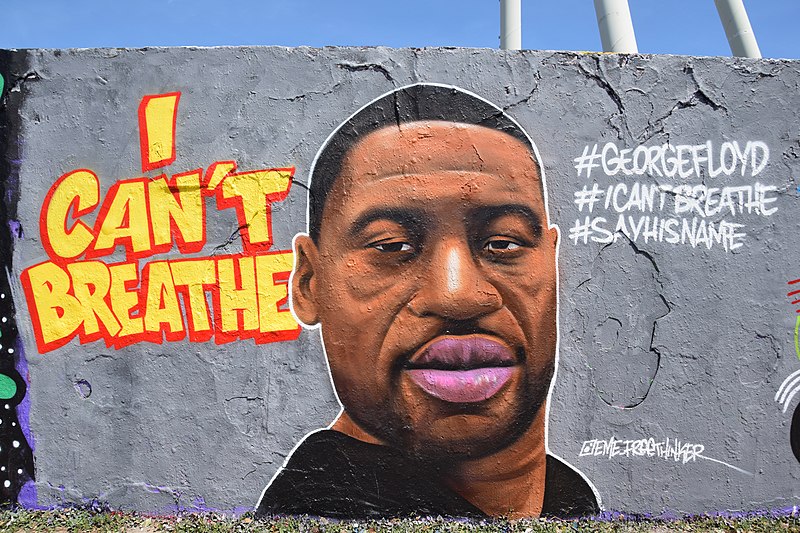
800px-Wandbild_Portrait_George_Floyd_von_Eme_Street_Art_im_Mauerpark_(Berlin)
Mural portrait of George Floyd by Eme Street Art in Mauerpark (Berlin, Germany)

A week ago I, like thousands of others in the United States, saw, for the first time, reports that an African American man had died in Minneapolis while a white police officer was kneeling on his neck. My initial reaction was probably somewhat numb. The stories of African Americans dying at the hands of, and/or in the custody of, law enforcement have become too common. Too, I am reluctant to jump to conclusion, especially when it seems that maybe I do not know or understand the full story. Furthermore, I am a relative of a police officer and a friend of a number of others, and I recognize that their jobs are often thankless—that they have to make difficult decisions every day, often without the time and the privilege of thinking through every possible option before acting.

When I saw the video footage of the police officer kneeling on George Floyd, though, I was confident that, whatever the further details of the situation may be, the matter was not handled properly and there was no reason for Floyd to have died. I could not imagine any scenario in which the officer would not be charged with murder. When Jacob Frey, the mayor of Minneapolis, said that Floyd “should not have died” and that the officer involved had “failed in the most basic human sense,” I had to agree. Melvin Carter, the mayor of St. Paul, said that the cell phone footage of “a defenseless, handcuffed man one of the most vile and heartbreaking images” he had seen. I had to agree. When Senator Amy Klobuchar said, “Those involved in this incident must be held accountable,” I had to agree.

Less than thirty minutes ago, as I write this, the results of Floyd’s autopsy were released. The finding was that Floyd died as a result of asphyxiation from sustained pressure.

The New York Times has put together a video that resulted from “combining videos from bystanders and security cameras, reviewing official documents and consulting experts.” It is an interesting video. It makes valid and significant points. For example, the police officers who responded to the scene were expecting, based on the 911 call they received, to be dealing with a man who was “awfully drunk” and out of control. No doubt that influenced their attitude and mindset before they even encountered Floyd. It also states that Floyd told the police officers who tried to put him into their vehicle that he was claustrophobic and unwilling to get in. I am sure that police officers hear excuses on a regular basis, and I cannot fault them for not putting much stock in that statement from Floyd. It goes to explain that nine minutes into the arrest, officers Tou Thao and Derek Chauvin arrive together. Apparently they are partners. Assuming the Times report that Thao has had six complaints and been the subject of a brutality lawsuit, and that Chauvin has had seventeen complaints and been involved in three shootings is correct, one has to question why these two men are partners—if not why they are still on the police force at all. Why Chauvin gets involved in trying to get Floyd into the vehicle, and why he then pulls Floyd all the way through and onto the road, is unclear. What is clear is that he puts his knee on Floyd’s neck and it remains there. According to the Times, it remained there for 8 minutes and 46 seconds. Someone is heard telling Floyd to get up and get in the car. Whether or not that is Chauvin, I cannot tell, but obviously Floyd could not get up or get in the car while Chauvin had his knee on Floyd’s neck.

According to the Times, Floyd tells the officers at least sixteen times in less than five minutes that he cannot breathe. To be fair, the first time I watched the footage of the incident I was skeptical of Floyd at first. After all, if he could continue to say that he could not breathe, he was obviously breathing. My thinking changed, however, when Chauvin kept his knee on Floyd’s neck even after Floyd stopped saying anything and appeared to be either unconscious or dead. Bystanders repeatedly asked that Chauvin get off of Floyd or that he at least check Floyd’s pulse. Again, I am sure that police officers hear many things from the public in the midst of an arrest and no doubt tend to ignore them, but it is clear that both Chauvin and Thao can hear them because Chauvin appears to draw mace from his belt and Thao is interacting with the bystanders and trying to position himself to block their view. Chauvin keeps his knee on Floyd’s neck for nearly a minute after EMS personnel arrive, and while Floyd is put into the ambulance and the ambulance drives away, he is pronounced dead at the hospital.

More than likely, you know most, of not all, of the above. There is nothing that can be done to change any of that, but there is much that can be learned from the incident. There are many questions to ask and attempt to answer. And then, of course, there is the reaction that is spreading across the country in the form of riots and looting. I would naïve to think or suggest that I have all of the answers or even that I have much to add to the discussion that is unique or new. But I am going to share a few thoughts regardless.

First, as I have already mentioned, law enforcement is a difficult and often thankless job. It is also a necessary job. As long as human beings are the ones serving in law enforcement, there will be mistakes made. There will be “bad apples.” There will be individuals who misuse and abuse their authority and their power. That is not a racial issue, it is a human issue. No race or gender or ethnicity is exempt from flaws. According to the National Law Enforcement Officers Memorial Fund, there are more than 800,000 law enforcement officers currently serving in the U.S. I am confident that many of them do their very best every day on the job and that they are just as upset over the death of George Floyd as anyone else. According to the same source, there has been an average of one law enforcement officer dying in the line of duty every 54 hours over the past ten years. That is a startling number, and a great reminder that law enforcement officers literally put their lives at risk to do their jobs.

Second, while it is clear that Chauvin needed to be both fired and charged, not much more than that is entirely clear yet. I read person comment on Facebook, of Chauvin’s charges, “Never seen a charge this fast with peaceful protests, all I’m saying.” Well, there is no way to know if the charges would have come that quickly without protests, though I cannot help but think that they would have. And if the point of the protests was to get Chauvin charged then the protests should stop. Is a third degree murder charge too lenient? My inclination is no…unless there is more to the story that we do not yet know. Multiple news sources, for example, are reporting that Floyd and Chauvin worked at the same night club in Minneapolis, El Nuevo Rodeo, and may have known each other. That needs to be investigated. If there was some personal motive behind Chauvin’s actions then the charges need to be increased and the protests against police discrimination and brutality are off the mark. Specifically, as The Western Journal noted, “that should give pause to those portraying law enforcement and the criminal justice system as being inherently biased against minority Americans.”

Third, cooler heads really do need to prevail. Saying something that captures headlines but has zero basis in reality is nothing short of stupid. Leslie Raymond, the president of Minneapolis NAACP, called Floyd’s death a “cruel display of the state-sanctioned murder.” That’s absurd, and not even remotely helpful. Raymond went on to say, “Their actions represent a dangerous precedent set forth by the racist, xenophobic, and prejudicial sentiment in our society against Black people.” Again, both absurd and unhelpful. Floyd’s death was wrong and that would be true even if the perpetrator were black and the victim were white. It would be true if the perpetrator and victim were both white. Or both black. Or both blue. That is a deeper truth that needs to be grasped. The taking of a life is wrong. Period. That’s not a racial issue.

In today’s issue of The Briefing—which is excellent in its entirety—Albert Mohler writes,

Every single human being is of the same dignity and of the same worth and have the same value, precisely because we are made by the same Creator equally in his image. And thus, every one of us bears the same dignity and that dignity must never be denied. It must never be slighted. It must never be reduced. It must never be hidden.

Mohler is correct, and that is why the death of George Floyd must not go unnoticed or unpunished.

Yesterday Wynton Marsalis wrote a lengthy post on his Facebook page addressing Floyd’s death and the deeper issues surrounding it. About halfway through, Marsalis wrote,

The whole construct of blackness and whiteness as identity is fake anyway. It is a labyrinth of bullshit designed to keep you lost and running around and around in search of a solution that can only be found outside of the game itself.

Excuse his language, but Marsalis is spot on. The problem is not racism and the solution is not eliminating racism. He continued,

Our form of Democracy affords us the opportunity to mine a collective intelligence, a collective creativity, and a collective human heritage. But the game keeps us focused on beating people we should be helping. And the more helpless the target, the more vicious the beating. Like I was trying to explain to my daughter, something just feels good about abusing another person when you feel bad about yourself.

I do not know if Chauvin felt bad himself, or somehow felt bigger, badder and tougher by kneeling on George Floyd’s neck, but the temporary good feeling that comes from abusing another is not a racial issue. It is human issue and a heart issue. It is, in fact, the very issue at the root of the current riots and looting. No one in their right mind thinks for a second that the destruction and violence we are seeing around the country will bring back George Floyd, make law enforcement officers act differently or improve race relations in the U.S. There is nothing constructive or helpful about the riots and looting. It is, quite frankly, part of the labyrinth of bovine feces Marsalis referred to in his post.

Earlier in the post, Marsalis describes a conversation he had with his eleven-year-old daughter about the death of Floyd. She asked him why “that man” would “just kneel on him and kill him like that in front of everybody?” Like a good parent in a teachable moment, Marsalis responded with an illustration and asked his daughter to come up with the answer herself. She gave some good ones, but she never quite got to where Marsalis wanted her to go, prompting him to—at her urging—just tell her. What was the deepest reason he had in mind? “Because he enjoyed it. For him, and for many others, that type of thing is fun.” He elaborated, saying, “this type of fun is much older even than America itself.”

I do not agree with everything that Marsalis said in his post. I do agree, however, that the death of George Floyd is not fundamentally a racist issue. That Chauvin enjoyed it—assuming he did (and there is no evident hesitance or concern on his face in the video)—would likely have been true if almost anyone had been under his knee. I do not know, of course, but I suspect that if we ever find out for sure, we will discover that Floyd said or did something to Chauvin that upset him—either when they worked at the club or just before Chauvin pulled Floyd through the vehicle onto the road—and Chauvin wasn’t going to put up with it.

This is a human flaw illustrated perfectly by Haman in the Old Testament book of Esther. Haman was a Jew and he refused to show Haman the physical homage he felt he deserved. Esther 3:5 reads, “And when Haman saw that Mordecai did not bow down or pay homage to him, Haman was filled with fury.” So full of fury was Haman, in fact, that he had a 75-foot gallows constructed and devised an elaborate plan to get the king to let him execute Mordecai—all because he got on his nerves. If you are not familiar with it, you can read the book of Esther to see how that worked out for Haman. Unfortunately, Derek Chauvin succeeded in killing George Floyd. Whether that was his intention or not I do not know and I doubt anyone ever will truly know. But, in the words of Max Lucado, here is what we do know: “the heart of the human problem is the heart of the human.” Why would Lucado say that? Because Jeremiah 17:9 says this: “The heart is more deceitful than anything else, and incurable” (HCSB). That is true of Derek Chauvin. It was also true of George Floyd. Whether we like it or not, it is also true of you and me.

Seemingly everyone, everywhere, is saying something about how wrong the killing of George Floyd was, and that’s fine. Within the past couple of hours I have seen messages from two of my alma maters condemning the actions of Derek Chauvin. One was headlined, “University condemns racial injustice and senseless violence.” The other included the statement, “Justice demands that we all do our part to confront and overcome the legacy of bigotry….” I suppose it is good that these schools, and others, are making such statements but they do not really do much.

Fifty-seven years ago Martin Luther King, Jr. said, “I have a dream that my four little children will one day live in a nation where they will not be judged by the color of their skin, but by the content of their character.” Sadly, our nation is still not that place. The color of one’s skin still matters far too much. No murder sentence for a police officer will change that. No riots will change that. No university announcements or presidential proclamations will change that. Nothing will change it until we realize, as Wynton Marsalis said, “The whole construct of blackness and whiteness as identity is fake anyway.” Or, as Albert Mohler said, “Every single human being is of the same dignity and of the same worth and have the same value….”

Maybe Nkwachukwu Ogbuagu said it best: “I have this feeling in me that those who continue to see race and color in everything must be as miserable as those who continue to see ghosts in every nook and cranny. They have no peace of mind because they are truly haunted.”


Photo credit: Singlespeedfahrer / CC0

A Lesson for the Church: The Other Example We Have Been Given by Rachael Denhollander

Rachael Denhollander is a name probably not many people knew until a year and a half ago. That is when she became the first person to come forward and publicly accuse Larry Nassar of sexual abuse. Even then her name was not nearly as well-known as it is now. After her victim impact statement on January 24, it is probably fair to say that not many people have not heard of her.

In 2000, Denhollander was a club level gymnast when she met Nassar at the age of fifteen due to a back injury. Nassar was, in the words of the Boston Globe, “the despicable doctor who systematically, for decades, used his position as a renowned, sought-after, and respected physician in the gymnastics world to sexually abuse countless young athletes under the guise of medical treatment.” Only at that time, no one knew—or, I should say, no one acknowledged—that Nassar was a predator. Others had complained about Nassar before 2000, but nothing had been done. By the time he was arrested his victims numbered in the hundreds. One hundred fifty-six of them spoke at his sentencing hearing, which resulted in a sentence of 40 to 175 years in prison.

Denhollander’s courage in coming forward and opening the door that gave voice to so many other victims has received plenty of attention in the media and I am not going to focus on that here. I would simply echo what Tara Sullivan wrote, that Denhollander is “Larry Nassar’s most important victim, his loudest and bravest opponent in the fight to expose his depravity as a serial pedophile disguised as a respected physician.”

What brought perhaps the most attention to Denhollander was her impact statement, nearly forty minutes long, in which she clearly spoke of what Nassar had done, the physical but, more importantly, emotional, damage it inflicted on Denhollander and others, and then shared the gospel with Nassar. Writing on The Gospel Coalition site, Justin Taylor said, “What she said directly to the man—who gratified himself off of her innocence and abused countless other girls in a malicious and manipulative way—is an incredible testimony to the grace and justice of Jesus Christ.” I agree. When I first heard it later that same day I described it as “an extraordinary presentation of the gospel to someone Rachael Denhollander has every human reason to hate and wish eternal condemnation in hell upon!”

Her bold stand against Nassar and her equally bold statement of the gospel to Nassar—and a watching world—has drawn tremendous attention, and rightfully so. In his edition of The Briefing the day after Denhollander spoke, Albert Mohler said,

…what so many in the world missed is that the moral clarity that was so evident in that courtroom yesterday cannot really emerge from a secular worldview. It can only emerge from a biblical worldview. And yesterday it wasn’t just the witness to good and evil that appeared. In the voice of Rachael Denhollander, there was a powerful witness to the Gospel of Jesus Christ, the Gospel that speaks so honestly about sin, and the Gospel that so honestly promises in Christ salvation from sin.

Denhollander has, indeed, set a beautiful example of what it means to be like Christ. To hate the sin but not the sinner. To extend mercy and forgiveness when it is not even remotely deserved—and never could be. Evangelical Christians are sharing her statement and celebrating her testimony and all of that is good. It is as it should be.

Sadly, there is something else about Denhollander’s experience that Christians seem to be overlooking, and we must not do so.

In her statement, Denhollander said,

Even my status as a sexual assault victim has impacted or did impact my ability to advocate for sexual assault victims because once it became known that I too had experienced sexual assault, people close to me used it as an excuse to brush off my concerns when I advocated for others who had been abused, saying I was just obsessed because of what I had gone through, that I was imposing my own experience upon other institutions who had massive failures and much worse.


My advocacy for sexual assault victims, something I cherished, cost me my church and our closest friends three weeks before I filed my police report. I was left alone and isolated. And far worse, it was impacted because when I came out, my sexual assault was wielded like a weapon against me.


In her op-ed for the New York Times, Denhollander wrote, “I lost my church. I lost my closest friends as a result of advocating for survivors who had been victimized by similar institutional failures in my own community.”


As incredible and beautiful as Denhollander’s courage to come forward and willingness to share the gospel with Nassar may be, that she “lost her church” through coming forward is just as incredible and hideous. I do not know exactly what transpired between Denhollander and her church, but the details here are not important. For her to say, twice, that she lost her church as a result of taking a stand against Nassar says all that we need to know. There is no justification anywhere in Scripture for abandoning a victim. Quite the contrary, in fact. Romans 12:15 says, “When others are happy, be happy with them. If they are sad, share their sorrow” (Living Bible).


In Matthew 25:40 Jesus said that whatever is done “to the least of these my brothers, you have done it to Me.” Commenting on that verse Matthew Poole wrote, that charity, or love, “must be chiefly shown to those of the household of faith.” Denhollander is clearly of the household of faith, yet her church abandoned her. Take note, fellow Christian: that means her church turned its back on Christ.


I do not focus on this to condemn Denhollander’s former church alone. I do not even know the name of the church she attended. I emphasize this to bring attention to such behavior that has gone on for far too long, and has been far too tolerated, in the Church in general. How can we claim to follow Christ if we abandon our brothers and sisters who are hurting? John Tillman wrote the following in a devotion on The Park Forum:


As the #MeToo movement sweeps around the world, Jesus stands with the victims, claiming their pain as his own, identifying with their feelings of powerlessness, of isolation, and of being silenced for so long. …


No environment, from Hollywood offices to the sanctuaries of our churches is untouched by the culture of degrading sexual manipulation and abuse. Christians have an opportunity to drop partisan loyalty, abandon “what-aboutism,” and step into this cultural problem with the perspective of the Gospel.

Christians can uniquely offer condemnation for abusive actions and the systems which allowed them, while offering compassion and protection for victims, and even forgiveness and redemption (though not necessarily reinstatement) for perpetrators.


Compassion for the victims is precisely what Christians should be offering. Compassion and support and encouragement. There is no room for abandonment or rejection or judgment of victims. In an April 2016 blog post entitled “4 Common Ways Churches Fail Abuse Victims (And What to Do Instead)” Ashley Easter states that the Church must take accusations of abuse seriously, whether made against someone inside or outside of the church, and “recognize how difficult it is for a victim to come forward.” Furthermore, the Church, and those within it, need to “believe and reassure the victim that there is nothing they could ever do to cause someone else to hurt them.”  In July 2015 Boz Tchividjian wrote of his own abuse as a child and the way churches so often respond inappropriately to abuse victims. “A primary reason why victims are afraid of the church is because of the level of immaturity and ignorance they have experienced in how they are treated or handled by the community and leadership of a church,” Tchividjian wrote. He continued, “There is now an entire generation that has left the church and might not ever return because of the negative impact that the church has had in the lack of understanding and compassion for the broken and the wounded.” Abuse is horrific and cannot be tolerated. But just as wrong and intolerable is this kind of response within the body of Christ.


I pray that Rachael Denhollander will be embraced and encouraged and prayed for by the Church even though she was not treated that way be her local church. I pray that she will remain a passionate and articulate voice for abuse victims and for the gospel. I also pray that she will prove to have taught us a significant lesson about abuse and how not to respond to it.

My trust and my hope

I know I am not the only one who has been thinking a lot about the unexpected passing of Supreme Justice Antonin Scalia over the past few days. His legacy will last for decades and his decisions, and minority reports, will no doubt be studied by law students, lawyers and judges for even longer. Albert Mohler was correct when he wrote, “Antonin Scalia is almost surely the most influential justice to sit on the Supreme Court in many decades. The loss of his influence, as well as his his crucial vote, is monumental.” I agree with Mohler, and I was very sad to learn of Scalia’s passing. I was sad for his family’s loss of a loved one but I was mostly sad for our country and for the impact that Scalia’s too-soon departure from the Supreme Court will potentially have on both the present and future of this nation. That is why I also found it necessary to reflect on the following thoughts.

First, the United States as a nation, conservatism as a movement, judicial restraint as a philosophy and respect for states’ rights and individual liberty as ideologies did not begin with Antonin Scalia nor will any of them end there. He was a great and influential figure in each of those areas but now that he is gone they must all go on. Someone else–or, ideally, multiple someone elses–must step up and fill the very large shoes left behind by Justice Scalia. This is much like a baseball team losing its star player. The face of the team may change, the strategy of the team may change, the success of the team may even change, but the other players do not pack up and go home.

Second, this has been a great opportunity for me to remember the importance of seeing things from someone else’s perspective. Right off the bat I was thinking that I hope there will be some way for the Republicans to delay the confirmation of a new justice until after the election. There is no guarantee how the election will turn out, of course, but there is at least a chance that a Republican will win, which would also greatly increase the likelihood of the new justice being more in line with the positions held by Scalia than any justice appointed by President Obama. Mitch McConnell announced right away that he thought the new justice should not be appointed until after the election, and others were saying the same thing. President Obama, of course, indicated that he would appoint a justice. On Sunday evening it occurred to me that if the situation was reversed and there were a Republican in the White House right now I have no doubt that I, Mitch McConnell, and many others would be advocating for an appointment and confirmation before the election. It was rather like remembering that I cannot only like and defend free speech when it is speech I agree with and approve of. The beauty of free speech is just that–it is free, meaning you can advocate whatever you want no matter how much I do not like it, and I can do the same no matter how much you do not like it. I am not saying I want President Obama to appoint the next justice, but I cannot in good conscience argue that he should not, or that his appointment should not be confirmed if qualified.

The third point is somewhat similar to the first one but is important enough on its own that it needs to be stated separately. No one’s hope is in–or should be in–originalism, conservatism or any other philosophy or ideology of man. Neither is it in any human being, politician, judge, theologian or anything else–including Antonin Scalia. Psalm 146:3 says, in the Good News Translation, “Don’t put your trust in human leaders; no human being can save you.” One reason not to put trust in them is that they, as Matthew Poole wrote, “are utterly unable frequently to give you that help which they promise, and you expect.” Antonin Scalia was a wonderful Supreme Court judge, but his power and influence was limited. He was also a flawed human being. In his Notes on the Bible Albert Barnes comments on Psalm 146:3 this way: “Rely on God rather than on man, however exalted he may be. There is a work of protection and salvation which no man, however exalted he may be, can perform for you; a work which God alone, who is the Maker of all things, and who never dies, can accomplish.” If Justice Scalia had lived to be 150 and remained on the Supreme Court for that entire time, he could not have ever accomplished anything that would save anyone, eternally speaking.

Albert Mohler was correct; a giant has fallen. But that giant was a human being. A giant in the legal realm, yes. Still–and Albert Mohler would wholeheartedly agree with me, so do not read this as me suggesting that he said anything otherwise–whether or not I like the person who assumes the seat vacated by Scalia, whether or not that person is an originalist or an activist judge, is not where my priority should be. Whether or not Antonin Scalia is on the Supreme Court does not matter, eternally speaking. What matters is that God is still on the throne–and in Him will I place my trust and my hope.

Real Idiocy

There were interesting observations contained in the Q&A feature in back-to-back issues of WORLD Magazine recently. In the May 30 issue J. Budziszewski, a government professor at the University of Texas at Austin, author and “nationally known Christian social conservative”, was discussing evolution with Marvin Olasky. Olasky commented, “Lots of Christians don’t want secular friends and colleagues to think of them as idiots.” Budziszewski replied, “If you want to be protected against being considered an idiot you have to stop worrying about whether you’re considered an idiot. Come out of hiding. Stop avoiding the issues. Go on the offensive. Talk back. Demand that the other side present its reasons. Examine its logic. Don’t allow the opponent to define idiocy as not accepting the conventional opinions. Real idiocy is fear of following the evidence to its conclusions.”

Then, in the June 13 issue, Albert Mohler, president of The Southern Baptist Theological Seminary, was talking to Olasky about his purge of theological liberals from the faculty at the seminary when Olasky asked him, “How do you view the wider culture war now?” Mohler replied, “A lot of people have backed off of it. The problem is the issues are still there and, if anything, the issues are more stark. The culture war isn’t over because there was some kind of truce. If it’s over, it is because the secular left is in control of even more of the culture.” Mohler acknowledged, when asked what lessons could be learned from those losses, that some Christians did not handle themselves well, behave appropriately or articulate effectively when engaging in the culture war, but he ended by saying this: “[I]n terms of standing for what we believe to be true–not just because we believe it to be true but because as Christians we believe that is what leads to human flourishing–we have no option to back off on those.” Despite the fact that he has seen some back off, then, both Mohler and Budziszewski believe that Christians need to be involved in the culture war and in defending the biblical position on a whole host of issues that come up in our world.

If you look back over the past few decades it is not difficult to see the gradual yet persistent efforts that have brought us to where we are today. I suppose you could go back half a century, really, and look at the removal from prayer and Bible reading from public schools, the ruling that abortion is a right and a choice to be made by a woman, but I am thinking more recent, since those rulings were not gradual or subtle. I am thinking about the embrace of relativism and the notion that each person can decide what is true for him/herself. I am thinking about political correctness. I am thinking about the gradual mainstreaming of homosexuality, from print ads to television shows. Back in 2000 Alan Keyes stressed, during his campaign for the Republican presidential nomination, the importance of the “marriage-based two-parent family.” Now, just fifteen years later, there is little such talk, and when there is the terms have been completely redefined. There was no need for Keyes to clarify that by marriage he meant a union of one man and one woman. There was no need for Keyes to stress that he meant a mother and a father when he talked about a two parent family. Now, in 2015, marriage, parent and family have all been hijacked and mean–at least in the vernacular of the mainstream–something completely other than they meant at the turn of the millennium.

Political correctness has certainly caused the timidity to which Budziszewski refers. Rather than be labeled bigoted, extreme, intolerant or closed-minded many who would hold to traditional values and oppose the redefinitions of marriage, parent and family have chosen to remain quiet. True, there are still some who have not learned the lessons to which Mohler refers (and many of them get paid handsomely to spout their positions on television and radio for shock value). The reality, though, is that very few of us individually, and even fewer collectively, have done what Budziszewski challenges us to do. Rarely do we go on the offensive in an articulate, considerate and effective way. Franklin Graham had an opinion piece in last weekend’s edition of USA Today explaining why the Billy Graham Evangelistic Association had stopped banking with WellsFargo and moved all of its accounts to BB&T. Graham has opportunities the rest of us would not have, but he used his opportunity to explain that while he believes all Christians should be friendly toward homosexuals, it would violate the beliefs of Graham and the BGEA to allow WellsFargo to profit from their business and then use that profit to promote a homosexual agenda. Graham is to be commended to articulating their position. Most of the time those who seek to take a stand for their convictions these days wind up facing legal charges, like the bakeries, photographers and print shops that have refused to make cakes or print shirts promoting homosexual messages or to photograph gay weddings. The truth is, if we do as Budziszewski says, and force the other side to present its reasons, and we really examine their logic, what we will find is that the reasons seldom have any merit other than that is what they want to do, what makes them feel good and what they think is right. Their logic will hold no water at all, since if the logic they use for their positions were applied to those positions which counter theirs they would also have to support the freedom of holding those positions. (Oops…there go the lawsuits!)

I would love to find the entirety of the following quote, but I cannot. I heard Erwin Lutzer share it in a sermon and a Google search produces only his sermon as a result. So while it is not complete, it makes the point. Lutzer did not say who penned this, either, saying only “someone wrote these words.” Whoever that someone is, here is how he defined political correctness:

If you can believe that there are no absolutes and believe that absolutely; if you can teach young minds that there are no objective truths, and yet you teach this truth objectively; if you can close your mind to the ideas of those who you consider to be close-minded; if you can refuse to tolerate anyone you choose to label intolerant; if you consider it immoral to stand against immorality; if you can make the judgment that judgmentalism is wrong and you can further make the judgment that others who judge things to be wrong are just too judgmental; if you can force others to conform to your idea of diversity…

That is the end of what Lutzer shared, ending with, “well, it goes on.” Whatever comes afterwards, though, the point is clear. Political correctness is self-contradictory, plain and simple. Mohler says too many of us have retreated from the front lines of the culture war, but we must, as he also says, stand for what is right and what is true. On that we do not have a choice if we truly claim to be followers of God. Budziszewski says we need to quit worrying about being thought an idiot by the liberal bullies and instead demand that they produce something more than name-calling to defend their positions, and he is right. Real idiocy is all around us. It’s time we start calling it what it is and take a stand for what’s true.

Good news for marriage

Believe it or not, there may be some good news for those of us who believe in defining marriage as a union between a man and a woman. In late October, United States District Judge Juan Perez-Gimenez upheld the Puerto Rican law defining marriage as the union of a man and a woman. Last week the United States Court of Appeals for the Sixth Circuit ruled, 2-1, that measures in Michigan, Ohio, Kentucky, and Tennessee limiting marriage to one man and one woman were constitutional. In both instances, the decisions held that the Supreme Court’s decision in United States v. Windsor, which struck down the federal Defense of Marriage Act, allows for states to define marriage.

Perez-Gimenez stated in his decision, “The Windsor opinion did not create a fundamental right to same gender marriage nor did it establish that state opposite-gender marriage regulations are amenable to federal constitutional challenges. If anything, Windsor stands for the opposite proposition: it reaffirms the State’s authority over marriage, buttressing Baker‘s conclusion that marriage is simply not a federal question.”

Baker v. Nelson, the other decision cited above, was a 1972 case in Minnesota in which the Minnesota Supreme Court ruled that a Minnesota law limiting marriage to a man and a woman did not violate the Constitution. Baker appealed, but the Supreme Court of the United States (SCOTUS) dismissed the appeal “for want of a substantial federal question.” Because of the way in which Supreme Court cases work, the Baker case went to the Supreme Court by way of mandatory appellate review. The refusal of SCOTUS to hear the case therefore became precedent because the refusal to hear the case was considered a decision on the merits of the case. This is important, because Perez-Gimenez explained that the Windsor case did not overturn Baker but rather complements it. “Windsor and Baker work in tandem to emphasize the States’ ‘historic and essential authority to define the marital relation’ free from ‘federal intrusion.'”

The Sixth Circuit decision came after a refusal by SCOTUS on October 6 to hear appeals from states that have had their traditional marriage laws struck down by courts, making it an important decision and one that has received considerable attention and no doubt will continue to do so.

Perhaps even more encouraging to defenders of traditional marriage than either decision in and of themselves, though, is the fact that both decisions take aim at the position of those who argue that homosexual marriage is a constitutional right. Perez-Gimenez wrote, “It takes inexplicable contortions of the mind or perhaps even willful ignorance–this Court does not venture an answer here–to interpret Windsor‘s endorsement of the state control of marriage as eliminating the state control of marriage.”

Judge Jeffrey S. Sutton wrote the majority decision in the Sixth Circuit case. He stated early in his decision that recent decisions are mostly ignoring a very, very long history of defining marriage as between a man and a woman. “For better, for worse, or for more of the same, marriage has long been a social institution defined by relationships between men and women. So long defined, the tradition is measured in millennia, not centuries or decades. So widely shared, the tradition until recently had been adopted by all governments and major religions of the world,” Sutton wrote. Sutton also wrote that it is not the place of the judges of the Sixth Circuit to make policy decisions for the citizens living in its circuit; rather, its purpose is to interpret laws vis-a-vis the existing laws and precedents, of which Baker still is one. This is a breath of fresh air coming from a federal bench, especially since so many courts seem more than happy to assume the role of making, rather than interpreting, laws. Sutton went on to write, “A dose of humility makes us hesitant to condemn as unconstitutionally irrational a view of marriage shared not long ago by every society in the world, shared by most, if not all, of our ancestors, and shared still today by a significant number of the States.”

This element of Sutton’s decision is a unique perspective on the issue, as far as I know, and I think it is going to prove to be a very important component of future cases dealing with the definition of marriage:

What we are left with is this: By creating a status (marriage) and by subsidizing it (e.g. with tax-filing privileges and deductions), the States created an incentive for two people who procreate together to stay together for purposes of rearing offspring. This does not convict the States of irrationality, only of awareness of the biological reality that couples of the same sex do not have children in the same way as couples of opposite sexes and that couples of the same sex do not run the risk of unintended offspring. This explanation, still relevant today, suffices to allow the States to retain authority over an issue they have regulated from the beginning.

The reason why this is so important is that is establishes that states do have a compelling interest in defining marriage as between a man and a woman–something that others have argued is not the case. If states have no compelling interest to define marriage as between a man and a woman, the argument goes, then states have no reason or justification for restricting marriage to a man and a woman other than legalized discrimination. So keep an eye on this rationale, because it is going to be extremely important.

Sutton went on to reinforce his point by writing this: “If it is constitutionally irrational to stand by the man-woman definition of marriage, it must be constitutionally irrational to stand by the monogamous definition of marriage.” This is, of course, one of the keystone elements of the argument I have been making against homosexual marriage all along; if we change the definition of marriage to be other than between a man and a woman we eliminate any justification for prohibiting any definition of marriage, whether male-male, female-female, adult-child, human-animal, multiple spouses, etc. Albert Mohler included this observation in his blog post on the Sixth Circuit decision: “He [Sutton] also recorded that in the oral arguments the attorneys arguing for same-sex marriage had been unable to answer his question [as to why marriage should be defined in terms of monogamy]. They could not, he stated, because the only argument they could advance was moral tradition. They could not cite moral tradition as the authority for monogamy because they argued that moral tradition was not a rational basis for law when it came to limiting marriage to a man-woman union.”

Perez-Gimenez stated in his decision, “The people and their elected representatives should debate the wisdom of redefining marriage. Judges should not.” Similarly, Sutton wrote, “The theory of the living constitution rests on the premise that every generation has the right to govern itself. If that premise prevents judges from insisting on principles that society has moved past, so too should it prevent judges from anticipating principles that society has yet to embrace.” In other words, both judges are taking a stand for courts restricting themselves to interpreting law and letting the people make the decision about how marriage is defined. Interestingly, this is exactly what the Windsor decision meant, as well.

Mohler closed his blog with this statement: “Sometimes the right argument just has to be made, even if it does not win at any given hour. The truth will stand the test of time, and Judge Sutton deserves our gratitude and respect for making an argument in defense of both marriage and the Constitution–and for making it so well.” I echo his sentiment, and would add Judge Perez-Gimenez to that, too. In the words of Galatians 6:9, let us not grow weary in doing what is good–and in this situation, it means continuing to take a stand for marriage as God defined it, and praying for those judges who are courageous enough to defend the right of the people to make that determination.

The Debate

On Tuesday, February 4 an historic event took place in Kentucky, just across the river from Cincinnati. It was attended by more than 800 people and it was viewed live through Internet streaming by more than one million. Odds are, you already know what I am talking about. As I skimmed through comments on Facebook last night after the event was over it seemed that many people were referring to it simply as “the debate.”

The Debate was just that, an intellectual exchange of ideas between Bill Nye, “The Science Guy,” and Ken Ham, co-founder and CEO of Answers in Genesis. Nye is an evolutionist and Ham is a young earth creationist. Their debate, at the Answers in Genesis Creation Museum, was over the question of whether or not creation is a viable model of origins in today’s scientific climate. To no one’s surprise, Ham believes it is while Nye believes it is not.

No doubt many individuals far more articulate than I will dissect the various arguments and elements of the debate, and no doubt from both sides. I can assert with equal certainty that individuals on both sides will also no doubt make derogatory comments about the individuals and the arguments on the other side, though history bears evidence that far more of these will come from the evolutionist side than the creationist side. I will leave the analysis of most of the nitty gritty details to others, and I do not intend to call anyone names.

On the contrary, I would like to commend both Mr. Ham and Mr. Nye for their willingness to engage in such a public exchange of ideas, placing themselves literally and figuratively in the spotlight on an international stage. Regardless of one’s convictions, beliefs and training, being on the spot, live, in front of millions, tasked with defending a belief system held strongly by millions as their sole at-the-moment spokesperson is not a position many people would envy or be willing to assume. The event no doubt benefited both men and the organizations of both men. Answers in Genesis, for example, reported more than two million visits to its web site in the month leading up to the debate. So sure, publicity was no doubt part of the motivation on both sides. I do not believe, however, that it was at the heart of either man’s willingness to participate in the debate.

As Albert Mohler pointed out in his blog post today, “Nye was criticized by many leading evolutionists, who argued publicly that nothing good could come of the debate.” Criticism is never pleasant, and when it comes from your own camp it is even less so. Kudos, then, to Bill Nye for his willingness to stand on a stage beside one of the world’s leading apologists for the biblical account of creation, and to do it on the creationist’s home turf.

The debate was well planned, well executed and–in a rarity for many debates these days–well moderated. Ham and Nye were civil to each other and respectful. Nye even told Ham after Ham’s initial presentation that he had learned something. (Interestingly, he never said what that something was, though, and it may well have been that Ham holds even crazier ideas than Nye originally thought).

I am a young earth creationist, as is Ham, and I believe that God created the world in six literal, 24-hour days. Odds are good that if you have ever read my blog before that you already knew that. If you are a newcomer, there you go–full disclosure, I agree with Ham. Actually, if you want truly full disclosure, I am a charter member of the Creation Museum and have supported both the museum and Answers in Genesis financially. So it will come as no surprise that I agreed with what Ham said in the debate and disagreed with much of what Nye said. That I went into the debate with my mind made up puts in no small company, though; the same can be said of both Ham and Nye as well as many, if not the majority, of the folks who watched the debate. As Mohler wrote, “If you agreed with Bill Nye you would agree with his reading of the evidence. The same was equally true for those who entered the room agreeing with Ken Ham; they would agree with his interpretation of the evidence.” No one expected Ham or Nye to be convinced by the other or to change his mind. Neither, I suspect, did either man expect to change the mind of the other. One thing that came through loud and clear in the debate is that reason will not change the minds of individuals devoted to either position. Sure, there may be people who have not made up their mind either way, and they may have been swayed, but the debate was more a presentation of data and dogma than an effort to win votes or converts. Ham, by the way, admitted that he would never change his mind, since his beliefs are rooted in the Word of God. Nye suggested that he would if evidence was presented to sway him, but he almost simultaneously stated that such evidence could not exist, so his seeming openness to change was not entirely legitimate.

There were a couple of things that the debate made clear to me that I will comment on. One is that Bill Nye has apparently never read the Bible. His comments about it, and his apparent shock when Ham stated that some of the Bible is history, some poetry, etc, served as proof positive that he is, at best, unfamiliar with the Word of God. One point in favor of those with a biblical worldview is that they are willing to listen to and even study the other side in their defense of their faith.

Two, Nye’s own comments made it clear that the evolutionist position relies just as much on faith as the creationist position does. There were at least two times during the question-and-answer section of the debate when Nye responded to a question by saying, “We don’t know.” Translation: no proof exists for what he believe on this issue, we just believe it. Interesting, given how strongly Nye and others on the evolution side of the argument criticize Ham and those on the creation side for clouding their understanding of science with “beliefs.” Ham made the point early in the evening that the evolution position is just as much a “religion” as the creation position; I never heard Nye comment on that statement.

Three, Bill Nye seems scared to death that schools might actually consider allowing creation to be taught in schools, or at least allow evolution to be questioned or “critically examined.” There were times during the debate when he sounded like a political candidate, appealing to voters to save the United States from falling behind in the world. This was not a new position for Nye; in a widely-seen video Nye made last year he said of those who believe in the creation position, “[I]f you want to deny evolution and live in your world, in your world that’s completely inconsistent with everything we observe in the universe, that’s fine, but don’t make your kids do it because we need them. We need scientifically literate voters and taxpayers for the future. We need people that can—we need engineers that can build stuff, solve problems.” In other words, Nye is suggesting, if you believe in the biblical account of creation you cannot be an intelligent, practicing scientist. You cannot accomplish great things within the scientific community. This position was why Ken Ham made such a point of quoting, mentioning and even playing video clips from accomplished scientists who hold to the creationist viewpoint, including the inventor of the MRI machine. I confess, initially I wondered why Ham kept including these references and dwelling on this point, because it did not seem to be a major tenet of the argument to me. As Nye went on though it became increasingly clear that it is a crucial part of the argument and Ham knew what he was doing. Oddly enough, perhaps, it had never occurred to me that someone would think that if you believe the Bible you cannot also be good at science. How naïve of me!

Albert Mohler concluded his blog post this way: “The central issue last night was really not the age of the earth or the claims of modern science. The question was not really about the ark or sediment layers or fossils. It was about the central worldview clash of our times, and of any time: the clash between the worldview of the self-declared ‘reasonable man’ and the worldview of the sinner saved by grace.” I really could not say it any better. Nye insists he is reasonable, and by default that Ham is not (nor are those who believe as he does). Interestingly enough, the Bible describes godly wisdom as “reasonable.” James writes, “But the wisdom from above is first pure, then peaceable, gentle, open to reason, full of mercy and good fruits, impartial and sincere” (James 3:17). I am thankful that Ken Ham demonstrated wisdom from above in his debate with Bill Nye; my prayer is that Bill Nye will come to know that reasonable wisdom from above some day, too.

“…the answer is increasingly no.”

Al Mohler begins his article “Is Public School An Option?” with this questions and statement: “Should Christian parents send their children to the public schools? This question has emerged as one of the most controversial debates of our times.” As I suggested in the previous post, I would have said “sure” if asked this question anytime prior to the early part of this century, and that was even after I had spent three years teaching in a Christian school. I felt that I had turned out just fine having attended public schools my whole life and, frankly, what I had heard and seen of some homeschooling and Christian school education made me cringe. I was convinced that public school education was usually more rigorous and better prepared students to be lifelong learners. Bottom line, I thought public school education was more legitimate.

Mohler writes, “Until fairly recently, exceptions to this rule [the expectation that parents would send their children to public schools] have been seen as profoundly un-democratic and practically un-American. Homeschoolers were seen as marginal eccentrics, Catholics were seen as hopelessly sectarian, and those who sent their children to private schools were seen as elitist snobs.” Perhaps not exactly, but that fit my way of thinking pretty well.

Of course, as Mohler also points out, public education in America was under the oversight and influence of parents and the local community for hundreds of years; “public schools were public in the sense that they were community schools maintained for and by the citizens of a community.” That way of thinking has certainly changed, and beginning with John Dewey the influence of the parents and local community members on the curriculum and policies of the local schools has significantly diminished.

As Mohler states, “decisions of the U.S. Supreme Court secularized schools in a way that separated the schools from their communities and families.” Of course I am not old enough to remember when there was prayer and Bible reading in school, so that removal happened before I came along. And in that small Midwestern town where I went to high school there was still release time once a week when students could leave the public school during the school day and go for an hour to the church of their choice for “religious instruction.” Students who did not wish to go could stay at school for a study hall. My public high school choir performed their year-end concert in a church and the performances included doctrinally-sound Christian hymns like “When I Survey the Wondrous Cross.” So maybe my experience had not been the norm… And maybe the decreasing influence of the local community had not become the reality in the Midwest yet by the time I graduated high school.

What eventually changed my mind about public schools as a viable option and the legitimacy of homeschooling and Christian schools was the realization that schools were not ideologically neutral, which I had deluded myself into thinking they could be. Mohler writes, “The ideological revolution has been even more damaging than the political change. Those who set educational policy are now overwhelmingly committed to a radically naturalistic and evolutionistic worldview that sees the schools as engines of social revolution. The classrooms are being transformed rapidly into laboratories for ideological experimentation and indoctrination.” If I may be so bold I would disagree with Mohler on that last part, because I am now convinced that classrooms have not been transformed into “laboratories for…indoctrination” but rather always have been. “Indoctrination” means “the act of indoctrinating, or teaching or inculcating a doctrine, principle, or ideology, especially one with a specific point of view.” Public schools have always done that because it is impossible to teach without doing it. Christian schools do it, too; in fact, that is the whole reason most parents who send their children to Christian schools do so!

Am I suggesting that it is not possible to take a non-ideological position on any subject or that a teacher cannot impartially present information to students? No; that can be done–though it often takes real intentionality to do. What I am suggesting is that every teacher has a belief system, a worldview, that influences their way of thinking about every subject, and that worldview comes through in their teaching.

What has happened is that the right and wrong that public schools used to teach have become various versions of right and debate over wrong because everything is relative. What has happened to the public schools is the removal of certainty and absolutes and facts and the substitution of questioning and relativism and opinion. This is what has led to the ridiculous stories we hear and read about graphic sex ed classes, infringement of student rights to gather or pray or express a minority viewpoint and the support by public education leaders for teaching an acceptance and even and embrace of sinful behavior.

What caused me to change my mind about public schools, and to pretty well determine that my own children will never attend a public school, was the realization that what the schools teach–even the decent ones–is almost always taught from a perspective and toward and end that is completely at odds with what I believe and what I want my children to believe; specifically, what the Bible says. Local control of public schools is increasingly rare. There is more local (and school-level) control than many of the loudest conservative voices claim there is, but it is not enough. The tidal wave of mental manipulation and cconvictionless character has crashed into the public school system and as the water settles the ruins are increasingly visible.

Paula Bolyard, blogging for PJ Lifestyle, has responded to Mohler’s article, too. She correctly writes, “This is one of the most difficult questions a Christian family must wrestle with as school curriculum and speech and behavior codes increasingly stand in opposition to Christian teachings.” I am not by any means attempting to make light of this issue or suggest that it is an easy decision. There are people I know well and respect (indeed, people I am related to) who have chosen to send their children to public schools, and I am not sitting in judgment of them. I personally think that many of their reasons are flawed, but that does not mean they do not hold them sincerely. I will address some of these arguments in a future post.

I think what it comes down to is this assertion by Bolyard: “The stakes are very high. Consider the effects of thirty or more hours a week in a government school where you have no control over what your children are taught — where your local teachers have little or no control over the content of their lessons. Where the federal bureaucrats — many of whom have antipathy toward your Christian values — dictate what your children learn, all day long. How much time are you willing to invest in debriefing your children?” That’s just it. Students will spend some fifteen thousand hours of their lives–their most formative years–in school. Does it make any sense for me to knowingly and willingly place my children for that length of time into an environment that I cannot control and that I increasingly am in opposition to? I don’t think so. If I do, I will have to deal with these candid questions Bolyard asks: “How will you convince them that you are the authority on any given subject — that what you’re teaching them is right — and not their teachers? Is it fair to put a young child in the position of choosing between what their teacher is telling them and what their parents and Sunday school teachers say?”

Nearing the end of his article Mohler asks and answers the question that is the basis for the entire article. “Is public school an option? For Christians who take the Christian worldview seriously and who understand the issues at stake, the answer is increasingly no.” I absolutely agree. In fact, I may well have left the word “increasingly.”

Changing My Mind

Now back to our previously scheduled programming…I will resume my multi-entry look at education in America.

In the October-December 2013 issue of Answers Magazine Southern Baptist Theological Seminary President R. Albert Mohler, Jr. wrote an article entitled, “Is Public School an Option?” The title of the article struck me for two main reasons: (1) As a Christian school administrator I was curious to read what Mohler would say, and (2) I am well aware that my own position on this question has changed completely in the past decade and a half. Mohler writes, “I spent every minute of my school life from the first grade to high school graduation in a public school.” I can say the same thing, but throw in kindergarten for me, too.

I had some cousins who attend Christian schools, but they did not live in my community. Other than them, I do not recall knowing anyone who went to a Christian school. I grew up being in church every time the doors were open. No one in the two churches our family attended between my ages five and thirteen attended Christian schools that I know of. I surely do not remember anyone who was homeschooled, either. When I was thirteen my family moved from just outside of Washington, D.C. to a town of 20,000 in the upper Midwest. (At the time I thought that had to be the smallest town in the country. Ironic, given that I now live thirteen miles outside of a town of about fifteen hundred people…not all that much bigger than my high school in that town of twenty thousand!) I was satisfied with my education in public schools. I had good teachers, there were minimal blatantly unbiblical influences that I recall, and only once do I remember my parents having me “opt out” of viewing a movie that was being shown in class. I went on to attend a private college, but not a Christian one.

Interestingly, after college I was teaching in a Christian school and even then I was adamant that there was nothing wrong with most public schools. Given that I was back in the suburbs of Washington, D.C. I was well aware that there were some poor public schools (and some dangerous ones) but I was not a die-heard devotee of the Christian school movement. I was even further away from the homeschooling movement. I was skeptical of the ability of most parents to effectively teach their children, skeptical of the quality of the education those children who were homeschooled were receiving, and skeptical of the futures those homeschooled children would have. I can remember telling my wife early in our marriage that if we ever had children we would not homeschool them and I was not even sure I would send them to Christian school. This was a bit brazen for me to say given that my wife had only ever attended Christian schools until she was in high school when her parents began homeschooling her and her five younger siblings. My in-laws were, in fact, still homeschooling until the end of the last school year.

In the years since then my mindset has changed dramatically. I have been married for fourteen years and now have two children, neither of whom has ever attended a public school. We have homeschooled and both are now in a Christian school where I am also the administrator. How did my mind change so completely? What does Al Mohler have to say in his article, and do I agree or disagree with him? Come back next time to find out….